Comparison of Cognitive Behavioral Therapy and Dialectical Behavior Therapy on Anxiety and Obsessive Beliefs in Patients with Obsessive-Compulsive Disorder
DOI:
https://doi.org/10.61838/kman.dp.psynexus.3.8Keywords:
Obsessive-Compulsive Disorder, Anxiety, Dialectical Behavior Therapy, Obsessive Beliefs, Cognitive Behavioral TherapyAbstract
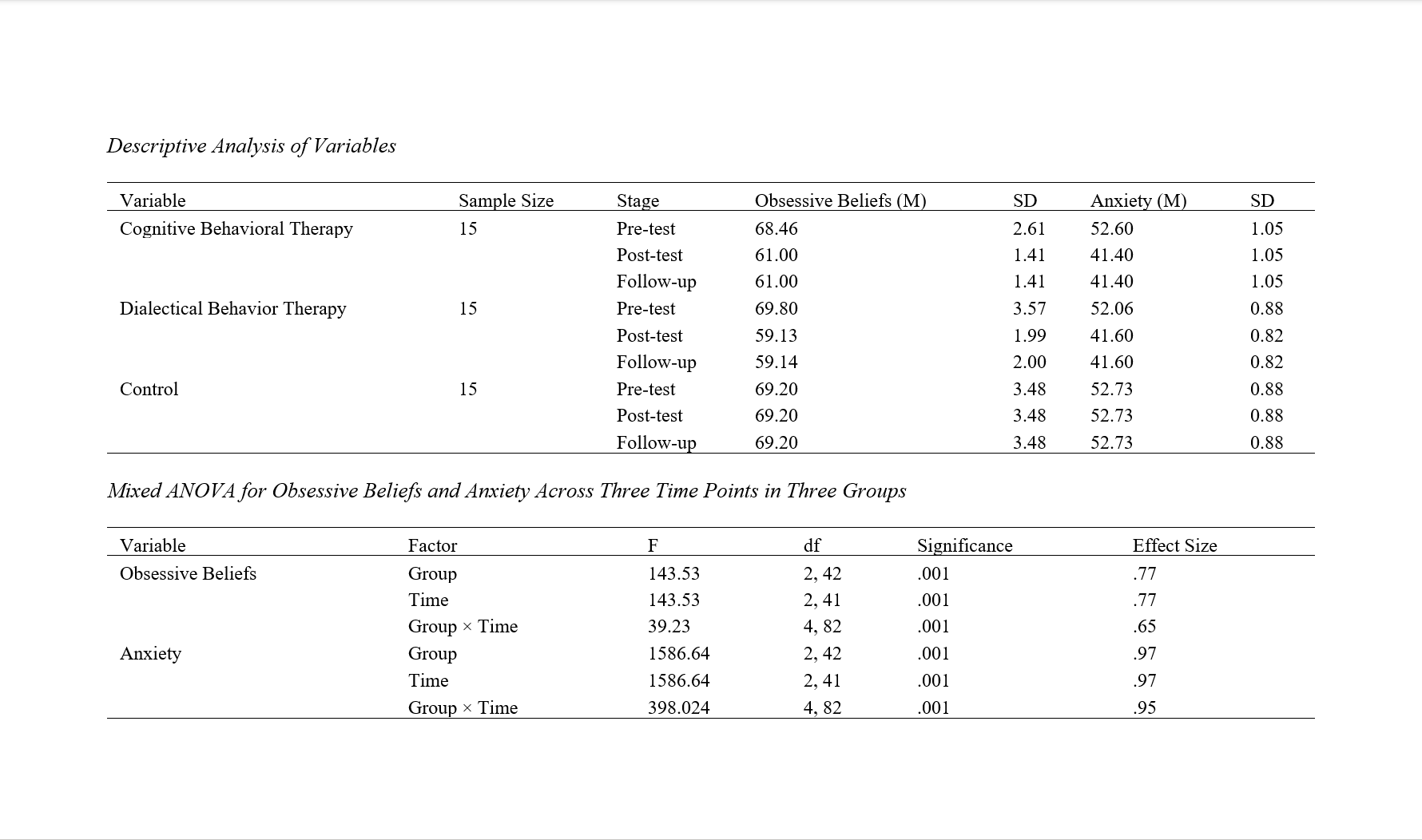
The present study aimed to compare the effectiveness of Dialectical Behavior Therapy (DBT) and Cognitive Behavioral Therapy (CBT) on anxiety and obsessive beliefs in individuals with OCD. This was a quasi-experimental study using a pretest-posttest control group design. The statistical population consisted of male students with OCD in lower and upper secondary schools in District 14 of Tehran in 2025. From this population, 45 individuals were selected through convenient and purposive sampling, screened, and randomly assigned to experimental and control groups. Data collection instruments included the Maudsley Obsessive-Compulsive Inventory (MOCI; 1977), the Obsessive Beliefs Questionnaire (OBQ-44), and the Beck Anxiety Inventory (BAI; 1988). In the experimental groups, CBT and DBT intervention packages were respectively administered. Data were analyzed using SPSS version 27 and mixed multivariate analysis of variance (MANOVA). The results indicated that both CBT and DBT led to significant reductions in anxiety (F = 39.23) and obsessive beliefs (F = 398.024) in individuals with OCD compared to the control group (MD = -8.2 and -10.06 for obsessive beliefs, MD = -11.13 and -11.33 for anxiety; p < .05). Moreover, DBT was found to be more effective than CBT in reducing obsessive beliefs (MD = 1.86; p < .05). Both CBT and DBT interventions were effective in reducing anxiety and obsessive beliefs in individuals with OCD. Given their demonstrated efficacy, these therapeutic approaches can be utilized as effective short- and long-term psychological interventions to reduce anxiety and obsessive beliefs.
Downloads
References
Afshari, B. (2020). Effects of dialectical behavior therapy on executive functions, emotion regulation, and mindfulness in bipolar disorder. Journal Contemporary Psychotherapy, 50(1), 23-31. https://doi.org/10.1007/s10879-019-09442-7
Alberti, R., & Emmons, M. (1990). Your perfect right. Impact Press. https://www.researchgate.net/publication/232496056_Your_Perfect_Right_A_Guide_to_Assertive_Behavior
Amighi, H. (2023). Comparing the Effectiveness of Dialectical Behavior Therapy and Cognitive-Behavioral Therapy on Anxiety and Aggression in Individuals with Obsessive-Compulsive Disorder. Journal of Cognitive Psychology and Psychiatry, 10(5), 87-102. https://doi.org/10.32598/shenakht.10.5.87
Baer, R. (2006). Using Self- Report Assessment Methods to Explore Facets of Mindfulness. Assessment, 27-45. https://doi.org/10.1177/1073191105283504
Beckner, V. (2013). Obsessive-Compulsive Disorder. https://doi.org/10.1016/B978-0-12-385157-4.01073-3
Boritz, T. (2018). Alliance rupture and resolution in dialectical behavior therapy for borderline personality disorder. Journal Personality Disorder, 32(1), 15-28. https://doi.org/10.1521/pedi.2018.32.supp.115
Clark, D., & Beck, A. (2010). Cognitive theory and therapy of anxiety and depression: convergence with neurobiological findings. Trends Cognitive Science, 14(4), 18-24. https://doi.org/10.1016/j.tics.2010.06.007
Corcoran, J., & Wolk, C. (2023). Anxiety Disorders and Obsessive-Compulsive Disorder. Oxford University Press. https://doi.org/10.1093/oso/9780197653562.003.0009
Cuijpers, P. (2014). Psychological treatment of generalized anxiety disorder: a meta-analysis. Clinical psychology review, 30-40. https://doi.org/10.1016/j.cpr.2014.01.002
Delir, M. (2014). Comparing the Effectiveness of Cognitive Grief Modification Therapy and Its Combination with Group Cognitive Behavioral Therapy in Reducing the Severity of Symptoms, Beliefs, and Behaviors of Obsession. Journal of Psychological Achievements, 1-24. https://psychac.scu.ac.ir/article_11178.html
Dell'Osso, L. (2025). Autism spectrum disorder, social anxiety and obsessive-compulsive disorders: beyond the comorbidity. BMC psychiatry, 25(1). https://doi.org/10.1186/s12888-024-06340-8
Duchesne, A. (2012). Worries about middle school transition and subsequent adjustment: The moderating role of classroom goal structure. Journal of Early Adolescence, 681-710. https://doi.org/10.1177/0272431611419506
Eisner, L. (2017). Dialectical behavior therapy group skills training for bipolar disorder. Behavior therapy, 48(5), 57-66. https://doi.org/10.1016/j.beth.2016.12.006
Evans, C. (2024). Anxiety and Obsessive-Compulsive Disorders Psychopathology and Psychotherapy. Routledge. https://doi.org/10.4324/9781003386179-4
Fitzpatrick, S. (2020). Changes in Emotions over the Course of Dialectical Behavior Therapy and the Moderating Role of Depression, Anxiety, and Posttraumatic Stress Disorder. Behavior therapy, 946-957. https://doi.org/10.1016/j.beth.2019.12.009
Fruzzetti, A., & Payne, L. (2020). Assessment of parents, couples, and families in dialectical behavior therapy. Cognitive and Behavioral Practice. https://doi.org/10.1016/j.cbpra.2019.10.006
Gross, J., & Thompson, R. (2006). Emotion regulation: conceptual foundations. Springer Nature. https://awspntest.apa.org/record/2007-01392-001
Haqayeq, A. (2007). The Effectiveness of Cognitive-Behavioral Group Therapy on Improving Health-Related Quality of Life in Patients with Irritable Bowel Syndrome
Hodgson, R., & Rachman, S. (1977). Obsessional-compulsive complaints. Behaviour Research and Therapy. https://doi.org/10.1016/0005-7967(77)90042-0
Hoffman, S. (2013). D-Cycloserine as an augmentation strategy with cognitive-behavioral therapy for social anxiety disorder. Am Journal Psychiatry. https://doi.org/10.1176/appi.ajp.2013.12070974
Hofmann, S. (2013). The science of cognitive therapy. Behavoir Therapy, 44, 199-212. https://doi.org/10.1016/j.beth.2009.01.007
Hoyer, J., & Gloster, A. (2009). Psychotherapy for generalized anxiety disorder: Don't worry, it works! Psychiatry Clinic, 32(6), 29-40. https://doi.org/10.1016/j.psc.2009.05.002ER -
Huguet, A. (2016). A systematic review of cognitive behavioral therapy and behavioral activation apps for depression. PLoS One. https://doi.org/10.1371/journal.pone.0154248
Karaaziz, M., & İskender, C. (2023). Relationship of Obsessive Compulsive Disorder with Social Anxiety and Psychological Resilience in Adults. International Journal of Disabilities Sports & Health Sciences. https://dergipark.org.tr/en/pub/ijdshs/issue/76388/1258313
Kornreich, C. (2004). Obsessive compulsive disorder. Revue Médicale de Bruxelles, 25(4). https://europepmc.org/article/med/15516064
Kumar, D. (2012). A review on obsessive compulsive disorder. https://www.ijrpc.com/files/25-3216.pdf
Leahy, R. (2011). Emotion regulation in psychotherapy: A practitioner's guide. Guilford press. https://www.guilford.com/books/Emotion-Regulation-in-Psychotherapy/Leahy-Tirch-Napolitano/9781609184834?srsltid=AfmBOoqe01qV5iQ6e78H1cNTObw9NjGQqRuFfZxtF-LZ_69lKYWDKp23
Linehan, M. (1993). Cognitive-behavioral treatment of borderline personality disorder. Guilford. https://psycnet.apa.org/record/1993-97864-000
Mahdipour Pilahroud, Z., & Bayat Paridari, M. (2024). The Effectiveness of Cognitive-Behavioral Therapy on Symptoms and Obsessive Beliefs and Quality of Life in Patients with Obsessive-Compulsive Disorder. National Conference on Applied Psychology and Human Development,
Malcomson, K. (2007). Journal Nuerol. https://pubmed.ncbi.nlm.nih.gov/17508135/
Navarro-Haro, M. (2019). Evaluation of a mindfulness-based intervention with and without virtual reality dialectical behavior therapy® mindfulness skills training for the treatment of generalized anxiety disorder in primary care: A pilot study. Frontiers in psychology. https://doi.org/10.3389/fpsyg.2019.00055
Pekrun, R. (2014). International handbook of emotions in education. Routledge. https://doi.org/10.4324/9780203148211
Postorino, V. (2017). Anxiety Disorders and Obsessive-Compulsive Disorder in Individuals with Autism Spectrum Disorder. Current psychiatry reports, 19(12), 92. https://doi.org/10.1007/s11920-017-0846-y
Ramasamy, R. (2012). Obsessive compulsive disorder. 1(1).
Rezaei, M. (2022). Comparing the Effectiveness of Cognitive-Behavioral Therapy and Acceptance and Commitment Therapy (Experience-Based Therapeutic Package) on Anxiety, Depression, and Quality of Life in Female Patients with Irritable Bowel Syndrome. Quarterly Journal of Applied Psychological Research, 395-412. https://japr.ut.ac.ir/article_90120.html
Rezaie, Z. (2021). Effects of dialectical behavior therapy on emotion regulation, distress tolerance, craving, and depression in patients with opioid dependence disorder. Journal Contemporary Psychotherapy. https://doi.org/10.1007/s10879-020-09487-z
Sadeghzadeh, R. (2024). Comparing the Effectiveness of Cognitive-Behavioral Therapy and Metacognitive Therapy on Improving Resilience and Quality of Life in Patients with Obsessive-Compulsive Disorder. Quarterly Journal of Applied Psychology, 18(1), 36-62. https://apsy.sbu.ac.ir/index.php/JPR/article_104150.html
Salters-Pedneault, K. (2006). Evidence of broad deficits in emotion regulation associated with chronic worry and generalized anxiety disorder. Cognitive Therapy Resolution, 30(4), 69-80. https://doi.org/10.1007/s10608-006-9055-4
Selwood, L. (2014). Obsessive compulsive disorder. SA Pharmaceutical Journal, 81(6), 30-32. https://journals.co.za/toc/mp.sapj/81/6
Shams, G. (2004). Validity and Reliability of the Persian Version of the Obsessive Beliefs Questionnaire. New Advances in Cognitive Sciences, 23-38. https://icssjournal.ir/browse.php?a_id=29&sid=1&slc_lang=fa
Stein, D. (2019). Obsessive-compulsive disorder. Nature Publishing Group, 5(1), 52. https://doi.org/10.1038/s41572-019-0102-3
Taylor, C. (2009). Obsessive-Compulsive Disorder. InnovAiT, 2(6), 358-363. https://doi.org/10.1093/innovait/inp058
Van Dijk, S. (2013). DBT made simple: a step-by-step guide to dialectical behavior therapy. New Harbinger Publications. https://www.amazon.com/DBT-Made-Simple-Step-Step/dp/1608821641
Vigne, P. (2019). The relationship between obsessive-compulsive disorder and anxiety disorders: A question of diagnostic boundaries or simply severity of symptoms? Comprehensive Psychiatry, 94, 152116. https://doi.org/10.1016/j.comppsych.2019.152116
Wells, A. (2004). A cognitive model of generalized anxiety disorder: advances in research and practice. Guilford. https://psycnet.apa.org/record/2004-16375-007
Wells, A., & Carter, K. (2014). Generalized anxiety disorder, in The Handbook of Adult Clinical Psychology. https://doi.org/10.1093/med:psych/9780192627254.003.0007
Zachariae, R. (2016). Efficacy of internet-delivered cognitive-behavioral therapy for insomnia - A systematic review and meta-analysis of randomized controlled trials. Sleep Med Rev, 1-10. https://doi.org/10.1016/j.smrv.2015.10.004
Downloads
Additional Files
Publication Timeline
- Submitted
- Revised
- Accepted
Issue
Section
Categories
License
Copyright (c) 2025 Shabnam Niknejad (Corresponding Author); Fahimeh Ghasemi , Mitra Torkashvand (Author)

This work is licensed under a Creative Commons Attribution-NonCommercial 4.0 International License.