Effectiveness of Active Music Therapy on Echolalia and Pitch Frequency in Level-One Autism Spectrum Disorder Children
DOI:
https://doi.org/10.61838/kman.isn.psynexus.3.7Keywords:
Active music therapy, Echolalia, Pitch frequency, Autism Spectrum Disorder, Prosody, Acoustic analysis, Rhythmic interventionAbstract
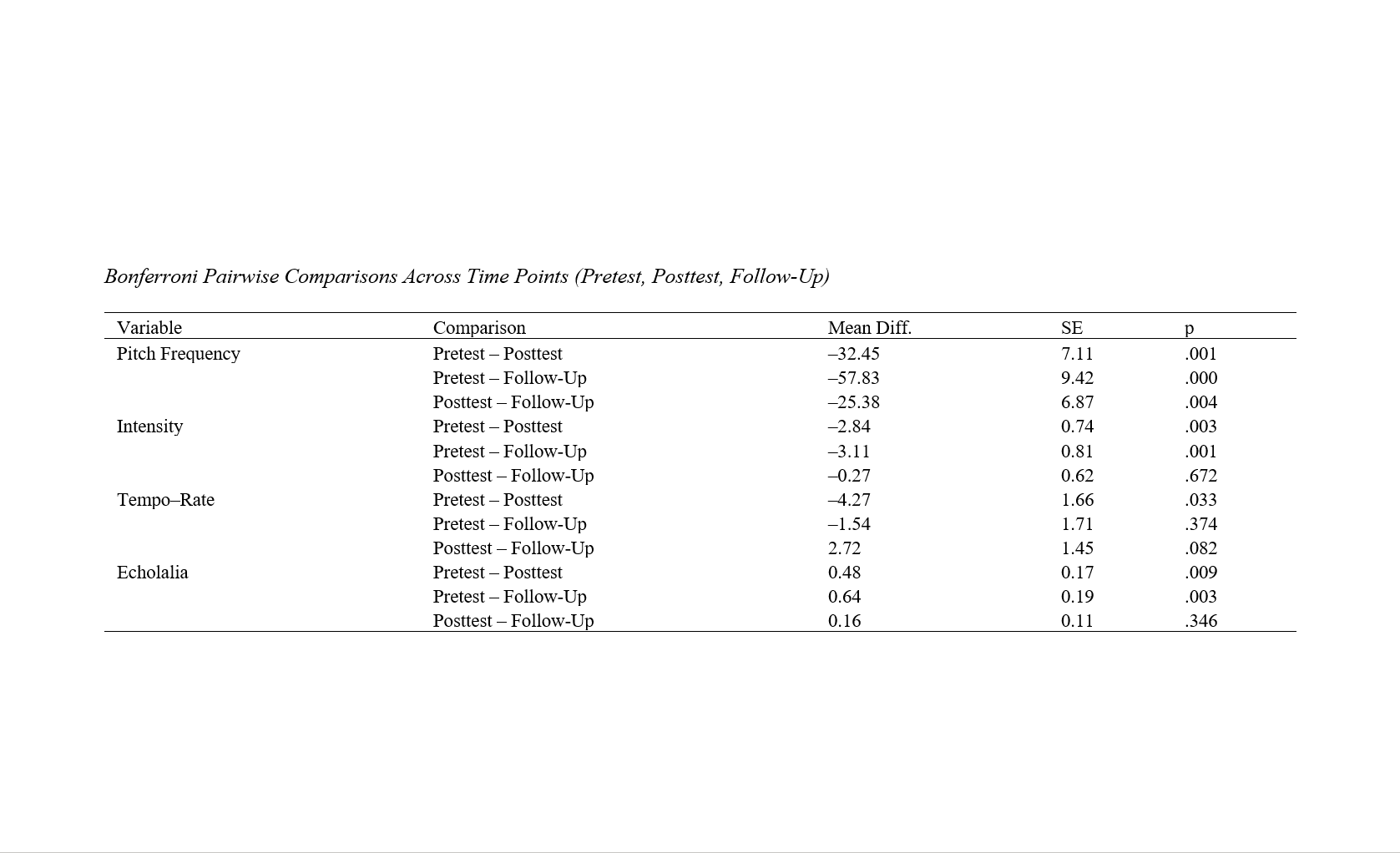
This study aimed to determine the effectiveness of an active music therapy protocol on reducing echolalia and improving pitch frequency among children with Level-One Autism Spectrum Disorder. This semi-experimental study employed a pretest–posttest design with a control group. Twenty-two children aged 4–7 years with Level-One ASD were selected through convenience sampling and randomly assigned to either an active music therapy group or a control group. The intervention was delivered across eight weeks using structured rhythmic, vocal, and auditory–motor activities. Echolalia was assessed using the Aberrant Behavior Checklist (Echolalia subscale), and pitch-related prosodic features were analyzed using Praat acoustic software. Data were collected across pretest, posttest, and follow-up phases. Statistical analysis was conducted using two-way repeated-measures ANOVA and Bonferroni-adjusted post-hoc tests. Repeated-measures ANOVA revealed a significant time × group interaction for pitch frequency, indicating greater improvement in the active music therapy group compared with controls across posttest and follow-up (p < .05). The intervention group showed a marked increase in pitch frequency from pretest to follow-up, while the control group demonstrated no meaningful change. Echolalia scores exhibited a significant reduction in the experimental group compared with the control group over time (p < .05), confirming the therapeutic effect of rhythmic–vocal engagement. Bonferroni post-hoc comparisons further indicated that the most substantial improvements occurred between pretest and follow-up in the therapy group, with effect sizes in the moderate-to-large range. Active music therapy produced significant improvements in prosodic features—particularly pitch frequency—and reductions in echolalia among Level-One ASD children, with gains maintained over time. The findings highlight the value of rhythmic, auditory–motor, and vocal synchronization activities for enhancing speech-related outcomes in this population.
Downloads
References
Caponnetto, P., LaMattina, G., & Quattropani, M. C. (2022). Music therapy and psychological-clinical impact in surgery: a systematic review. Health Psychology Research, 10(4), 38615. https://doi.org/10.52965/001c.38615
Chenausky, K. V., Norton, A. C., & Schlaug, G. (2017). Auditory-Motor Mapping Training in a More Verbal Child with Autism. Frontiers in human neuroscience, 11, 426. https://doi.org/10.3389/fnhum.2017.00426
Farahani Sepehr, F., Hashemi, J., & Pezeshk Sh, S. (2014). The effectiveness of speech repetition on echolalia and challenging behaviors among autistic children. Journal of Exceptional Individuals, 4(15), 57-72. https://jpe.atu.ac.ir/article_297.html
Ferdosi, N., & Ashayeri, H. (2015). The effect of music on language disorders (Melodic intonation therapy in autism and aphasia). Tehran: Jungle, Javadaneh.
Ferdosi, N., Ashayeri, H., Modarresi, Y., & Rovshan, B. (2013). The Effects of Melodic Intonation Therapy on 7-10-year, Persian, Autistic, Male Children's Speech. Advances in Cognitive Sciences, 15(3), 12-23. https://ensani.ir/fa/article/321148/
Gao, X., Xu, G., Fu, N., Ben, Q., Wang, L., & Bu, X. (2025). The effectiveness of music therapy in improving behavioral symptoms among children with autism spectrum disorders: a systematic review and meta-analysis. https://doi.org/10.3389/fpsyt.2024.1511920
Geretsegger, M., Elefant, C., Mössler, K. A., & Gold, C. (2014). Music therapy for people with autism spectrum disorder. Cochrane Database Syst Rev(6), CD004381. https://doi.org/10.1002/14651858.CD004381.pub3
Hamidifard, S., DashtBozorgi, Z., & Hafezi, F. (2023). The Effectiveness of Music Therapy on Self-Harm Behaviors and Executive Functions in Children with Autism Disorder. ijrn, 10(1), 10-20. https://ijrn.ir/article-1-813-fa.html
Harbison, A. L., Woynaroski, T. G., & McDaniel, J. (2020). Speech prosody interventions for persons with autism spectrum disorders: A systematic review. American Journal of Speech-Language Pathology, 29(4), 1912-1928. https://doi.org/10.1044/2020_AJSLP-19-00127
Holbrook, S., & Israelsen, M. (2020). Speech Prosody Interventions for Persons With Autism Spectrum Disorders: A Systematic Review. Am J Speech Lang Pathol. https://doi.org/10.1044/2020-AJSLP-19-00127
Kaat, A. J., Lecavalier, L., & Aman, M. G. (2014). Validity of the aberrant behavior checklist in children with autism spectrum disorder. Journal of Autism and Developmental Disorders, 44(5), 1103-1116. https://doi.org/10.1007/s10803-013-1970-0
Kabuk, A., Şendir, M., & Filinte, G. (2022). The effect of reflexology massage and passive music therapy intervention before burn dressing on pain, anxiety level and sleep quality. Burns, 48(7), 1743-1752. https://doi.org/10.1016/j.burns.2021.10.012
Karami, J., Alikhani, M., Zakiei, A., & Khodadi, K. (2012). The effectiveness of art therapy (painting) in reducing the aggressive behavior of students with dyslexia. Journal of Learning Disabilities, 1(3), 105-117. https://journal.uma.ac.ir/article_106.html
Khaliulin, I., Hamoudi, W., & Amal, H. (2025). The multifaceted role of mitochondria in autism spectrum disorder. Molecular Psychiatry, 30(2), 629-650. https://doi.org/10.1038/s41380-024-02725-z
Khanjani, Z., & Khaknezhad, Z. (2016). The Effect of Inactive Music Therapy on Symptoms, Communication Deficit, and Social Interaction of Children with Autism Spectrum Disorder. J Child Ment Health, 3(3), 97-105. http://childmentalhealth.ir/browse.php?a_code=A-10-229-1&sid=1&slc_lang=fa
Lim, H. A. (2010). Effect of "developmental speech and language training through music" on speech production in children with autism spectrum disorders. Journal of Music Therapy, 47(1), 2-26. https://doi.org/10.1093/jmt/47.1.2
Shiri, E., Pouretemad, H., Fathabadi, J., & Narimani, M. (2018). Evaluation effectiveness of the family-based program of the management on Behavioral Excesses with children autism. Journal of Family Research, 15(2), 267-282. https://jfr.sbu.ac.ir/article_97754.html
Stekić, K. (2024). The role of active and passive music engagement in cognitive development: A systematic review. International Journal of Music Education. https://doi.org/10.1177/02557614241268049
Wang, M., Wu, J., & Yan, H. (2023). Effect of music therapy on older adults with depression: A systematic review and meta-analysis. Complementary Therapies in Clinical Practice, 53, 101809. https://doi.org/10.1016/j.ctcp.2023.101809
Yinger, O. S., & Gooding, L. F. (2014). Music therapy for preschool children with autism: A systematic review. Journal of Music Therapy, 51(2), 151-181.
Downloads
Additional Files
Publication Timeline
- Submitted
- Revised
- Accepted