Comparison of the Effectiveness of Mindfulness-Based Therapy and Emotion-Focused Therapy on Heart Rate in Patients with Cardiovascular Diseases
DOI:
https://doi.org/10.61838/kman.hp.psynexus.4836Keywords:
Mindfulness-based therapy; Emotion-focused therapy; Heart rate; Cardiovascular disease; Psychological intervention; Autonomic regulationAbstract
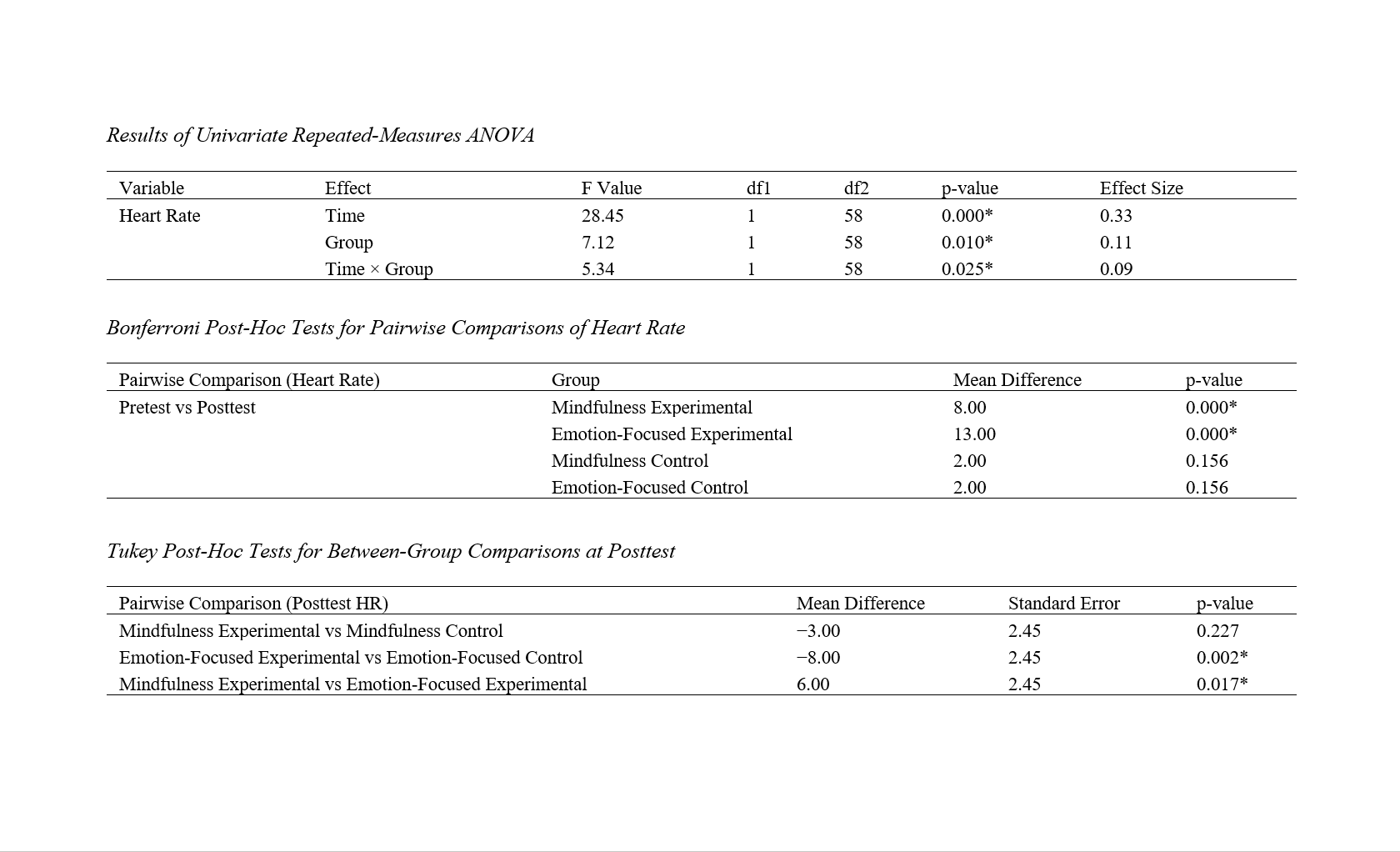
The objective of this study was to compare the effectiveness of mindfulness-based therapy and emotion-focused therapy on reducing heart rate among patients with cardiovascular diseases. This quasi-experimental study included two experimental groups and one control group, selected from patients diagnosed with coronary artery disease who attended a specialized cardiology clinic in Rasht during the first quarter of 2025. Sixty eligible participants aged 45–70 were recruited through purposive sampling and randomly assigned to a mindfulness-based therapy group, an emotion-focused therapy group, or a control group. All groups completed a pretest assessment of heart rate, after which the experimental groups received nine sessions of either mindfulness-based or emotion-focused therapeutic intervention, while the control group attended a single non-therapeutic educational session for ethical purposes. Heart rate was measured objectively at pretest and posttest using a pulse oximeter. Inclusion and exclusion criteria ensured medical stability and the ability to participate consistently in treatment sessions. Data were analyzed using repeated-measures ANOVA with Bonferroni and Tukey post-hoc tests through SPSS version 26. Results indicated a significant main effect of time on heart rate (F = 28.45, p < 0.001, η = 0.33), as well as a significant group effect (F = 7.12, p = 0.010, η = 0.11) and a significant time × group interaction (F = 5.34, p = 0.025, η = 0.09). Bonferroni post-hoc tests showed significant heart rate reductions in the mindfulness-based group (MD = 8.00, p < 0.001) and the emotion-focused group (MD = 13.00, p < 0.001), with no significant change in control groups. Tukey tests confirmed that emotion-focused therapy produced significantly greater posttest reductions than both its control group (MD = −8.00, p = 0.002) and the mindfulness-based group (MD = 6.00, p = 0.017). Both mindfulness-based and emotion-focused therapies effectively reduced heart rate in cardiac patients, with emotion-focused therapy demonstrating superior physiological benefits and stronger autonomic regulation effects compared to mindfulness-based therapy.
Downloads
References
Akbarinejad, H., & Naqizadeh Alamdari, M. (2023). Comparison of the effectiveness of mindfulness-based cognitive therapy and brief solution-focused therapy on quality of life and resilience in adolescent girls with heart disease. Journal of Psychological Research, 18(108), 59-91. magiran.com/p2676151
Andersen, M. M., Rosas, F. E., Schjoedt, U., Mediano, P. A. M., Price, H., Konvalinka, I., & Clasen, M. (2025). Scared Together: Heart Rate Synchrony and Social Closeness in a High-Intensity Horror Setting. Emotion. https://doi.org/10.1037/emo0001556
Bahrambagi, Z., Lotfi Kashani, F., & Vaziri, S. (2023). Effectiveness of mindfulness-based therapy on chronic stress and disease perception in heart patients [Semi-pilot]. Medical Sciences Journal of Islamic Azad University, 33(1), 70-79. https://doi.org/10.52547/iau.33.1.70
Braet, J., & Braet, C. (2024). I Can Feel My Heartbeat: The Relationship Between Interoceptive Abilities and Emotional States During Stress and Recovery in Healthy Adolescents. Psychophysiology, 61(12). https://doi.org/10.1111/psyp.14679
Changi Ashtiani, M., Fattahi, N., Balali, D., Alavi, S. H., & Mahmoudzadeh, M. (2024). Effectiveness of Mindfulness-Based Schema Therapy on Mental Pain and Experiential Avoidance in Patients with Cardiovascular Diseases. Journal of Assessment and Research in Applied Counseling (JARAC), 6(1), 90-96. https://doi.org/10.61838/kman.jarac.6.1.10
Ebrahimi, E., Hatami, M., & Seirafi, M. (2022). Comparison of the effectiveness of emotional self-regulation strategies and coping strategies with pain on emotional process regulation in female patients with coronary heart disease. Applied Family Therapy Journal (AFTJ), 3(3), 66-79. https://doi.org/10.61838/kman.aftj.3.3.5
Farhadi, F. (2023). The effectiveness of Emotion-Focused Therapy on rumination and alexithymia in individuals experiencing emotional heartbreak. Quarterly Journal of New Ideas in Psychology, 19(23). https://jnip.ir/article-1-1138-fa.html
Gu, J.-J., Tong, X.-S., Meng, S.-S., Xu, S.-H., & Huang, J.-Y. (2023). Effect of mindfulness-based stress reduction in patients with acute myocardial infarction after successful primary percutaneous coronary intervention: a retrospective study. BMC Cardiovascular Disorders, 23(1), 315. https://doi.org/10.1186/s12872-023-03346-0
Hunt, M., Al-Braiki, F., Dailey, S., Russell, R., & Simon, K. (2018). Mindfulness Training, Yoga, or Both? Dismantling the Active Components of a Mindfulness-Based Stress Reduction Intervention. Mindfulness, 9(2), 512-520. https://doi.org/10.1007/s12671-017-0793-z
Kang, Q., & Luo, A. (2022). The efficacy of mindfulness-based intervention for heart diseases: A meta-analysis of randomized controlled trials. Medicine, 101(39). https://doi.org/10.1097/MD.0000000000029649
Khairi, Y., Shalchi, B., & Kazemi, S. A. (2022). The relationship between mindfulness and religious attitude with forgiveness: the mediating role of cognitive flexibility. Quarterly Journal of Psychology and Religion, 14(4), 133-149. https://www.magiran.com/paper/2415190
Latipah, S., Prabawati, D., & Susilo, W. H. (2020). The Effectiveness of Mindfulness Based Intervention: Prayer Open Hearts Against Depression in HIV/AIDS Patients. Jurnal Ilmiah Keperawatan Indonesia [JIKI], 4(1), 26-40. https://doi.org/10.31000/jiki.v4i1.2819
Lee, E. K. P., Yeung, N. C. Y., Xu, Z., Zhang, D., Yu, C.-P., & Wong, S. Y. S. (2020). Effect and Acceptability of Mindfulness-Based Stress Reduction Program on Patients With Elevated Blood Pressure or Hypertension. Hypertension, 76(6), 1992-2001. https://doi.org/10.1161/HYPERTENSIONAHA.120.16160
Mittal, T. K., Evans, E., Pottle, A., Lambropoulos, C., Morris, C., Surawy, C., & Tyrer, P. (2022). Mindfulness-based intervention in patients with persistent pain in chest (MIPIC) of non-cardiac cause: a feasibility randomised control study. Open Heart, 9(1). https://doi.org/10.1136/openhrt-2022-001970
Moghadam, M., Hatami, M., Baghdassarians, A., & Sepah Mansour, M. (2020). A comparison of effectiveness of cognitive behavioral therapy and mindfulness-based therapy on quality of life in patients with coronary heart disease. Journal of Nurse and Physician Within War, 8(28), 33-43. https://doi.org/10.52547/npwjm.8.28.33
Ochghaz, M. G., Mohammadkhani, P., Hatami, M., & Mohammadrezaei, R. (2020). Compare Compassion-Based Therapy and Mindfulness-Based Cognitive Therapy to Reduce Fear of Compassion and Self-Criticism in People with Heart Failure. Contemporary psychology, 15(1), 123-136. http://bjcp.ir/article-1-1690-fa.pdf
Pascual-Madorran, T., Zocca, G., Ploumen, E. H., Szabo - Te Fruchte, K., Buikema, L., Kok, M. M., Van Buiten, D. G., Kuijpers, P. M. J. C., Von Birgelen, C., & De Man, F. (2021). Efficacy of mindfulness-based cognitive therapy on symptoms of depression and anxiety in patients with coronary artery disease: insights from a prospective registry. European Heart Journal, 42(Supplement_1), ehab724.3035. https://doi.org/10.1093/eurheartj/ehab724.3035
Safari, S., Parandin, S., & Akbari, M. (2024). Development of a Hope Model Based on Emotion Regulation With Spiritual Well-Being as a Mediator in Heart Failure Patients in Kermanshah and Its Effectiveness on Death Anxiety. PDMD, 3(4), 64-81. https://doi.org/10.61838/kman.pdmd.3.4.5
Sooreh, J., Hajloo, N., Atadokht, A., & Basharpoor, S. (2023). Comparing the Effectiveness of Positive Thinking Skills (PTS) and Mindfulness‐Based Cognitive Therapy (MBCT) in Promoting Demoralization and Psycho-Social Adjustment in Cancer Patients. Journal of Sabzevar University of Medical Sciences, 30(2), 193-207. https://doi.org/10.30468/jsums.2023.1557
Tarun Kumar, M., Emma, E., Alison, P., Costas, L., Charlotte, M., Christina, S., Antony, C., Felicia, C., Ranil de, S., Mark, M., Winston, B., Diviash, T., & Peter, T. (2022). Mindfulness-based intervention in patients with persistent pain in chest (MIPIC) of non-cardiac cause: a feasibility randomised control study. Open Heart, 9(1), e001970. https://doi.org/10.1136/openhrt-2022-001970
Voci, A., Veneziani, C. A., & Fuochi, G. (2019). Relating mindfulness, heartfulness, and psychological well-being: The role of self-compassion and gratitude. Mindfulness, 10(2), 339-351. https://doi.org/10.1007/s12671-018-0978-0
Downloads
Additional Files
Publication Timeline
- Submitted
- Revised
- Accepted