Comparison of Difficulty in Emotion Regulation, Emotional Literacy, and Sexual Knowledge and Attitudes in Married Female Students with Emotional Divorce Experience and Other Married Female Students
DOI:
https://doi.org/10.61838/kman.fct.psynexus.4848Keywords:
emotional divorce, sexual knowledge and attitudes, difficulty in emotion regulation, emotional literacyAbstract
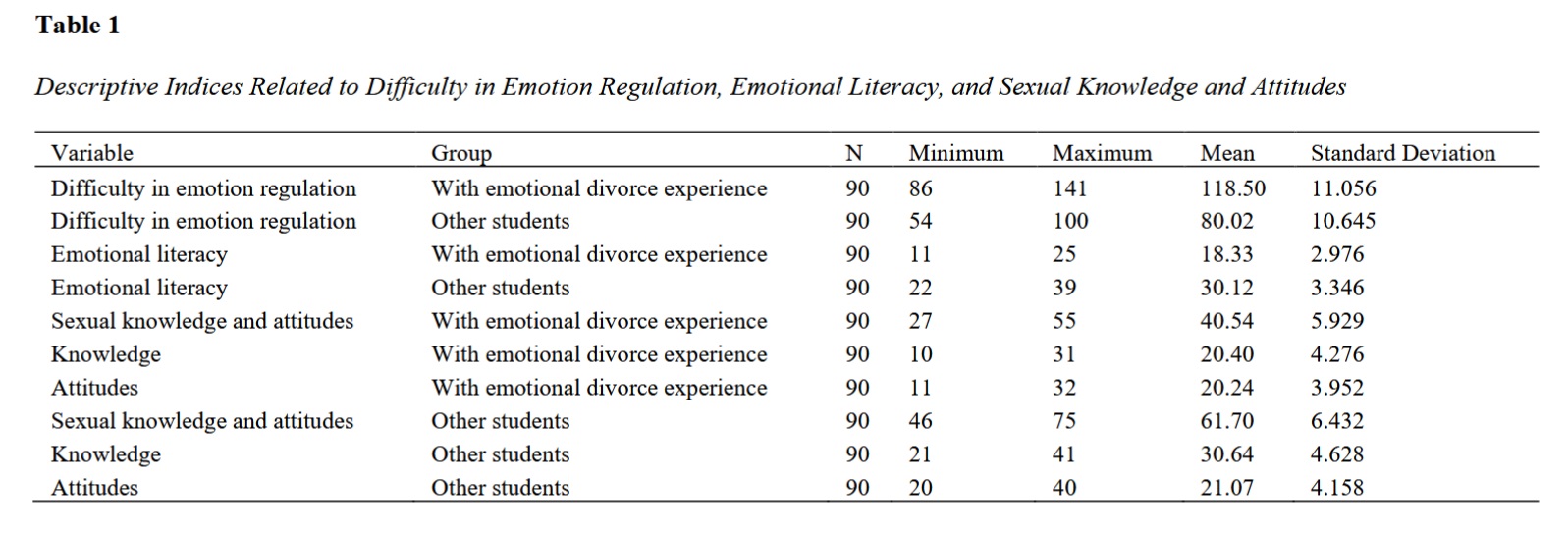
Emotional divorce is a condition in which spouses, despite living together, experience no emotional exchange or feelings toward each other. This phenomenon is considered one of the fundamental causes of social and familial dysfunctions. The present study aimed to examine and compare difficulty in emotion regulation, emotional literacy, and sexual knowledge and attitudes among married female students who have experienced emotional divorce and other married female students. This research employed a causal–comparative design. The statistical population included all married students of Islamic Azad University, Lahijan Branch, during the 2024–2025 academic year. The population size was 8,543 individuals. The sample consisted of 90 students with emotional divorce experience and 90 students without such experience, selected through convenience sampling. The instruments used included the Gottman Emotional Divorce Questionnaire (2008), the Iranian Family Psychological Functioning Scale (2012), the Difficulties in Emotion Regulation Scale by Gratz (2004), and the Sexual Knowledge and Attitudes Scale by Farjina et al. (2014). Data were analyzed at two levels: descriptive statistics (dispersion indices) and inferential statistics (univariate and multivariate analysis of variance) using SPSS version 26. The results indicated that students with emotional divorce experience had greater difficulty in emotion regulation and lower levels of emotional literacy as well as sexual knowledge and attitudes (p < .05). Difficulty in emotion regulation and deficiencies in emotional literacy and sexual knowledge are significant contributing factors to emotional divorce. Providing comprehensive educational and psychological interventions focused on emotion regulation, emotional literacy, and sexual education can improve marital relationship quality and reduce the consequences of emotional divorce.
Downloads
References
Akbari, M., Azimi, Z., Talebi, H., & Fahimi, F. (2020). Prediction of emotional divorce based on early maladaptive schemas, emotion regulation and its components. Clinical Psychology & Personality, 14(2), 23-34. https://cpap.shahed.ac.ir/article_2783_en.html?lang=en
Al-Shahrani, H. F., & Hammad, M. A. (2023). Impact of emotional divorce on the mental health of married women in Saudi Arabia. PLoS One, 18(11), e0293285. https://doi.org/10.1371/journal.pone.0293285
Alaghband, L., Sharifi, H., Farzad, V., & Aghayousefi, A. (2019). A Model for Predicting Emotional Divorce Based on Emotional Literacy, Coping Styles, Quality of Life, and Emotion Seeking with Emotion Regulation Mediation. medical journal of mashhad university of medical sciences, 62(3), 288-402. https://doi.org/10.22038/mjms.2019.14890
Alvarez, I., Herrero, M., & Martínez-Pampliega, A. (2024). The impact of emotion regulation on the establishment of the therapeutic alliance in post-divorce group intervention: A multilevel approach. PLoS One, 19(10), e0312293. https://doi.org/10.1371/journal.pone.0312293
Amato, P. R. (2000). The consequences of divorce for adults and children. Journal of marriage and family, 62(4), 1269-1287. https://doi.org/10.1111/j.1741-3737.2000.01269.x
Attaky, A., Schepers, J., Kok, G., & Dewitte, M. (2021). The role of sexual desire, sexual satisfaction, and relationship satisfaction in the sexual function of Arab couples living in Saudi Arabia. Sexual Medicine, 9(2), 100303. https://doi.org/10.1016/j.esxm.2020.100303
Goleman, D. (1995). Emotional intelligence: Why it can matter more than IQ. Bantam Books. https://www.scirp.org/reference/referencespapers?referenceid=773626
Gratz, K. L., & Roemer, L. (2004). Multidimensional Assessment of Emotion Regulation and Dysregulation: Development, Factor Structure, and Initial Validation of the Difficulties in Emotion Regulation Scale. Journal of psychopathology and behavioral assessment, 26(1), 41-54. https://doi.org/10.1023/B:JOBA.0000007455.08539.94
Grych, J. H., & Fincham, F. D. (1990). Marital conflict and children's adjustment: A cognitive-contextual framework. Child development, 61(3), 665-679. https://psycnet.apa.org/fulltext/1991-00924-001.html
Hadian, S., & Amini, D. (2019). The prediction of marital degradation based on emotional intelligence, communication skills and marital conflicts in married couples of Hamadan Azad University. Women's Research, 10(27), 179-211. https://womenstudy.ihcs.ac.ir/article_4033.html?lang=en
Jahanbakhshie, Z., Soltanian, S., & Pourshahriar Koleshtri, H. (2025). Prediction of Emotional Divorce based on Marital Commitment and Family Power Structure with the mediator role of Intimacy. Journal of Applied Psychological Research. https://doi.org/10.22059/japr.2025.372580.644895
Jardine, B. B., Boyes, M. E., & Fletcher, G. J. O. (2022). Emotional intelligence and romantic relationship satisfaction: A meta-analysis. Personality and individual differences, 188, 111470. https://doi.org/10.1016/j.paid.2022.111713
Masters, W. H., & Johnson, V. E. (1966). Human Sexual Response. Boston: Little, Brown and Company. https://www.amazon.com/Human-Sexual-Response-William-Masters/dp/0316549878
Momeni, Z., & Azadi-Fard, F. (2015). The relationship of sexual knowledge, sexual attitudes and communication beliefs with emotional divorce. Family Pathology, Counseling & Enrichment Journal, 1(2), 119-136. https://fpcej.ir/browse.php?a_id=97&sid=1&slc_lang=en
Mónaco, E., De la Barrera, U., Montoya-Castilla, I., & et al. (2021). The effectiveness of EMOVERE: An emotional education program for young couples. International journal of environmental research and public health, 18(3), 12-40. https://doi.org/10.3390/ijerph18041677
Morgan, P. C., Wittenborn, A. K., Morlan, G. L., & Snyder, R. (2024). Emotion regulation difficulties as a mediator between relationship satisfaction predicting depressive symptom trajectories among couples in couple therapy. Behavioral Sciences, 14(12), 1215. https://doi.org/10.3390/bs14121215
Mousavi Khorrami, Z., Doukaneifard, F., & Khakpour, R. (2020). Providing a model for predicting emotional divorce based on attachment styles and sexual function components with the mediating role of emotional intelligence in women. Journal of Applied Family Therapy, 2(7), 25-50. https://doi.org/10.61838/kman.aftj.2.3.2
Payamani, S., Alipour, A., Moradi Doliskani, M., & Saffarinia, M. (2024). Comparing the effectiveness of emotion regulation training (ETF) and Gutman couple therapy on emotional regulation of married women facing divorce in Tehran. medical journal of mashhad university of medical sciences, 67(3), 1047-1068. https://doi.org/10.22038/mjms.2024.25023
Sadeghzadeh, Z., Ghodssi-ghassemabad, R., Hamdieh, M., & et al. (2023). The assessment of the related factors of emotional divorce among Iranian people during the Covid-19 pandemic: a descriptive study. BMC psychology, 11, 360. https://doi.org/10.1186/s40359-023-01395-w
Shahi, F., & Eskandari, H. (2025). The Relationship Between Love Style and Emotional Divorce With the Mediating Role of Resilience and Social Support. Iranian Journal of Neurodevelopmental Disorders, 4(2), 1-11. https://maherpub.com/jndd/article/view/535
Shareh, H., & Foshtanqi, K. (2019). The role of emotional intelligence and marital satisfaction in women's quality of life: Structural equation modeling. Journal of Fundamentals of Mental Health, 21(2), 109-120. https://jfmh.mums.ac.ir/jufile?ar_sfile=280421&lang=en
Teymouri, Z., Mojtabaei, M., & Rezazadeh, S. M. R. (2020). The Effectiveness of Emotionally Focused Couple Therapy on Emotion Regulation, Anger Rumination, and Marital Intimacy in Women Affected by Spouse Infidelity. CJHR, 5(4), 78-82. https://doi.org/10.52547/cjhr.5.4.78
Downloads
Additional Files
Publication Timeline
- Submitted
- Revised
- Accepted