Explaining the Causal Relationship Between Existential Anxiety and Post-Traumatic Growth in Women and Men Affected by Infidelity: Assessing the Mediating Role of Resilience
Keywords:
existential anxiety, post-traumatic growth, marital infidelity, resilienceAbstract
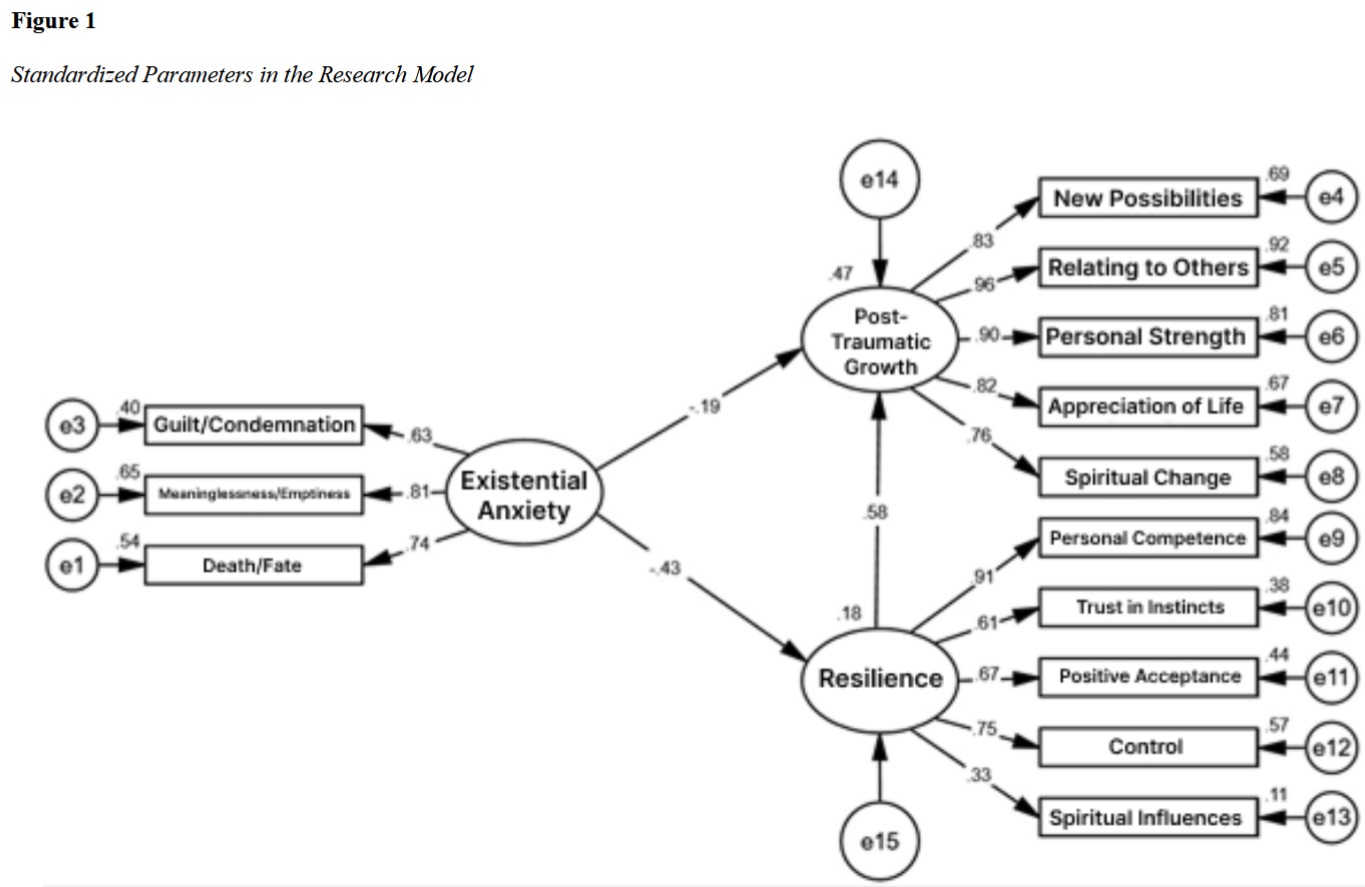
Marital infidelity, as one of the most severe emotional stressors, can lead to extensive psychological consequences, including existential anxiety and disruptions in individual adjustment. In recent years, researchers have increasingly focused on identifying mechanisms that influence psychological reconstruction and growth following such events. The purpose of this study was to explain the causal relationship between existential anxiety and post-traumatic growth in women and men affected by infidelity, and to assess the mediating role of resilience. The statistical population consisted of all women and men affected by infidelity who had sought services in counseling and psychological centers in Tehran during 2024. Using convenience sampling, 200 individuals affected by infidelity were selected as the sample. The research method was correlational with a structural equation modeling design. Data were collected using the Post-Traumatic Growth Inventory (Tedeschi & Calhoun, 1996), the Existential Anxiety Questionnaire (Raimz et al., 2004), and the Connor–Davidson Resilience Scale (Connor & Davidson, 2003). Data analysis was performed using structural equation modeling (SEM). The results indicated that resilience negatively and significantly mediated the relationship between existential anxiety and post-traumatic growth in individuals affected by infidelity. It can be concluded that resilience plays a crucial role in reducing the negative effects of existential anxiety and facilitating post-traumatic growth among individuals who have experienced infidelity. Strengthening resilience skills may serve as an effective approach for enhancing their psychological adjustment.
Downloads
References
Abzug, R. (2016). Extramarital affairs as occupational hazard: A structural, ethical (cultural) model of opportunity. Sexualities, 19(1-2), 25-45. https://doi.org/10.1177/1363460715583586
Aydogan, D., & Dincer, D. (2020). Creating resilient marriage relationships: Self-pruning and the mediation role sacrifice with satisfaction. Current Psychology, 39(2), 500-510. https://doi.org/10.1007/s12144-019-00472-x
Chopani, M., & Karami, M. (2019). Epidemiology of Psychosocial Disorders Based on the Family Life Cycle in Families of Tehran. Research Project in Counseling,
Chopani, M., Sohrabi Fard, M., Mohammadi, F., Ismaili, N., & Samadi Fard, A. (2019). Perceptions of Unfaithful Men Regarding the Causes and Factors Deterring Extramarital Relationships: A Qualitative Study. Journal of New Findings and Research in Counseling, 18(65), 1-1. https://irancounseling.ir/journal/article-1-498-fa.html
Choupani, M., Asanjarani, F., & de Castro Correa, A. M. (2021). The Effectiveness of Rollo May Existential-Humanistic Approach to the Willingness to Infidelity in Disloyal Men: A Single Case Study. Contemporary psychology, 16(1), 39-53. https://www.magiran.com/author/profile/452233/
Connery, T., Riotto, G. D., Macdonald, D., & Menzies, R. E. (2025). Associations Between Death Anxiety and Fear of Illness Progression or Recurrence: A Protocol for a Systematic Review and Meta-Analysis. PLoS One, 20(6), e0325176. https://doi.org/10.1371/journal.pone.0325176
Dinç, G., & İlgar, M. Z. (2022). In maintaining a marriage, examination of the relationship between mutual happiness levels, and adult attachment styles and psychological resilience levels. Psycho-Educational Research Reviews, 11(2), 1-22. https://doi.org/10.52963/PERR_Biruni_V11.N2.01
Eindor, T., Perrypaldi, A., Hirschberger, G., Birnbaum, G. E., & Deutsch, D. (2015). Coping with mate poaching: Gender differences in detection of infidelity-related threats. Evolution & Human Behavior, 36(1), 17-24. https://doi.org/10.1016/j.evolhumbehav.2014.08.002
Etemad, J., Dehghan Manshadi, Z., & Mozaffari, N. (2016). Psychometric properties of existential anxiety scale in the elderly. Gerontology, 1(3), 48-39. https://doi.org/10.18869/acadpub.joge.1.3.39
Ghareh Daqi, A., & Seyed Mirzaei, S. M. (2020). The Effectiveness of Acceptance and Commitment Therapy on Emotional PTSD Symptoms in Women Affected by Marital Infidelity. Family Research, 16(2), 217-229. https://jfr.sbu.ac.ir/article_97818.html
Ghareh Gozlou, N., Morad Hasli, M., & Atadokht, A. (2018). Comparing the Effectiveness of In-Person and Virtual Cognitive-Behavioral Couples Therapy on Post-Traumatic Stress Disorder in Extramarital Relationships. Journal of counseling research, 17(65), 206-208. https://ensani.ir/fa/article/423575/
Gonzalez, T. (2023). Resilience and Willingness to Forgive Infidelity: An Examination of the Relationship by Type of Infidelity, Attitudes Toward Infidelity, and Relationship Investment. https://search.proquest.com/openview/3d63b16029795a1d1df6bee45fe109ae/1?pq-origsite=gscholar&cbl=18750&diss=y
Hasanah, M. (2025). Religion, Existential Anxiety, and the Search for Lifes Meaning: A Humanistic Psychology Approach in Religious Societies. Al-Ihath Jurnal Bimbingan Dan Konseling Islam, 5(2), 120-131. https://doi.org/10.53915/jbki.v5i2.635
Kang, H., Fischer, I. C., Dickinson, S., Na, P. J., Tsai, J., Tedeschi, R. G., & Pietrzak, R. H. (2024). Posttraumatic Growth in US Military Veterans: Results from the National Health and Resilience in Veterans Study. Psychiatric Quarterly, 95(1), 17-32. https://doi.org/10.1007/s11126-023-10061-8
Kretschmer, M., & Storm, L. (2018). The relationships of the five existential concerns with depression & existential thinking. International Journal of Existential Psychology & Psychotherapy, 7(1), 1-10. https://www.meaning.ca/web/wp-content/uploads/2019/10/216-13-513-4-10-20180704.pdf
Menzies, R. E., Brown, J., & Marchant, J. (2025). "To Die, To Sleep": A Systematic Review and Meta-Analysis of the Relationship Between Death Anxiety and Sleep. Journal of anxiety disorders, 103001. https://doi.org/10.1016/j.janxdis.2025.103001
Najafizadeh, M., & Hamzehpoor-Haghighi, T. (2022). The Role of Resilience, Conflict Resolution Strategies, and Sensation Seeking in Predicting Attitude to Marital Infidelity of Married Female Students of Lahijan Azad University. Community Health, 9(1), 11-20. https://journals.sbmu.ac.ir/ch/index.php/ch/article/download/31335/20513/126084
Nasab, K., Hamid, B., Ganji, L., Amini, M., Pashmdarfard, M., & Davari, Z. (2025). Relationship of Loneliness, Perceived Social Support, and Dysfunctional Attitudes with Death Anxiety in Older Adults; the Mediating Role of Spiritual Health. Iranian Journal of War and Public Health, 17(1), 29-35.
Orayfig, A. N. (2018). Multicultural and International Posttraumatic Growth: A Mixed-Method Approach. https://search.proquest.com/openview/d461a5e58f0badd1703eb8ee1dbc97e3/1?pq-origsite=gscholar&cbl=18750
Pichon, M., Treves-Kagan, S., Stern, E., Kyegombe, N., Stöckl, H., & Buller, A. M. (2020). A mixed-methods systematic review: Infidelity, romantic jealousy and intimate partner violence against women. International journal of environmental research and public health, 17(16), 5682. https://doi.org/10.3390/ijerph17165682
Prieto-Ursúa, M., & Jódar, R. (2020). Finding meaning in hell: The role of meaning, religiosity and spirituality in posttraumatic growth during the coronavirus crisis in Spain. Frontiers in psychology, 11, 567836. https://doi.org/10.3389/fpsyg.2020.567836
Ramsay, T., & Manderson, L. (2011). Resilience, spirituality and posttraumatic growth: Reshaping the effects of climate change Climate change and human well-being: Global challenges and opportunities. https://link.springer.com/chapter/10.1007/978-1-4419-9742-5_9
Roby, F. C. L. (2024). Infidelity, Post-Infidelity Stress Disorder, and Post-Infidelity Stress Marital Outcomes. https://search.proquest.com/openview/1f42c8a6f5703008dbd8eb5b1780840a/1?pq-origsite=gscholar&cbl=18750&diss=y
Selterman, D., Garcia, J. R., & Tsapelas, I. (2019). Motivations for extra dyadic infidelity revisited. The Journal of Sex Research, 56(3), 273-286. https://doi.org/10.1080/00224499.2017.1393494
Seyed Mahmoudi, S., Rahimi, C., Mohamadi, N., & Hadian Fard, H. (2010). Increasing Posttraumatic Growth during Time and Its Relationship with Coping Styles and Optimism in Individuals with HIV. Psychological Achievements, 17(2), 165-186. https://psychac.scu.ac.ir/article_11685_en.html
Silvan-Grau, M. (2024). Predicting Empathic Ability and Post-Traumatic Growth Among Anxiously Attached Therapists: A Moderated Mediation Examining the Role of Self-Differentiation. https://digitalcommons.liu.edu/symposium_discoveryday/2024/posters/26/
Soudani, M., Karimi, J., Mehrabi Zadeh Honarmand, M., & Nissi, A.-K. (2012). The Effectiveness of Emotion-Focused Couples Therapy on Reducing Harm from Spousal Infidelity. Journal of Behavioral Science Research, 10(4), 258-266. https://ensani.ir/fa/article/317817/
Tedeschi, R. G., & Calhoun, L. G. (2020). Posttraumatic growth: Theory, research, and applications. Routledge. https://www.taylorfrancis.com/books/mono/10.4324/9781315527451/posttraumatic-growth-richard-tedeschi-jane-shakespeare-finch-kanako-taku
Weems, C. F., Costa, N. M., Dehon, C. H., & Berman, S. L. (2004). Paul Tillich's theory of existential anxiety: A preliminary conceptual and empirical examination. Anxiety, Stress & Coping: An International Journal, 4, 383-399. https://doi.org/10.1080/10615800412331318616
Weiser, D. A., Shrout, M. R., Thomas, A. V., Edwards, A. L., & Pickens, J. C. (2023). "I've been cheated, been mistreated, when will I be loved": Two decades of infidelity research through an intersectional lens. Journal of Social and Personal Relationships, 40(3), 856-898. https://doi.org/10.1177/02654075221113032
Downloads
Additional Files
Publication Timeline
- Submitted
- Revised
- Accepted