Comparison of the Effectiveness of Schema Therapy and Emotion-Focused Therapy (EFT) in Increasing Marital Intimacy among Couples
DOI:
https://doi.org/10.61838/kman.fct.psynexus.4857Keywords:
effectiveness, schema therapy, emotion-focused therapy (EFT), marital intimacy, couplesAbstract
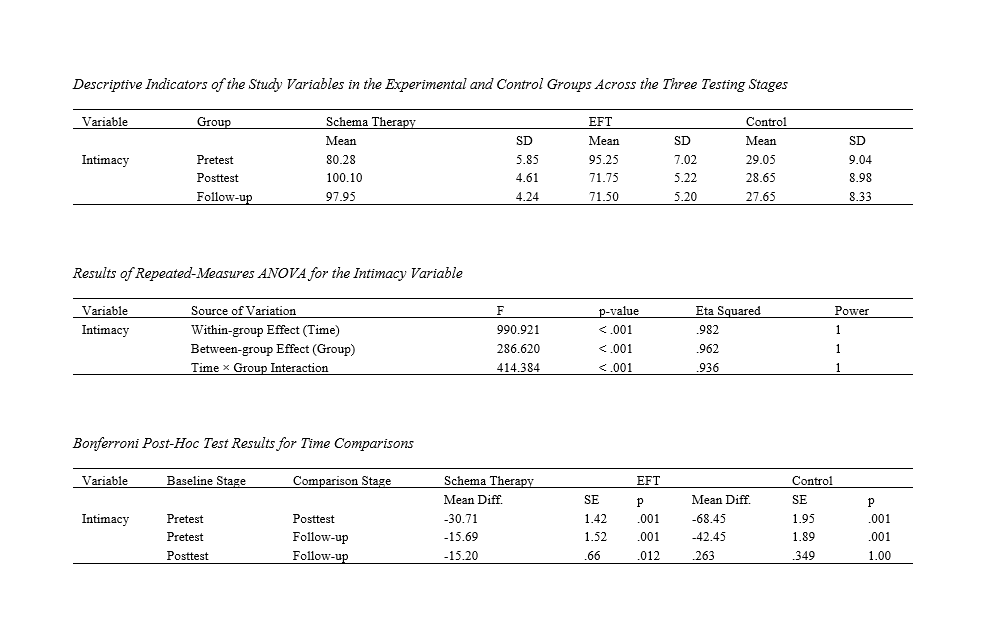
Intimacy is one of the fundamental pillars of stable relationships and is defined as emotional closeness, trust, the exchange of thoughts and feelings, and mutual understanding between spouses. Accordingly, the present study was conducted with the aim of comparing the effectiveness of schema therapy and emotion-focused therapy (EFT) in increasing marital intimacy among couples. The research employed a quasi-experimental design with pretest, posttest, and follow-up measurements using two experimental groups and one control group. The sample consisted of 60 eligible volunteer couples who had sought services at counseling centers in Hamedan and were purposively selected based on cutoff scores on the Marital Conflict Questionnaire. Participants were then assigned to three groups of 20 individuals. Two groups were randomly designated as the experimental groups (schema therapy and emotion-focused therapy), and the third group served as the control group. Two standardized instruments were used: the Sanaei Marital Conflict Questionnaire (1996) and the Thompson and Walker Marital Intimacy Scale (1983). Considering the statistical assumptions, the research findings were analyzed using repeated-measures ANOVA and the Bonferroni post-hoc test in SPSS version 26. The results indicated a significant difference between the schema-therapy and EFT experimental groups and the control group in marital intimacy (p < .05). Moreover, no significant difference was found between the schema-therapy and EFT groups in the posttest and follow-up phases based on the mean scores of the variable (p < .05). Both schema therapy and emotion-focused therapy are effective in enhancing marital intimacy. Therefore, training in schema therapy and EFT can be used to increase marital intimacy among couples.
Downloads
References
Arntz, A., Jacob, G. A., Lee, C. W., Brand-de Wilde, O. M., Fassbinder, E., Harper, R. P., & et al. (2022). Effectiveness of predominantly group schema therapy and combined individual and group schema therapy for borderline personality disorder: A randomized clinical trial. JAMA Psychiatry, 79(4), 287-299. https://doi.org/10.1001/jamapsychiatry.2022.0010
Bradbury, T. N., & Karney, B. R. (2014). Intimate relationships. W. W. Norton Company. https://www.amazon.com
Busby, D. M., Leavitt, C. E., Yorgason, J. B., Richardson, S., & Allsop, D. B. (2024). Health, depression, and marital processes as they relate to sexual satisfaction and harmonious sexual passion: A biopsychosocial model. Sex Relatsh Ther, 39(3), 742-760. https://doi.org/10.1080/14681994.2021.2019699
Hunter, T. R., Chiew, B. A., McDonald, S., & Adhikari, K. (2024). The prevalence of maternal depression and anxiety beyond 1 year postpartum: A systematic review. Matern Child Health J, 28(8), 1283-1307. https://doi.org/10.1007/s10995-024-03930-6
Kamali, Z., Fani, H., Molaei, E., & Amiri, S. (2025). The effectiveness of schema therapy with emphasis on imagery rescripting on marital intimacy in couples with marital conflicts. The 1st National Conference on Quality Living from the Perspective of Psychology, Counseling and Social Work, Khomeinishahr.
Koppers, D., Van, H. L., Peen, J., & Dekker, J. J. (2023). Exploring the effect of group schema therapy and comorbidity on the treatment course of personality disorders. Curr Opin Psychiatry, 36(1), 80-85. https://doi.org/10.1097/YCO.000000000000082
Kover, L., Szollosi, G. J., Frecska, E., Bugan, A., Berecz, R., & Egerhazi, A. (2025). The association between early maladaptive schemas and romantic relationship satisfaction. Front Psychol, 15, 1460723. https://doi.org/10.3389/fpsyg.2024.1460723
Mendes-Teixeira, A. I., & Duarte, C. (2021). Forgiveness and marital satisfaction: A systematic review. Psicologia: Ciência e Profissão. https://doi.org/10.1590/1982-3703003200730
Mohammadi, M., Shirafkan-Kopekan, A., Shafiabadi, A., & Farhangi, A. (2025). The effectiveness of schema therapy on attachment styles and marital intimacy in couples in Tehran. Women Fam Stud Q, 17(64), 173-195. https://srb.sanad.iau.ir/en/Article/954007
Najafi, S., & Khoyini, F. (2019). The effectiveness of acceptance and commitment group therapy on couples’ communication patterns. National Congress of New Findings in Humanities, Tehran.
Panabad, S., Jofreh, M. G., Asgari, P., & Moghaddam, K. K. (2022). Effectiveness of emotionally-focused couples therapy on marital violence, marital adjustment, and sexual intimacy of couples visiting counseling centers of Ahvaz. Adv Nurs Midwifery, 31(1). https://doi.org/10.22037/anm.v31i1.38541
Peeters, N., van Passel, B., & Krans, J. (2022). The effectiveness of schema therapy for patients with anxiety disorders, OCD, or PTSD: A systematic review and research agenda. Br J Clin Psychol, 61(3), 579-597. https://pmc.ncbi.nlm.nih.gov/articles/PMC954473
Sharma, P., Sharma, D., & Jilani, A. Q. (2024). Determinants and correlates of depression in psoriasis patients: Does marital adjustment play a role? Indian J Priv Psychiatry, 18(2), 76. https://doi.org/10.5005/jp-journals-10067-0159
Spengler, E. S., Johnson, S. M., & Wiebe, S. A. (2025). A comprehensive meta-analysis on the efficacy of emotionally focused couple therapy: Long-term effects on intimacy and empathy. Fam Process, 63(2), 489-508. https://doi.org/10.1111/famp.12987
Spiker, D. A., Berney, E. C., Hammer, J. H., & Jensen, K. C. (2020). Maintaining the relationship: Relational schemas and women’s intent to seek couple therapy. Couns Psychol, 48(6), 801-825. https://doi.org/10.1037/cou0000754
Tahmasebi, H., & Khoramabadi, Y. (2023). Prediction of marital satisfaction based on extraversion, marital empathy, and marital forgiveness in married women. J Soc Psychol Stud, 13(51), 61-74. http://frooyesh.ir/article-1-5035-fa.html
Timulak, L., Keogh, R., Dillon, P., & McNally, R. (2024). Transdiagnostic emotion-focused therapy for couples with comorbid relational and mood disorder symptoms. J Affect Disord, 355, 103-112. https://doi.org/10.1016/j.jad.2024.01.019
Uluyol, H., & Özen-Çıplak, A. (2024). Dyadic relationship of adult attachment patterns and interpersonal schemas in marital adjustment: Actor–partner effect model. J Couple Relatsh Ther, 23(1), 55-72. https://doi.org/10.1080/15332691.2024.2298773
Wen, X., Zhang, Q., Zhou, Y., Du, J., & Xu, W. (2022). Mindfulness and intimate relationship satisfaction in daily life: The role of empathy. PsyCh J, 11(4), 500-509. https://doi.org/10.1002/pchj.53
Zaman, N. I., Shakoor, S., & Yusuf, S. (2022). Menopausal symptoms: Prediction of quality of marital relationship among couples. J Mind Med Sci, 9(1), 133-142. https://doi.org/10.22543/7674.91.P133142
Downloads
Additional Files
Publication Timeline
- Submitted
- Revised
- Accepted