Comparison of the Effectiveness of Schema Therapy and Dialectical Behavior Therapy on Interpersonal Cognitive Distortions in Patients with Borderline Personality Disorder
DOI:
https://doi.org/10.61838/kman.hp.psynexus.4884Keywords:
Dialectical behavior therapy, schema therapy, interpersonal cognitive distortions, borderline personality disorderAbstract
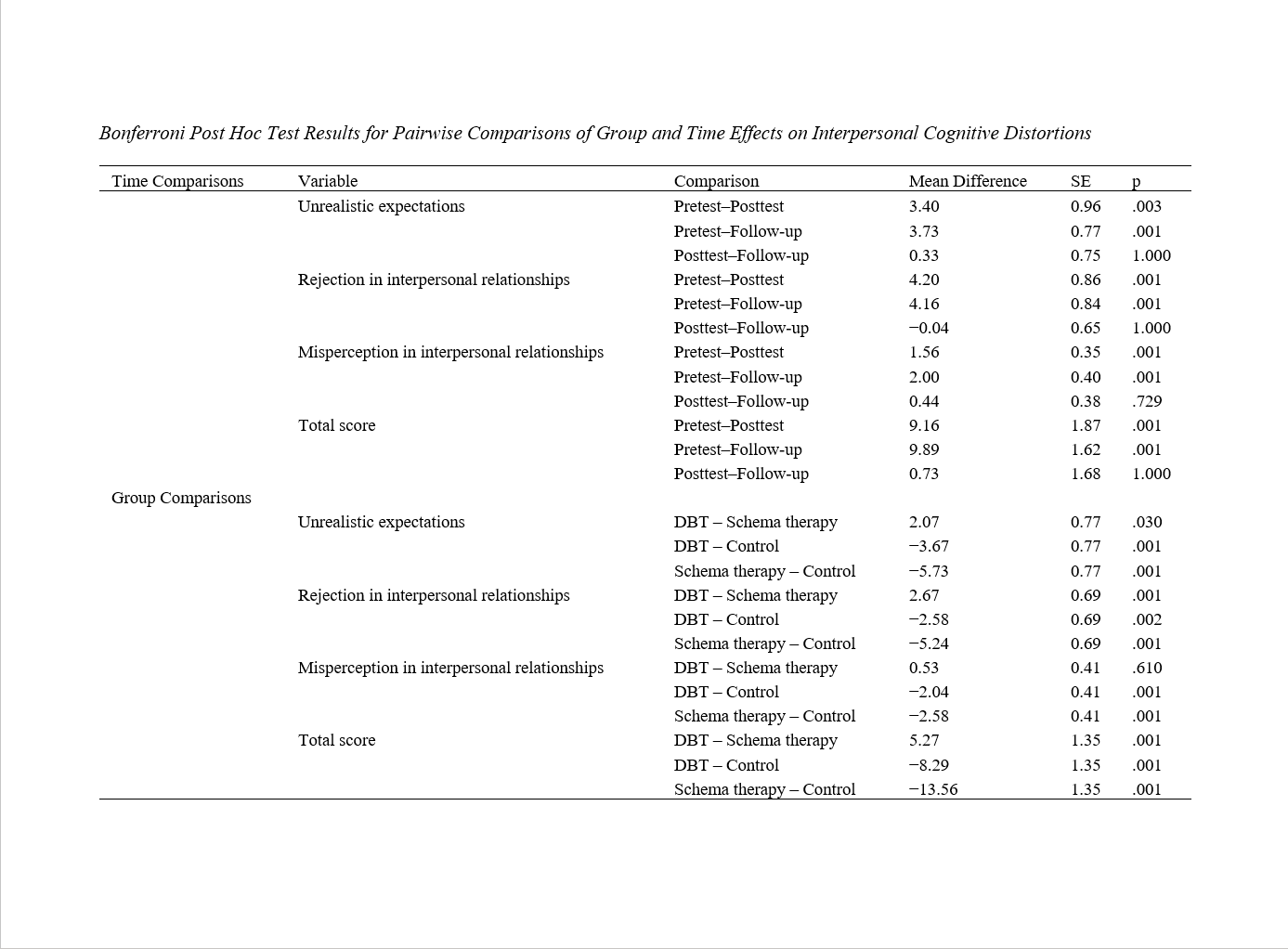
The present study aimed to compare the effectiveness of dialectical behavior therapy and schema therapy on interpersonal cognitive distortions in patients with borderline personality disorder. This study employed a quasi-experimental methodology with a pretest–posttest design and parallel groups. The statistical population comprised all patients diagnosed with borderline personality disorder who referred to clinics, psychiatric hospitals, and psychological and counseling centers in the city of Tehran during the years 2024 to 2025. The study sample consisted of 45 patients who were selected through purposive non-random sampling and were then randomly assigned to three groups of 15 participants each (two experimental groups and one control group). The first experimental group received group schema therapy in 16 sessions of 60 minutes, and the second experimental group received dialectical behavior therapy in 16 sessions of 60 minutes, while the control group did not receive any therapeutic intervention during the study period. The data collection instruments included the Structured Clinical Interview for Personality Disorders, the Borderline Personality Questionnaire, and the Interpersonal Cognitive Distortions Scale. The collected data were analyzed using repeated measures analysis of variance. The results indicated a significant difference between the effectiveness of the two therapeutic approaches in the components of unrealistic expectations (p = 0.030), rejection in interpersonal relationships (p = 0.001), and the total score of interpersonal cognitive distortions (p = 0.001), such that the reduction in these components and the total score of interpersonal cognitive distortions was significantly greater in the schema therapy group compared to the dialectical behavior therapy group. Accordingly, it can be concluded that schema therapy, compared to dialectical behavior therapy, is more effective in reducing interpersonal cognitive distortions in patients with borderline personality disorder and can be considered an efficient intervention for improving the cognitive and interpersonal patterns of these patients.
Downloads
References
Allah Rabi, M., Golayi, H., Barzegar, M., & Nazari, G. (2024). Exploring the Foundations and Principles of Borderline Personality Disorder: A Novel Approach to Child Education. Journal of Educational Innovations, 6(4), 126-139. https://journal.iocv.ir/article_209008.html
Arntz, A., Jacob, G. A., Lee, C. W., Brand-de Wilde, O. M., Fassbinder, E., Harper, R. P., & Farrell, J. M. (2022). Effectiveness of predominantly group schema therapy and combined individual and group schema therapy for borderline personality disorder: a randomized clinical trial. JAMA Psychiatry, 79(4), 287-299. https://doi.org/10.1001/jamapsychiatry.2022.0010
Askari Zadeh, G., Bagheri, M., & Arab Nejad Khanoqi, M. (2022). The Role of Interpersonal Cognitive Distortions, Self-Differentiation, and Interpersonal Problems in Predicting Borderline Personality Organization among Undergraduate Students. https://journals.iau.ir/article_699725.html
Boldanazar, K., Timouri, S., Rajai, A., & Najat, H. (2023). The Impact of Group Schema Therapy on Self-Control, Emotional Regulation, and Distress Tolerance in Open-Dependent Addicts. Journal of Rehabilitation Research in Nursing, 10(66), 79-90. https://journals.iau.ir/article_701286.html
Bozzatello, P., Blua, C., Brandellero, D., Baldassarri, L., Brasso, C., Rocca, P., & Bellino, S. (2024). Gender differences in borderline personality disorder: a narrative review. Frontiers in Psychiatry, 15, 1320546. https://doi.org/10.3389/fpsyt.2024.1320546
Clark, J. M. (2020). Self-Esteem as a Predictor for Thinking Errors in Prison Inmates The Chicago School of Professional Psychology]. https://search.proquest.com/openview/10c3ff47979d2b9c4391f9dfcd05ade6/1?pq-origsite=gscholar&cbl=44156
Cooper, M. L., Kuntsche, E., Levitt, A., Barber, L. L., & Wolf, S. (2016). Motivational models of substance use: A review of theory and research on motives for using alcohol, marijuana, and tobacco In - The Oxford handbook of substance use and substance use disorders. In (Vol. 1, pp. 375-421). https://doi.org/10.1093/oxfordhb/9780199381678.013.017
Damiano, S. R., Reece, J., Reid, S., Atkins, L., & Patton, G. (2015). Maladaptive schemas in adolescent females with anorexia nervosa and implications for treatment. Eating behaviors, 16, 64-71. https://doi.org/10.1016/j.eatbeh.2014.10.016
Darvish Nejad Sikaroudi, A., Asghari, F., Zarbakhsh Bahri, M., & Ghasemzadeh, A. (2024). Comparative Effectiveness of Emotion Management Strategies Based on Schema Therapy and Emotion-Focused Couple Therapy on Reconstructing Couples' Communication Patterns. Scientific-Research Bi-monthly Journal of Educational Strategies in Medical Sciences, 17(4), 419-432. https://www.sid.ir/paper/1590387/fa
Ellison, W. D. (2020). Psychotherapy for borderline personality disorder: Does the type of treatment make a difference? Current Treatment Options in Psychiatry, 7(3), 416-428. https://doi.org/10.1007/s40501-020-00224-w
Giesen-Bloo, J., van Dyck, R., Spinhoven, P., van Tilburg, W., & Dirksen, C. (2025). Outpatient psychotherapy for borderline personality disorder: Randomized trial of schema-focused therapy vs transference-focused psychotherapy. Archives of General Psychiatry, 63(6), 649-658. https://doi.org/10.1001/archpsyc.63.6.649
Hamamci, Z., & Büyüköztürk, Ş. (2004). The interpersonal cognitive distortions scale: Development and psychometric characteristics. Psychological Reports, 95(1), 291-303. https://doi.org/10.2466/pr0.95.1.291-303
Hepworth, N. S., & Simpson, S. G. (2025). "When Standard Treatments Are Not Enough"-Showcasing Schema Therapy for the Treatment of Anorexia Nervosa and Borderline Personality Disorder. Journal of Clinical Psychology. https://doi.org/10.1002/jclp.23801
Hernandez-Bustamante, M., Cjuno, J., Hernández, R. M., & Ponce-Meza, J. C. (2024). Efficacy of dialectical behavior therapy in the treatment of borderline personality disorder: A systematic review of randomized controlled trials. Iranian Journal of Psychiatry, 19(1), 119. https://doi.org/10.18502/ijps.v19i1.14347
Hozh, A., Mahmud Alilu, M., & Esmailpour, K. (2024). The Effectiveness of Emotion Regulation Techniques and Mindfulness-Based Dialectical Behavior Therapy in Reducing Substance Abuse and Self-Harm in Borderline Personality Disorder. Ibn Sina Journal, 22, 36. https://ebnesina.ajaums.ac.ir/article-1-1350-fa.html
Kiosses, D. N., Szanto, K., & Alexopoulos, G. S. (2014). Suicide in older adults: the role of emotions and cognition. Current psychiatry reports, 16(11), 495. https://doi.org/10.1007/s11920-014-0495-3
Leichsenring, F. (1999). Development and first results of the Borderline Personality Inventory: A self-report instrument for assessing borderline personality organization. Journal of Personality Assessment, 73(1), 45-63. https://doi.org/10.1207/S15327752JPA730104
Leucci, A. C., De Giorgi, I., Pelizza, L., Bortolotti, B., D'Adda, F., Gammino, L., & Menchetti, M. (2024). Borderline personality disorder and aggressive behavior: A study based on the DSM-5 alternative model. Journal of psychiatric research, 173, 367-371. https://doi.org/10.1016/j.jpsychires.2024.03.020
Mahmud Alilu, M., Esmailpour, K., & Hozh, A. (2023). The Effectiveness of Emotion Regulation Techniques and Behavioral Dialectical Therapy-Based Meta-Awareness in Improving Negative Emotions (Depression, Anxiety, Anger) in Borderline Personality Disorder. http://ebnesina.ajaums.ac.ir/browse.php?a_code=A-10-6821-1&sid=1&slc_lang=en
Mohammadzadeh, A., & Rezaei, A. (2011). Validation of the Borderline Personality Questionnaire in the Iranian Population. Journal of Behavioral Sciences, 5(3), 269-278. https://www.noormags.ir/view/fa/articlepage/916824
Sadeghian-Lemraski, S., Akbari, H., & Mirani, A. (2024). The Effectiveness of Dialectical Behavior Therapy on Self-Compassion and Integrative Self-Knowledge in People with Borderline Personality Disorder : The effectiveness of DBT in people with BPD. International Journal of Body, Mind and Culture, 11(5), 660-668. https://doi.org/10.22122/ijbmc.v11i5.660
Sadri Damirchi, I., Honarmand Quje Baglu, P., & Amir, S. M. B. (2020). Suicidal Thoughts in Unmarried Elderly: The Role of Interpersonal Cognitive Distortions, Positive and Negative Affect, Perceived Social Support, and Meaning in Life. Journal of Psychology and Aging, 5(4), 347-359. https://www.sid.ir/paper/519836/fa
Sahour, A., Mirzaeian, B., & Heydari, S. (2024). Comparative Effect of 'Schema Therapy' and 'Mindfulness-Based Cognitive Therapy' on Rumination and Worry in Infertile Women. Journal of Health Promotion Management, 13(4), 40-54. https://doi.org/10.47176/rjms.30.153
Sayyadi, M. (2019). Dialectical Behavior Therapy and Borderline Personality Disorder: A Review Study. Journal of Psychology Development, 8(11), 126-119. https://frooyesh.ir/article-1-1251-fa.html
Taj Iliayifar, S. G., Alipanah, S., Majidpour, Z., Ghanbarnezhad, M., Aghayee, N., & Pourmohammad ghouchani, K. (2025). The Effectiveness of Schema Therapy on Frustration Tolerance and Internalized Shame in Individuals with Borderline Personality Disorder. Quarterly of Experimental and Cognitive Psychology, 1(4), 103-116. https://doi.org/10.61838/qecp.111
Widiger, T. A., Hines, A., & Crego, C. (2024). Evidence-based assessment of personality disorder. Assessment, 31(1), 191-198. https://doi.org/10.1177/10731911231176461
Young, J. E., Klosko, J. S., & Weishaar, M. E. (2006). Schema therapy: A practitioner's guide. Guilford Press. https://books.google.com/books?hl=fa&lr=&id=pS5uAAAAQBAJ&oi=fnd&pg=PP1&dq=Schema+therapy:+A+practitioner%27s+guide&ots=C_Hfc_9XY-&sig=dURg9oSt6eOZ38W9vy86CfSkQ8M
Young, R. C., Biggs, J. T., Ziegler, V. E., & Meyer, D. A. (2000). Young mania rating scale. Journal of affective disorders. https://psycnet.apa.org/doiLanding?doi=10.1037/t20936-000
Downloads
Additional Files
Publication Timeline
- Submitted
- Revised
- Accepted