The Relationship Between Social Comparison Processes and Well-Being in Digital Environments
DOI:
https://doi.org/10.61838/kman.ooc.psynexus.4893Keywords:
Social comparison; digital environments; well-being; social media; psychological healthAbstract
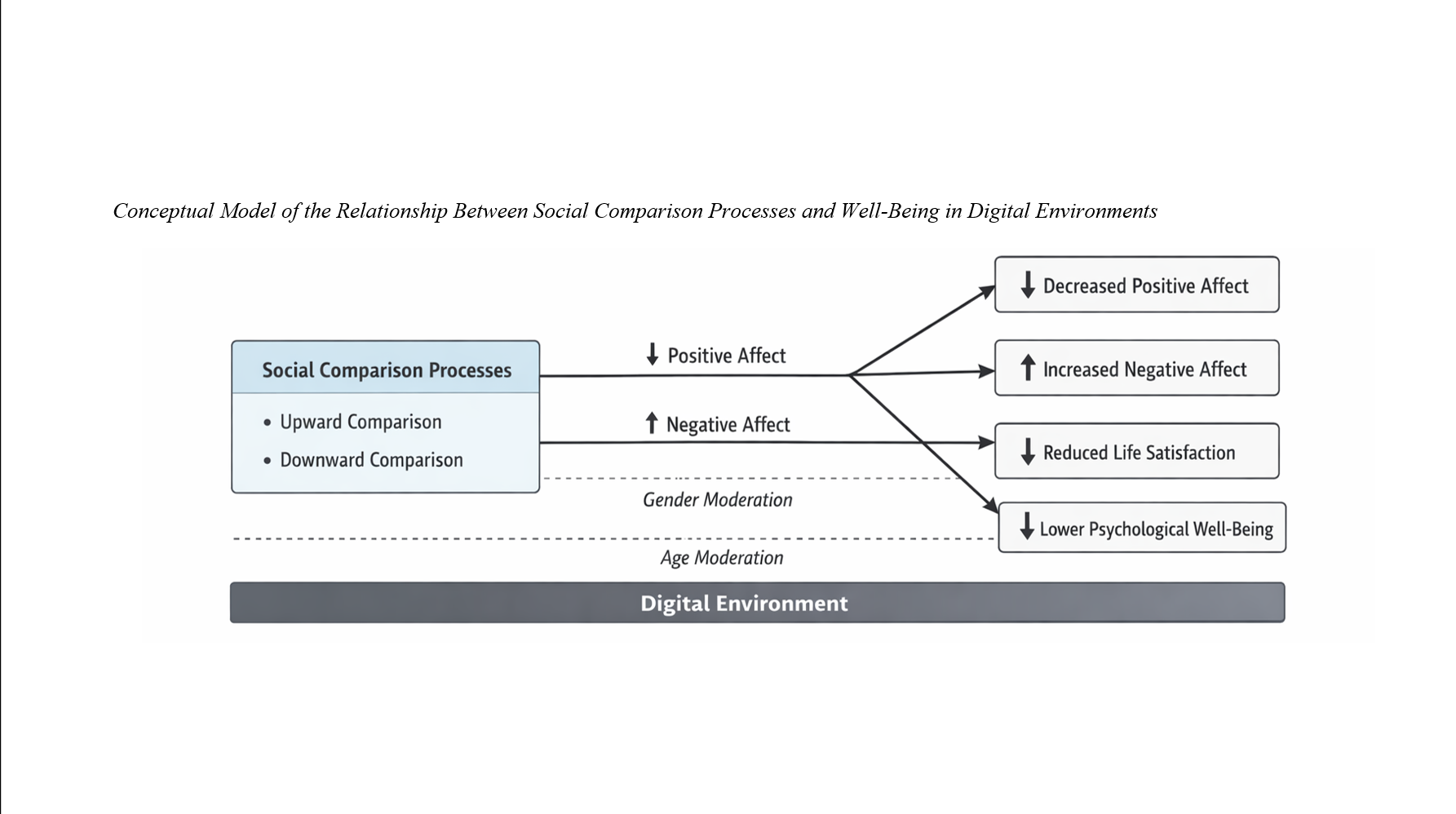
The objective of this study was to examine the relationship between social comparison processes and multiple dimensions of well-being within digital environments among adults. This study employed a cross-sectional correlational design and was conducted among adult residents of Tehran who reported regular engagement with digital environments, particularly social media platforms. Participants were recruited through online and offline convenience sampling methods and completed a set of standardized self-report questionnaires administered electronically. The instruments assessed social comparison orientation in digital contexts, positive affect, negative affect, life satisfaction, and psychological well-being, along with demographic variables and indicators of digital engagement intensity. Data were screened for statistical assumptions, and analyses were performed using descriptive statistics, Pearson correlation coefficients, multiple regression analyses, group comparisons, and moderation analysis to examine gender differences in the observed relationships. Inferential analyses revealed significant negative associations between social comparison orientation and positive affect, life satisfaction, and psychological well-being, alongside a significant positive association with negative affect. Multiple regression analyses demonstrated that social comparison orientation significantly predicted all well-being outcomes even after controlling for demographic variables and intensity of digital use. Group comparison analyses indicated that individuals with high levels of social comparison reported significantly lower well-being and higher negative affect compared to those with low comparison orientation. Moderation analysis further showed that gender significantly moderated these relationships, with stronger negative effects of social comparison on well-being observed among female participants. The findings indicate that social comparison processes play a central role in shaping emotional and psychological well-being in digital environments, highlighting social comparison orientation as a key risk factor for reduced well-being. These results underscore the importance of addressing maladaptive comparison tendencies in efforts to promote healthier digital engagement and psychological well-being.
Downloads
References
Adefisayo, A. J. (2024). Perceived Influence Of Gender, Increased Responsibility, Fear Of Failure And Social Comparison As Predictor For After-School Achievement Anxiety Among Fuoye Undergraduates.
Apare, J. (2024). Substance Use, Peer Social Comparison, Academic Stress and Psychological Well-Being of Students in Tertiary Institution in Delta South Senatorial District. Asian Research Journal of Arts & Social Sciences, 22(3), 1-17. https://doi.org/10.9734/arjass/2024/v22i3518
Apopei, D., Coe, J., & Cordoba, S. (2024). Examining the Role of Family, Media, Peers in Young Caucasian Men’s Understandings of Body Dissatisfaction: A Thematic Analysis Using the Tripartite Influential Model and Social Comparison Theory. Gender Issues, 41(4). https://doi.org/10.1007/s12147-024-09339-3
Azizi, S., Gharashi, S., & Eivazi Nejad, S. (2023). Evaluating the Effects of Regret Sources, Social Comparison, and Regret on Customer Reactions. Consumer Behavior Studies, 10(1), 128-146. https://cbs.uok.ac.ir/article_62556.html
Cao, Y., Wang, J., Huang, Z., Qin, Y., Gao, S., Zhang, H., Yuan, M., & Tang, X. (2025). The Relationship Between Social Anxiety and Depression Among Rural High School Adolescents: The Mediating Role of Social Comparison and Social Support. Healthcare, 13(5), 533. https://doi.org/10.3390/healthcare13050533
ÇİFÇİ, S., & Kumcağız, H. (2023). The Relation Between Fear of Missing Out and Subjective Well-Being: The Mediating Role of Social Comparison and Loneliness. E-International Journal of Educational Research. https://doi.org/10.19160/e-ijer.1187412
Galhardo, A., Gregori, P. E. M., Ferreira, C., & Cunha, M. (2024). The Relationship Between Body Image Dissatisfaction, Psychopathological Symptoms, Social Comparisons With Peers and Celebrities, and Self-Compassion in Men. Psychological Reports. https://doi.org/10.1177/00332941241270652
Intan, D. S., & Dhani, D. R. (2025). Hubungan Antara Adiksi Media Sosial Dan Social Comparison Terhadap Kecenderungan Body Dissatisfaction Mahasiswi Pengguna Tiktok. As-Syar I Jurnal Bimbingan & Konseling Keluarga, 7(1), 322-329. https://doi.org/10.47467/as.v7i1.6741
Jin, T., Chen, Y., & Zhang, K. (2024). Effects of Social Media Use on Employment Anxiety Among Chinese Youth: The Roles of Upward Social Comparison, Online Social Support and Self-Esteem. Frontiers in psychology, 15. https://doi.org/10.3389/fpsyg.2024.1398801
Kang, M., & Jo, H. (2024). The Influence of Social Comparison Tendency on SNS Addiction Tendency: The Mediating Effect of Internalized Shame Moderated by Self-Compassion. Korean Association for Learner-Centered Curriculum and Instruction, 24(22), 1-16. https://doi.org/10.22251/jlcci.2024.24.22.1
Kato, S., & Virlia, S. (2024). Self Esteem Remaja Pengguna Instagram Ditinjau Dari Body Image Dan Social Comparison Sebagai Moderator. Jurnal Psikologi, 17(1), 174-188. https://doi.org/10.35760/psi.2024.v17i1.10828
Kim, D.-G., & Kim, S. (2023). Social Media Affordances of Ephemerality and Permanence: Social Comparison, Self-Esteem, and Body Image Concerns. Social Sciences, 12(2), 87. https://doi.org/10.3390/socsci12020087
Li, P., Jiang, J. J., Han, M., Fu, S., Bai, X., & Wang, X. (2024). The Relationship Between Psychological Resilience and Learning Engagement of College Students: Moderated Mediation Effects of Upward Social Comparison and Shame. https://doi.org/10.21203/rs.3.rs-5040948/v1
Park, J., & Yun, S.-J. (2024). Social Comparison of Home Appliance Ownership and Use and Heterogeneous Impact on Electricity Consumption: A Case of Apartment Households in Korea. Energy Efficiency, 17(5). https://doi.org/10.1007/s12053-024-10219-8
Pigart, C. J., MacKinnon, D. P., & Cooper, K. M. (2024). Academic social comparison: a promising new target to reduce fear of negative evaluation in large-enrollment college science courses. International Journal of Stem Education, 11(1), 42. https://doi.org/10.1186/s40594-024-00501-7
Pourhosein, R., Gholamali Lavasani, M., & Pirmohammadi, F. (2023). The mediating role of social comparison in relation to early maladaptive schemas with attitudes related to body image of female students with obesity. frooyesh, 12(8), 1-12. http://frooyesh.ir/article-1-4188-en.html
Ruan, Q. N., Shen, G. H., Yang, J. S., & Yan, W. J. (2023). The interplay of self-acceptance, social comparison and attributional style in adolescent mental health: cross-sectional study. BJPsych Open, 9(6), e202. https://doi.org/10.1192/bjo.2023.594
Safdar Bajwa, R., Abdullah, H., Zaremohzzabieh, Z., Wan Jaafar, W. M., & Abu Samah, A. (2023). Smartphone addiction and phubbing behavior among university students: A moderated mediation model by fear of missing out, social comparison, and loneliness. Frontiers in psychology, 13, 1072551. https://doi.org/10.3389/fpsyg.2022.1072551
Sayyed Muhammad Mehdi Raza, N., Khan, F. R., Shoaib, R., Muntaha, & Shehzad, M. (2025). The Psychology of Social Comparison on Instagram: Exploring Its Impact on Body Dissatisfaction, Self-Esteem, and Mental Health in Adolescents. RJS, 3(3), 691-709. https://doi.org/10.59075/rjs.v3i3.234
Sheffler, P., & Cheung, C. (2023). Growth Mindset and Social Comparison Effects in a Peer Virtual Learning Environment. Social Psychology of Education, 27(2), 493-521. https://doi.org/10.1007/s11218-023-09850-7
Steinberger, P., & Kim, H. (2023). Social comparison of ability and fear of missing out mediate the relationship between subjective well-being and social network site addiction. Frontiers in psychology, 14, 1157489. https://doi.org/10.3389/fpsyg.2023.1157489
Sun, S., Chen, S., Wang, Z., Xiong, Y., & Xie, S. (2023). Social Networking Site Use and Emotional Eating Behaviors Among Chinese Adolescents: The Effects of Negative Social Comparisons and Perspective-Taking. Behavioral Sciences, 13(9), 768. https://doi.org/10.3390/bs13090768
Syed, U. E., Safdar, G., & Khan, A. (2023). Relationship Between Social Anxiety, Social Comparison and Competitive Behavior Among Social Media Users. Om&s, 4(2), 101-108. https://doi.org/10.71016/oms/2w56b079
Tedjawidjaja, D., & Christanti, D. (2022). Effect of Social Comparison in Social Media on Psychological Distress in Adolescents: Role of Emotion Regulation as Moderator. Journal of Educational Health and Community Psychology, 11(4), 836. https://doi.org/10.12928/jehcp.v11i4.25056
Wu, Y., Mulkens, S., & Alleva, J. M. (2022). Body image and acceptance of cosmetic surgery in China and the Netherlands: A qualitative study on cultural differences and similarities. Body Image, 40, 30-49. https://doi.org/10.1016/j.bodyim.2021.10.007
Yaqoob, A., Hafeez, R., Khan, R. N., & Khan, M. A. (2025). Navigating the Digital Self: Social Media Addiction and Its Effect on Social Comparison and Internalizing Symptoms. SocSciSpec, 4(3), 197-215. https://doi.org/10.71085/sss.04.03.329
Yu, Y., & Sun, H. (2024). Shyness and Self-Consistency and Congruence Among Chinese Adolescents: Mediating Role of Social Comparison Orientation and Moderating Role of Self-Focused Attention. Frontiers in psychology, 15. https://doi.org/10.3389/fpsyg.2024.1418123
Downloads
Additional Files
Publication Timeline
- Submitted
- Revised
- Accepted