Comparing the Effectiveness of Mindfulness-Based Cognitive Behavioral Group Therapy and Psychodrama on Distress Tolerance and Anxiety Sensitivity in Bereaved Survivors of Deceased COVID-19 Patients
DOI:
https://doi.org/10.61838/kman.cp.psynexus.4941Keywords:
COVID-19 Bereavement, Distress Tolerance, Anxiety Sensitivity, Mindfulness-Based Cognitive Behavioral Therapy, PsychodramaAbstract
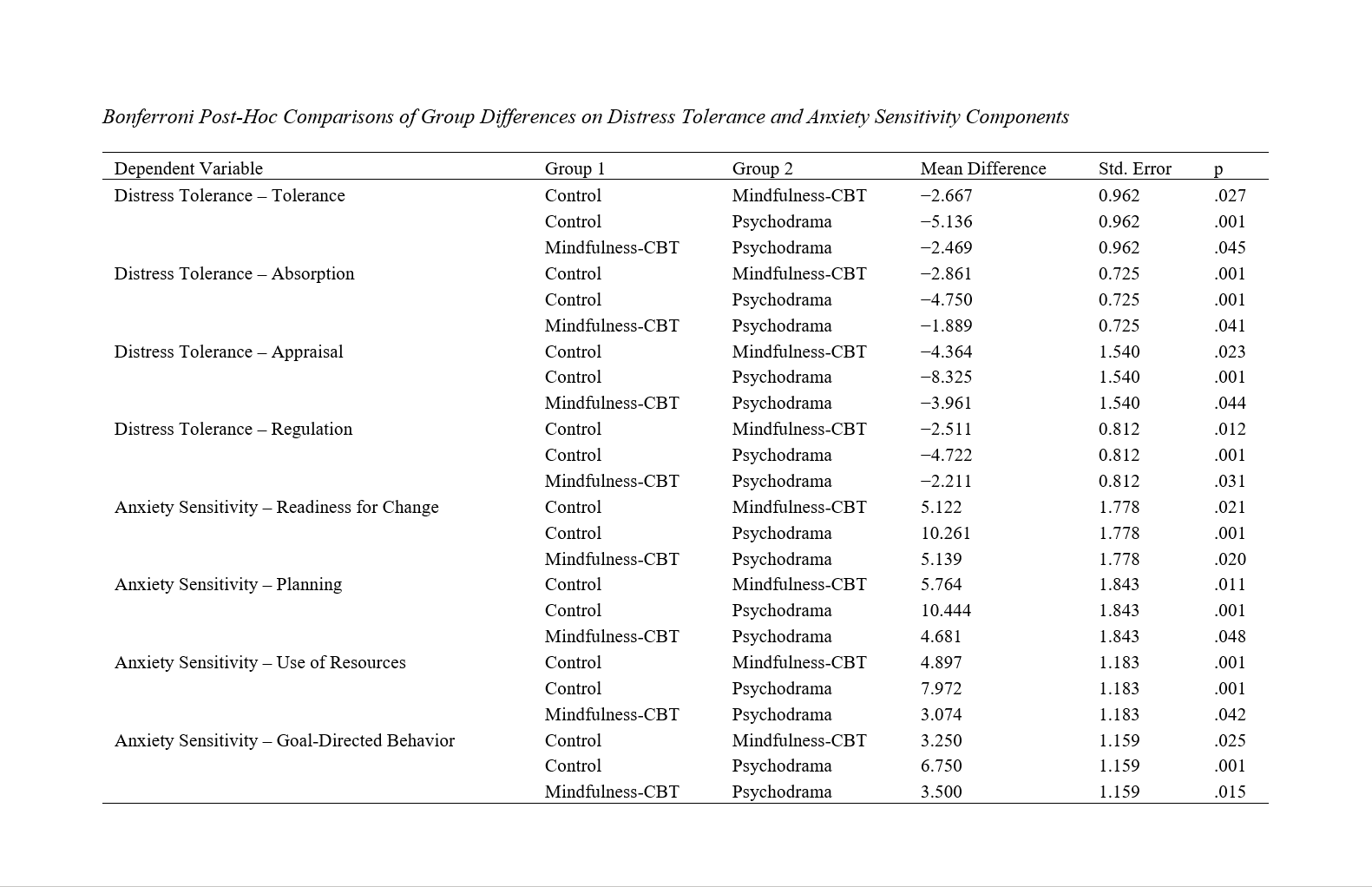
The objective of this study was to compare the effectiveness of mindfulness-based cognitive behavioral group therapy and psychodrama on distress tolerance and anxiety sensitivity among bereaved survivors of patients who died due to COVID-19. This applied, quasi-experimental study employed a pretest–posttest control group design with a two-month follow-up. The population consisted of bereaved survivors of deceased COVID-19 patients in Shiraz, Iran. Thirty-six eligible participants were selected through purposive sampling and randomly assigned to a mindfulness-based cognitive behavioral therapy group, a psychodrama therapy group, or a control group (12 participants per group). The interventions were delivered in group format over eight and ten 90-minute sessions respectively. Data were collected at pretest, posttest, and follow-up using the Distress Tolerance Scale and the Anxiety Sensitivity Index-Revised. Statistical analysis was conducted using repeated-measures ANOVA and Bonferroni post-hoc tests in SPSS-22. Repeated-measures ANOVA revealed significant main effects of time and significant interaction effects between time and group for all components of distress tolerance and anxiety sensitivity (p < .001). Between-group comparisons indicated significant differences across all outcome variables (p < .001). Bonferroni post-hoc analyses demonstrated that both intervention groups significantly outperformed the control group, while the psychodrama group showed significantly greater improvement than the mindfulness-based cognitive behavioral therapy group on all components (p < .05). Treatment gains were maintained at follow-up. Both mindfulness-based cognitive behavioral therapy and psychodrama effectively enhanced distress tolerance and reduced anxiety sensitivity in bereaved COVID-19 survivors, with psychodrama producing superior and more durable outcomes.
Downloads
References
Akbari, R., & Khalatbari, A. (2025). The Mediating Role of Perceived Social Support and Mindfulness in the Relationship between Psychological Hardiness and Distress Tolerance Among Students. Journal of Adolescent and Youth Psychological Studies, 6(2), 79-89. https://doi.org/10.61838/kman.jayps.6.2.10
Dayton, T. (2015). Neuropsychodrama in the Treatment of Relational Trauma: A Model Using Experiential Group Processes for Healing PTSD. Health Communications, Inc. https://www.amazon.com/Neuropsychodrama-Treatment-Relational-Trauma-Dayton/dp/0757318789
Dejestan, N., & Fahimi, H. (2022). The effectiveness of the psychodrama method on emotion regulation, distress tolerance, social isolation, and self-efficacy in women addicted to opioids. The 5th International Conference on Law, Psychology, Educational and Behavioral Sciences, Tehran,
Dizaj Khalili, M., Makvand Hosseini, S., & Sabahi, P. (2023). Effects of Mindfulness-Based Cognitive Therapy on Anxiety Sensitivity in Patients with Multiple Sclerosis [Research Article]. Jundishapur J Chronic Dis Care, 12(1), e132672. https://doi.org/10.5812/jjcdc-132672
Elhai, J. D., Levine, J. C., O’Brien, K. D., & Armour, C. (2018). Distress tolerance and mindfulness mediate relations between depression and anxiety sensitivity with problematic smartphone use. Computers in human Behavior, 84, 477-484. https://doi.org/10.1016/j.chb.2018.03.026
Esnaasharan, S., Yazdkhasti, F., & Oreyzi, H. (2018). Comparison of the Effectiveness of Psychodrama and Dialectical Behavioral Therapy in Emotion Regulation and Distress Tolerance among the Women under Abstinence. Research on Addiction, 12(45), 247-264. https://www.magiran.com/paper/1857718
Fortuna, L. R., Martinez, W., & Porche, M. V. (2023). Integrating spirituality and religious beliefs in a mindfulness based cognitive behavioral therapy for PTSD with Latinx unaccompanied immigrant children. Journal of Child & Adolescent Trauma, 16(3), 481-494. https://doi.org/10.1007/s40653-023-00541-1
Giacomucci, S., & Marquit, J. (2020). The Effectiveness of Trauma-Focused Psychodrama in the Treatment of PTSD in Inpatient Substance Abuse Treatment [Original Research]. Frontiers in psychology, 11. https://doi.org/10.3389/fpsyg.2020.00896
Giacomucci, S., Marquit, J., & Miller Walsh, K. (2022). A controlled pilot study on the effects of a therapeutic spiral model trauma-focused psychodrama workshop on post-traumatic stress, spontaneity and post-traumatic growth. Zeitschrift für Psychodrama und Soziometrie, 21(1), 171-188. https://doi.org/10.1007/s11620-022-00665-w
Giacomucci, S., Marquit, J., Walsh, K. M., & Saccarelli, R. (2022). A mixed-methods study on psychodrama treatment for PTSD and depression in inpatient substance use treatment: A comparison of outcomes pre-pandemic and during Covid-19. The Arts in Psychotherapy, 81, 101971. https://doi.org/10.1016/j.aip.2022.101971
Karimi, M., Belyad, M., Peymani, J., Havasi Somar, N., & Zhian Bagheri, M. (2023). Comparing the Effectiveness of Intensive Short-Term Dynamic Psychotherapy with Mindfulness-Based Cognitive Therapy on Anxiety Sensitivity and its Components in Women with Chronic Pain. Community Health, 17(3), 1-13. https://chj.rums.ac.ir/article_187141.html?lang=en
Norouzi, H., Hatami, N., & Sadri, D. (2024). The effectiveness of group psychodrama therapy and cognitive-behavioral play therapy on executive functions (working memory, response inhibition, cognitive flexibility, and emotional self-regulation) in male students with social anxiety disorder. Neuropsychology, 9(35), 1-17. https://www.pachjournal.com
Sadeghi, K., Goodarzi, G., & Foroughi, A. (2023). Recovering from Post-Traumatic Stress Disorder symptoms: A study on the combination of art and mindfulness. Shenakht, 9(6), 131-145. https://doi.org/10.32598/shenakht.9.6.131
Saifulah, D., Rellyta, N., & Saputro, H. (2024). Effectiveness of Psychodrama Model Group Activity Therapy on Anxiety Levels in The Elderly. Open Access Health Scientific Journal, 5(2), 29-37. https://doi.org/10.55700/oahsj.v5i2.54
Sasono, S. A., Khan, R. I., & Milasanty, D. A. (2025). Implementation of psychodrama-based group counseling to overcome communication anxiety in high school students. Asa Journal of Educational Research and Learning, 2(1), 33-42. https://doi.org/10.63709/ajppp.v2i1.4
Timajchi, M., Aghahheris, M., Rafiepoor, A., & Nikoozadeh, E. K. (2025). The Effectiveness of Mindfulness-Based Stress Reduction Training on Psychological Distress Tolerance, Sexual Function, and Psychosocial Distress in Diabetic Patients. Ijbmc, 12(2), 104-112. https://doi.org/10.61838/ijbmc.v12i2.779
Yeşil Örnek, B., & Kırlangıç Şimşek, B. (2023). The effects of group psychodrama on the ruminative thinking style, dysfunctional attitudes, anxiety and depressive symptoms: a quasi-experimental study. Archives of Psychiatry and Psychotherapy, 25(3), 84-93. https://doi.org/10.12740/APP/166563
Zamani, S., & Zolfaghari, M. (2022). The Relationship Between Mindfulness and Tolerance of Ambiguity with Death Anxiety and Improving Sleep Quality in the Elderly. Aging Psychology, 8(3), 299-310. https://doi.org/10.22126/jap.2023.8258.1649
Zareei, M. B., Bahrainian, S. A. M., Ahi, Q., & Mansouri, A. (2024). Comparison of the effectiveness of cognitive therapy based on mindfulness and schema therapy on emotion regulation and distress intolerance of women with obsessive-compulsive symptoms. Journal of Research in Psychological Health, 17(4), 82-105. https://rph.khu.ac.ir/article-1-4421-en.html
Zayman, E., & Simsek, B. (2023). The Effect of Psychodrama on Anxiety Levels and Stress Coping Styles in Academicians. Medicine Science | International Medical Journal, 12(1), 253. https://doi.org/10.5455/medscience.2022.12.261
Zhong, Z. M., Jiang, H., Wang, H., & Liu, Y. (2025). The Association Between Mindfulness and Athletes' Distress Tolerance: The Mediating Roles of Cognitive Reappraisal and Mental Toughness. Behavioral Sciences, 15(3), 298. https://doi.org/10.3390/bs15030298
Downloads
Additional Files
Publication Timeline
- Submitted
- Revised
- Accepted