Comparison of the Effectiveness of Progressive Muscle Relaxation Training and Mindfulness-Based Stress Reduction Training on the Modification of Tinnitus Symptoms and Anxiety Sensitivity in Individuals with Tinnitus
DOI:
https://doi.org/10.61838/kman.hp.psynexus.4969Keywords:
Progressive muscle relaxation, mindfulness-based stress reduction, tinnitus, anxiety sensitivityAbstract
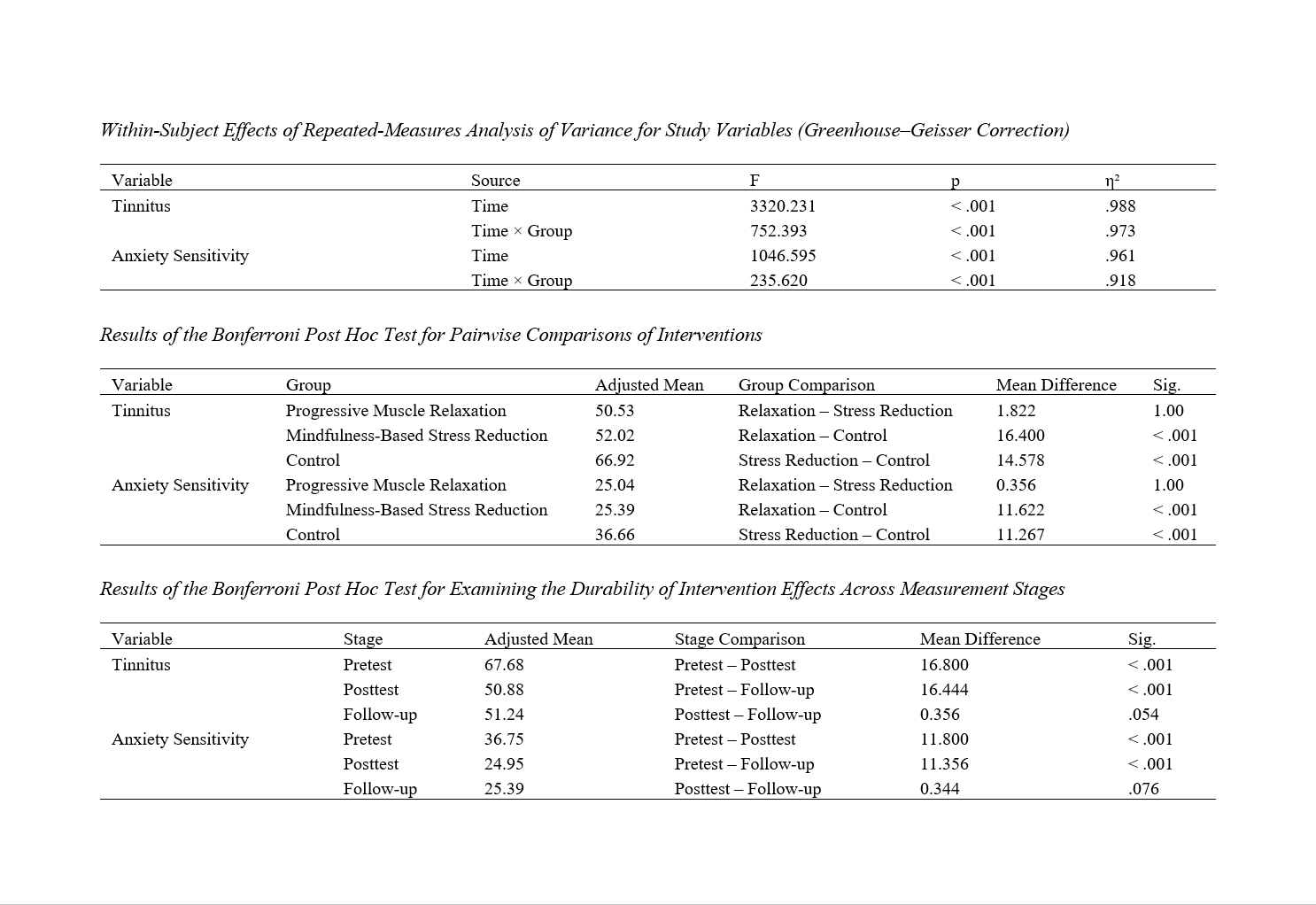
Tinnitus disorder, with its chronic and multidimensional nature, is not merely an auditory challenge but a biopsychosocial phenomenon that adversely affects patients’ quality of life. Given that anxiety sensitivity plays a significant role in the exacerbation and persistence of this disorder, the present study aimed to compare the effectiveness of two psychological interventions—progressive muscle relaxation (PMR) training and mindfulness-based stress reduction (MBSR) training—on tinnitus symptoms and anxiety sensitivity in individuals with tinnitus. The present study employed a quasi-experimental design with pretest, posttest, and three-month follow-up, including a control group. The statistical population consisted of 45 individuals who referred to Amir A’lam Hospital in Tehran in 2025, selected through purposive sampling and randomly assigned to three groups (two experimental groups and one control group). The research instruments included the Tinnitus Handicap Inventory (THI) and the Anxiety Sensitivity Index–Revised (ASI-3). Data were analyzed using repeated-measures analysis of variance and Bonferroni post hoc tests. The results indicated that both PMR and MBSR interventions led to significant reductions in tinnitus and anxiety sensitivity scores at the posttest and follow-up stages, whereas no significant change was observed in the control group. The difference in effectiveness between the two experimental interventions was not statistically significant, suggesting comparable efficacy of both approaches. The findings underscore the importance of non-pharmacological mind–body interventions in the management of tinnitus and demonstrate that both relaxation training and mindfulness training can be incorporated as cost-effective and efficient treatments within comprehensive tinnitus rehabilitation programs.
Downloads
References
Aini, H. N., Hakim, J. S., & Revita, N. C. T. (2023). Efektivitas Progressive Muscle Relaxation Dan Mindfulness Sebagai Manajemen Nyeri Kepala. Journal of Telenursing (Joting), 5(2), 1686-1694. https://doi.org/10.31539/joting.v5i2.5633
Apriany, A. (2024). Role of progressive muscle relaxation and cognitive behavioral therapy to control insomnia among elderly. International journal of health sciences, 2(1), 443-453. https://doi.org/10.59585/ijhs.v2i1.333
Awad, E., Naeem, M., Zakaria, M., Kadry, A., Kentiba, E., & Mohamed, E. (2025). Effects of relaxation exercise combined with electroacupuncture on pelvic floor muscle rehabilitation in primary vaginismus: A randomized controlled trial. Health, Sport, Rehabilitation. https://hsr-journal.com/index.php/journal/article/view/1297
Boecking, B., Stoettner, E. M., Brueggemann, P. G., & Mazurek, B. (2024). Emotional Self-States and Coping Responses in Patients with Chronic Tinnitus: A Schema Mode Model Approach. Frontiers in Psychiatry, 15, 1257299. https://doi.org/10.3389/fpsyt.2024.1257299
Carmody, N., Eikelboom, R. H., & Tegg-Quinn, S. (2023). Seeking Help for Tinnitus and Satisfaction With Healthcare Providers Including Diagnosis, Clinical Services, and Treatment: A Scoping Review. Evaluation & the Health Professions, 46(2), 170-193. https://doi.org/10.1177/01632787231158402
Engelke, M., Simões, J., Vogel, C., Schoisswohl, S., Schecklmann, M., Wölflick, S., Pryss, R., Probst, T., Langguth, B., & Schlee, W. (2023). Pilot Study of a Smartphone-Based Tinnitus Therapy Using Structured Counseling and Sound Therapy: A Multiple-Baseline Design With Ecological Momentary Assessment. PLOS Digital Health, 2(1), e0000183. https://doi.org/10.1371/journal.pdig.0000183
Esmaeilian, M., Mohammadi, S., & Hasani, J. (2021). The Structural Equations Model of Mindfulness Skills, Emotion Regulation, and Anxiety Sensitivity with Adolescents' Social Anxiety. Knowledge and research in applied psychology, 22(83), 121-134. https://sanad.iau.ir/en/Article/895090
Gasparre, D., Pepe, I., Laera, D., Abbatantuono, C., De, M. F., Taurino, A., D’Erasmo, D., Fanizzi, P., Antonucci, L. A., Pantaleo, A., Cavallaro, G., Pontillo, V., Taurisano, P., & Quaranta, N. (2023). Cognitive Functioning and Psychosomatic Syndromes in a Subjective Tinnitus Sample. Frontiers in psychology, 14. https://doi.org/10.3389/fpsyg.2023.1256291
Ghafari, S., Ahmadi, F., Nabavi, M., Anoshirvan, K., Memarian, R., & Rafatbakhsh, M. (2009). Effectiveness of applying progressive muscle relaxation technique on quality of life of patients with multiple sclerosis. J Clin Nurs, 18(15), 2171-2179. https://doi.org/10.1111/j.1365-2702.2009.02787.x
Hajishabani, R., Abdi, Reza. (2020). The role of experiential avoidance, mindfulness and anxiety sensitivity as transdiagnostic factors in prediction of emotional disorder. Clinical Psychology and Personality, 17(1), 203-212. https://doi.org/10.22070/cpap.2020.2897
Hidayati, L., Keliat, B. A., & Wardani, I. Y. (2019). Combination of Thought Stopping Therapy and Progressive Muscle Relaxation to Reduce Anxiety. https://doi.org/10.2991/icosihsn-19.2019.45
Jha, P. C., Deaver, U. J., & Sarin, J. (2020). Effects of Dance and Movement Therapy (DMT) Versus Progressive Muscle Relaxation(PMR) on Depression Among Elderly Residing in Selected Old Age Homes of Haryana: A Quasi Experimental Study. Indian Journal of Forensic Medicine & Toxicology. https://doi.org/10.37506/ijfmt.v14i4.12310
Karimi, M., Belyad, M., Peymani, J., Havasi Somar, N., & Zhian Bagheri, M. (2023). Comparing the Effectiveness of Intensive Short-Term Dynamic Psychotherapy with Mindfulness-Based Cognitive Therapy on Anxiety Sensitivity and its Components in Women with Chronic Pain. Community Health, 17(3), 1-13. https://chj.rums.ac.ir/article_187141.html?lang=en
Kurniawati, D., & Bungsu, P. P. (2021). The Effect of Progressive Muscle Relaxation and Hearing Holy Quran Sound on the Quality of Life Among Elderly With Hypertension. International Journal of Health and Medical Sciences, 7. https://doi.org/10.20469/ijhms.7.30003
Luo, S., Luo, B., Wei, Z., & Xin, L. (2025). Chain Mediation of Rumination and Anxiety State Between Mindfulness and Depressed Mood in Infertile Women. Scientific reports, 15(1). https://doi.org/10.1038/s41598-025-99147-w
Qarib-Bolook, M., Mikaeili, N., & Basharpour, S. (2022). The mediating role of mindfulness in the relationship between dysfunctional attitudes and anxiety sensitivity with sleep quality in high school students. Journal of psychiatric nursing, 10(2), 61-72. https://ijpn.ir/article-1-2015-fa.html
Sharma, S., & Sanal, L. (2025). Role of Mindfulness Meditation in Reducing Anxiety: A Review. International Ayurvedic Medical Journal, 13(02), 492-495. https://doi.org/10.46607/iamj2913022025
Štánerová, E., & Novotná, M. (2025). A meta-analysis of mindfulness-based interventions for depression, anxiety, and quality of life in chronic illness. Journal of psychosomatic research, 143, 110384. https://doi.org/10.1016/j.jpsychores.2025.110384
Štánerová, E., Zelenayová, V., & Rajčáni, J. (2025). Mindfulness-based interventions for cancer patients in standard treatment: A meta-analysis of effects on depression, anxiety, and quality of life. Journal of psychosomatic research, 196, 112312. https://doi.org/10.1016/j.jpsychores.2025.112312
Tang, G., Chen, B., Wu, M., Sun, L., Fan, R., Hou, R., & Li, T. (2025). Effectiveness of mindfulness-based cognitive therapy for treating generalized anxiety disorder and the moderating influence of abuse during childhood: A randomized controlled trial. Journal of affective disorders. https://doi.org/10.1016/j.jad.2025.02.103
Toqan, D., Ayed, A., & Khalaf, I. (2023). Effect of Progressive Muscle Relaxation Exercise on Anxiety Among Nursing Students Prior to Critical Care Clinical Training. Journal of Public Health Research, 12(2). https://doi.org/10.1177/22799036231181668
Zamani, S., & Zolfaghari, M. (2022). The Relationship Between Mindfulness and Tolerance of Ambiguity with Death Anxiety and Improving Sleep Quality in the Elderly. Aging Psychology, 8(3), 299-310. https://doi.org/10.22126/jap.2023.8258.1649
Zhang, X., & Yan, S. (2024). Comment on "The effect of psychological inflexibility on health-related quality of life, depression, and anxiety in patients with chronic tinnitus without hearing loss. Revista Da Associação Médica Brasileira, 70(5), e20231734. https://doi.org/10.1590/1806-9282.20231734
Downloads
Additional Files
Publication Timeline
- Submitted
- Revised
- Accepted