The Effectiveness of Emotion-Focused Psychotherapy and Counseling in Married Women with Vaginismus
DOI:
https://doi.org/10.61838/kman.fct.psynexus.4978Keywords:
Vaginismus, Emotion-Focused Psychotherapy, Counseling, Sexual Dysfunction, Married WomenAbstract
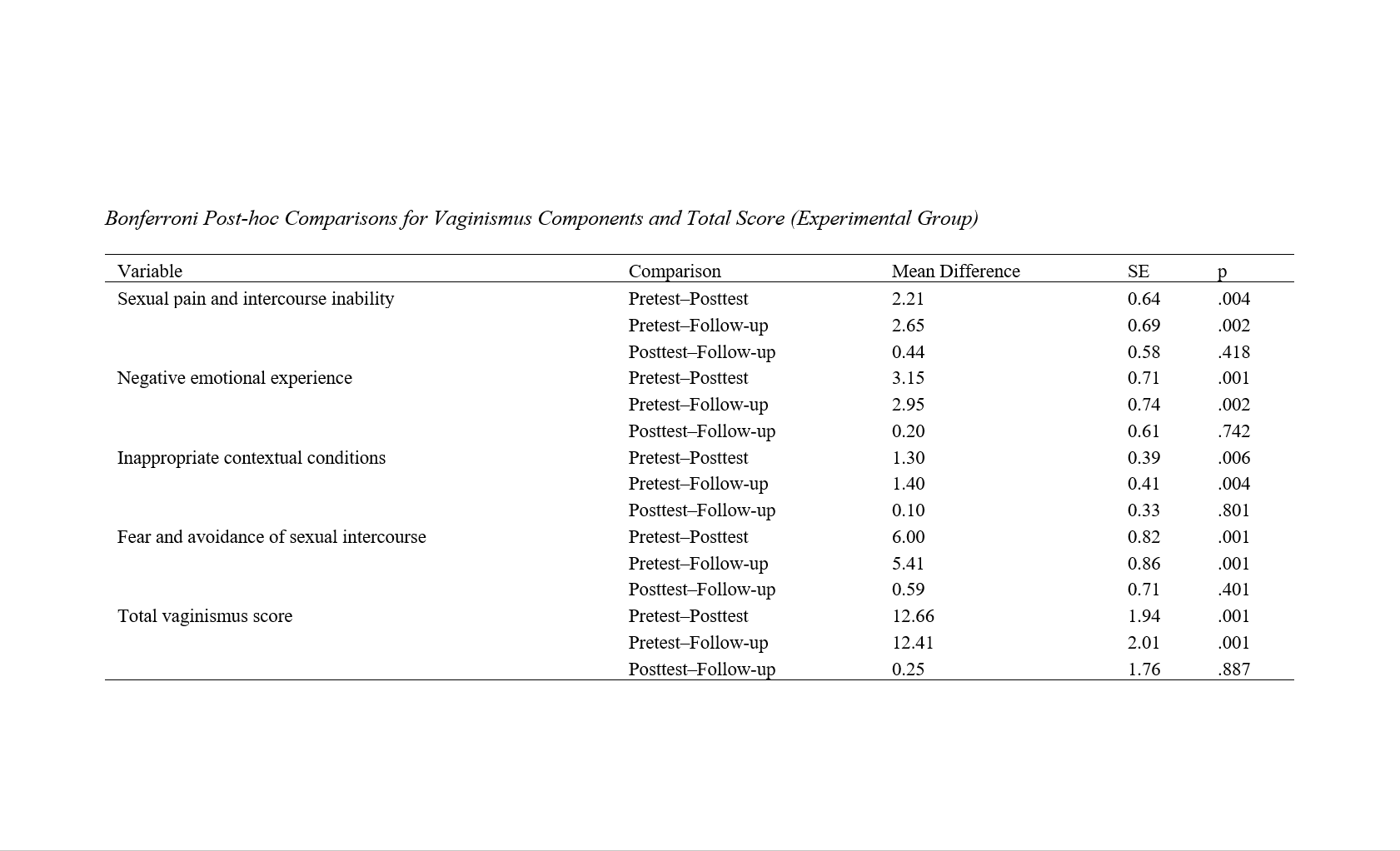
This study aimed to examine the effectiveness of emotion-focused psychotherapy and counseling in reducing vaginismus symptoms among married women. The study employed a quasi-experimental design with a pretest–posttest and follow-up structure including a control group. The statistical population comprised married women with vaginismus who referred to counseling centers in District 2 of Tehran during the second half of 2024 and the first half of 2025. Using purposive and convenience sampling, 30 eligible participants were selected and randomly assigned to an experimental group receiving emotion-focused psychotherapy and counseling and a control group, each consisting of 15 participants. Inclusion criteria included age between 30 and 45 years, at least two years of marital life, minimum lower secondary education, and willingness to participate in therapy sessions. Exclusion criteria involved pregnancy, severe psychiatric disorders, use of psychotropic medication, chronic physical illness, or excessive absence from sessions. Data were collected using a demographic questionnaire and the Vaginismus Questionnaire. Measurements were conducted at pretest, posttest, and follow-up stages. Data analysis was performed using repeated measures analysis of variance and Bonferroni post-hoc tests in SPSS version 26. Repeated measures ANOVA revealed significant main effects of time and group, as well as significant time × group interaction effects for all vaginismus components and the total score (p < .001). Effect sizes ranged from moderate to large, indicating substantial treatment impact. Bonferroni post-hoc comparisons showed significant reductions from pretest to posttest and from pretest to follow-up in the experimental group across all components (p < .01), while differences between posttest and follow-up were not statistically significant, suggesting stability of treatment effects over time. Emotion-focused psychotherapy and counseling were effective in significantly reducing vaginismus symptoms and maintaining therapeutic gains over time, highlighting the value of emotion-centered interventions in addressing the emotional and relational dimensions of vaginismus.
Downloads
References
Abdenijad, R., & Simber, M. (2021). A Review of Treatment Options for Vaginismus. Journal of Women's Midwifery and Infertility in Iran, 24(Special Issue 7), 83-97. https://sid.ir/paper/1036660/fa
Ahmadi, F., Tahmasebi, R., Norouzi, A., Akbarizadeh, F., Omidvar, Z., Bayazi, M. H., & Faridhosseini, F. (2022). Comparing the effectiveness of mindfulness-based cognitive therapy and cognitive-behavioral therapy on sexual satisfaction in women with vaginismus. Journal of Southern Medicine, 25(2), 114-129. https://doi.org/10.52547/ismj.25.2.114
Akhlaghi, F., & Rasouli, N. (2022). The Effectiveness of Emotion-Focused Schema Therapy on Reducing Symptoms of Vaginismus and Increasing Sexual Satisfaction in Housewife Women. Nurse and Physician in War, 10(36), 88-97. https://sid.ir/paper/1126817/fa
Eserdag, S., Kurban, D., Yakut, E., & Mishra, P. C. (2021). Insights into the vaginismus treatment by cognitive behavioral therapies: Correlation with sexual dysfunction identified in male spouses of the patients. Journal of family & reproductive health, 15(1), 61. https://pubmed.ncbi.nlm.nih.gov/34429738/
Fitria, R. (2025). Vaginismus in Primary Health Care: Challenges in Diagnosis and Management-A Narrative Review. Jurnal Impresi Indonesia, 4(9), 3545-3555. https://doi.org/10.18502/jfrh.v15i1.6079 10.58344/jii.v4i9.7012
Hashemi, M., & Ghahramani, M. (2021). The Effectiveness of Emotion-Focused Couples Therapy on Improving Sexual Dysfunction and Anxiety During Sexual Intercourse in Women with Vaginismus. Studies on Disabilities, 11(1 Continuous 19), 0-0. https://sid.ir/paper/1029149/fa
Kakavand, R., Khayatan, F., & Golparvar, M. (2025). Effect of Vaginismus-Specific Schema Therapy and Conventional Schema Therapy on Sexual Self-Assertiveness & Self-Esteem in Women with Vaginismus Disorder. Health Education and Health Promotion, 12(4), 553-560. https://ensani.ir/fa/article/527621/
Karav, H. M., Dursun, R., & Şanlı, Z. D. (2025). Hypnotherapeutic KARAV Algorithm in Vaginismus Treatment: A Retrospective Evaluation of a Novel Therapeutic Approach. International Journal of Sexual Science, 1(2), 64-69. https://doi.org/10.33719/sexscij.2508.18
Nekoolal Tak, M., Azin, S. A., Nazari, F., & Ghorbani, B. (2021). Vaginismus Treatment and Subsequent Pregnancy 18 Years After Marriage: A Case Report. Journal of Women's Midwifery and Infertility in Iran, 24(4), 108-119. https://sid.ir/paper/522870/fa
Omidvar, Z., Biyazi, D. M. H., & Faridhosseini, D. F. (2021). Comparison of the Effects of Mindfulness-Based Cognitive Therapy and Cognitive Behavioral Therapy on Cognitive Emotion Regulation in Women with Vaginismus. Iranian Journal of Women, Obstetrics, and Infertility, 24(9), 40-49. https://www.sid.ir/paper/1036400/fa
Ozturk, S., & Arkar, H. (2017). Effects of cognitive behavioral therapy on sexual satisfaction, marital adjustment, and levels of depression and anxiety symptoms in couples with vaginismus. Turkish Journal of Psychiatry, 28, 172-180. https://pubmed.ncbi.nlm.nih.gov/28936816/
Sahoo, M. K., & Biswas, H. (2024). Unraveling the Complexity of Vaginismus in Marital Relationship: A Case Series. Cureus. https://doi.org/10.7759/cureus.73414
Soleimani, E., Esmaieli, A., Taştan, K., Yoruk, N., Işık, M., Taştan, K., Yoruk, N., & Işık, M. (2021). The Effectiveness of Cognitive-Behavioral Hypnotherapy on clinical symptoms of Irritable Bowel Syndrome A Comparison of the Effectiveness of Hypnotherapy and Cognitive Behavioral Therapy in the Treatment of Primary Vaginismus. Rooyesh-e-Ravanshenasi Journal (RRJ), 13(3), 536-541. https://doi.org/10.18521/ktd.881318
Taştan, K., Yoruk, N., & Işık, M. (2021). A Comparison of the Effectiveness of Hypnotherapy and Cognitive Behavioral Therapy in the Treatment of Primary Vaginismus. Konuralp Medical Journal, 13(3), 536-541. https://doi.org/10.18521/ktd.881318
ter Kuile, M. M., van Lankveld, J. J., de Groot, E., Melles, R., Neffs, J., & Zandbergen, M. (2007). Cognitive-behavioral therapy for women with lifelong vaginismus: Process and prognostic factors. Behaviour Research and Therapy, 45(2), 359-373. https://doi.org/10.1016/j.brat.2006.03.013
Zulfikaroglu, E. (2025). Vaginismus treatment: a systematic review and meta-analysis of contemporary therapeutic approaches. The Journal of Sexual Medicine, 0, qdaf295. https://doi.org/10.1093/jsxmed/qdaf295
Downloads
Additional Files
Publication Timeline
- Submitted
- Revised
- Accepted