A Structural Model of Job Burnout and Work-Family Conflict in Teachers, with the Mediating Role of Mental Health and Psychological Capital: A Gender Comparison
DOI:
https://doi.org/10.61838/kman.ooc.psynexus.5149Keywords:
Work-Family Conflict, Gender Differences, Job Burnout, Psychological Capital, Mental HealthAbstract
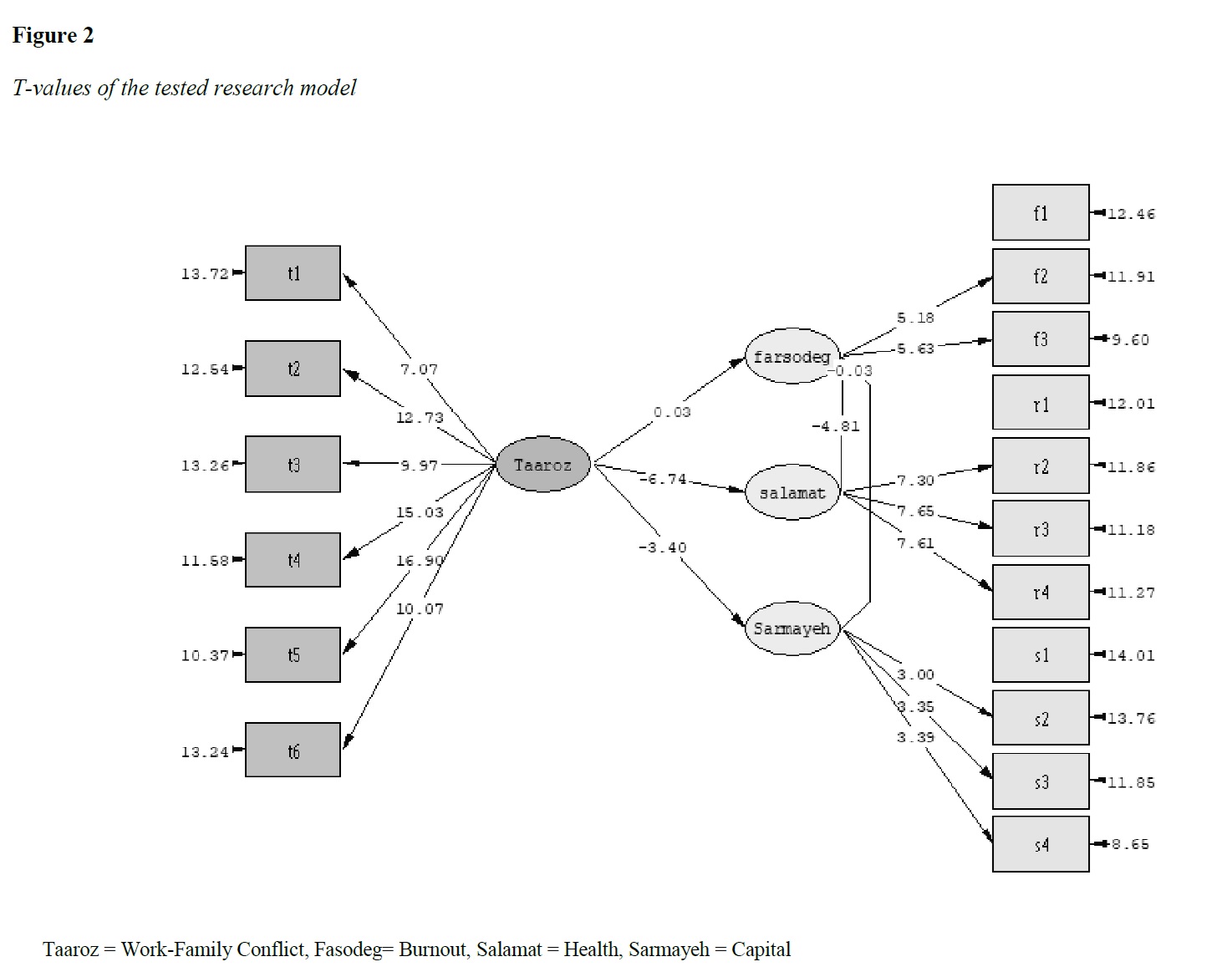
The purpose of this research is to present a structural model of job burnout based on work-family conflict, mental health, and psychological capital, considering gender differences. The study population comprised sixth-grade teachers in Tehran, from which a sample of 400 individuals (223 female and 177 male) was selected using stratified sampling with equal allocation. Research instruments included the Maslach Burnout Inventory, the Carlson Work-Family Conflict Scale, the Goldberg and Hiller General Health Questionnaire, and the Luthans Psychological Capital Questionnaire. Data were analyzed using correlation matrix and structural equation modeling. All paths were significant at the p≤.01level, except for the path from work-family conflict to job burnout and the path from psychological capital to job burnout. Among these coefficients, mental health (β=0.82) had the largest effect on job burnout. Overall, 41% of the total variance in job burnout was explained by work-family conflict, mental health, and psychological capital. There was a difference between the job burnout models for women and men. Given the impact of mental health on job burnout and work-family conflict among teachers, it appears that providing counseling and specialized psychological workshops for teachers could be effective in reducing their levels of job burnout and work-family conflict.
Downloads
References
Alinejhad, R., & Rouzbahani, M. (2018). The relationship between psychological capital and mental health of woman teachers. The Fifth Scientific Conference of Education and Psychology, Social and Cultural Harm, Tehran, Iran.
Aminafshar, Z., Kazazi, A., & Hooshangi, M. (2020). The Role of Psychic Capital in Work-Family Conflict and Organizational Performance: The Case of Real Estate Registration Office in Mashhad. https://civilica.com/doc/1376910
Artz, B., Kaya, I., & Kaya, O. (2022). Gender role perspectives and job burnout. Review of Economics of the Household, 20, 447-470. https://doi.org/10.1007/s11150-021-09571-w
Ashraf, F., Ahmad, H., Shakeel, M., Aftab, S., & Masood, A. (2019). Mental health problems and psychological burnout in Medical Health Practitioners: A study of associations and triadic comorbidity. Pakistan Journal of Medical Sciences, 35(6), 1558-1564.
Astuti, B., S, T. T. B., & Fitriana, N. (2025). Pengaruh Work Family Conflict Dan Psychological Well-Being Terhadap Burnout Pada Pegawai Negeri Sipil (PNS) Wanita Di Organisasi “X” Wilayah Jawa Tengah Dan Daerah Istimewa Yogyakarta. Jurnal Pendidikan Indonesia, 6(8), 4325-4338. https://doi.org/10.59141/japendi.v6i8.8553
Bahary, H., & Ahangar, A. (2020). Considering the relationship between family-work conflict and burnout by welfare of police officers of Orumieh. The Fifth International Conference of Innovation and Research in Education, Management, and Psychology, Tehran.
Ede, M. O., & Mawila, D. (2025). Career Dysfunctional Thoughts, Work-Family Conflict, and Administrative Burnout in a Sample of Female Educational Administrators: Implications for Resilience Counselling. Psychological Reports. https://doi.org/10.1177/00332941251343532
Fernandez, M. D., & Roque, D. H. (2021). Psychological capital and entrepreneurship: gender differences. Gender in Management: An International Journal. https://www.emerald.com/insight/1754-2413.html
Goodini, M., Shakib, B., & Karimi Seraji, S. (2021). Considering the relationship between family-work conflict and burnout in Isfahan Oil industry workers. The Tenth International Congress of Innovation and Research in Engineering Sciences,
Grönlund, A., & Öun, I. (2018). In search of family-friendly careers? Professional strategies, work conditions and gender differences in work–family conflict. Community, Work & Family, 21(1), 87-105.
Homayouni, A., Seifi, Z., & Mortazavi, N. (2020). The prediction of occupational well-being based on religious coping styles, psychological capital and work-family conflict. Islamic Life Style, 3(3).
Hosseini Nejhad, N., & Pourshahriari, M. (2020). The role of family work conflict in job stress and mental health of Municipal employees in Shiraz. The Third National Conference of Social Harm, Ardabil.
Kalhor, M., & Rashidi Joneidabad, R. (2020). Considering the relationship between psychological capital and burnout of teachers by mediating teaching emotions. The Sixth Global Conference of Knowledge and Technology of Education, Social Studies, and Psychology, Tehran, Iran.
Li, Y., Ni, X., Zhang, W., Wang, J., Chengfu, Y., & Zou, H. (2024). The Relationship Between Work–family Conflict and Job Burnout Among Primary and Secondary School Teachers: The Role of Depression and Cognitive Reappraisal. Frontiers in psychology, 15. https://doi.org/10.3389/fpsyg.2024.1438933
Lotfi, A. (2020). Considering the relationship between mental health and burnout by mediating Identification styles in Mashhad high schools teachers [Master dissertation, Shandiz Institute of Higher Education].
Memarzadeh Ghanavati, M. (2018). Considering psychological capital in relationship between psychological wellbeing by emotional intelligence in Behbahan first section High school Teachers [Master dissertation, Islamic Azad University].
Miller, S. P. (2023). Family climate influences next-generation family business leader effectiveness and work engagement [Original Research]. Frontiers in psychology, 14. https://doi.org/10.3389/fpsyg.2023.1110282
Motaghed, A., & Ghashghayee Zadeh, N. (2019). Mediated Role of Psychological Capital in Ethical Leadership and Job Burnout of Teachers. Ethics in Science and Technology, 14(2), 113-120.
Nazarpour, N. (2020). The relationship between social support and psychological capitals by stress in Baharestan teachers [Master dissertation, Qazvin Payame-noor University].
Okechukwu, B. I. U., Anayo, C. C., Paschaline, O., & Udochukwu, C. (2023). The Moderating Role of Psychological Capital on the Relationship Between Work-Family Conflict and Burnout Among Artisans. International Journal of Research and Innovation in Social Science, VII(X), 2064-2076. https://doi.org/10.47772/ijriss.2023.701157
Piko, B., & Mihalka, M. (2018). Study of Work–Family Conflict (WFC), Burnout and Psychosocial Health Among Hungarian Educators. Central European Journal of Occupational and Environmental Medicine, 24(1-2), 83-95.
Piri, M., & Karbalaee Harafteh, F. (2019). Considering the relationship between mental health dimension and burnout of nurses in hospitals under supervision of Zahedan University of Medical Sciences. The Sixth International Conference of New Scientific Achievements in Social Sciences, Education and Psychology, Esfahan.
Pourrajab, M., Panahi Darcheh, A., Sadeghi, H., & Baba Ahmadi Milani, S. (2020). Effective factors in teachers burnout. New Progresses in Behavioral Sciences, 5(42), 34-55.
Raji Asadabadi, S. (2021). Considering the relationship between psychological capitals by mental health and Psychological well-being of high school students in Shiraz. The Eighth National Conference on the News of Positive Psychology, Bandar Abbas.
Shabani, M. G., Karaminejad, J., Namjoo, B., & Namjoo, F. (2019). Investigating the Relationship between Work-Family Conflict and Marital Conflict with a Mediating Role of Psychological Capital. Journal of Advanced Research in Humanities and Social Science (JARAC), 1(1), 1-13.
Soleymani, M., Ghadampour, E., & abasi, m. (2023). The pattern of structural relationships of academic achievement identity based on basic psychological needs With the mediation of mindfulness and academic self-efficacy. Journal of Educational Psychology Studies, 20(49), 102-181. https://doi.org/10.22111/jeps.2023.43747.5216
Su, Q., & Jiang, M. (2023). “Ideal Employees” and “Good Wives and Mothers”: Influence Mechanism of Bi-Directional Work–family Conflict on Job Satisfaction of Female University Teachers in China. Frontiers in psychology, 14. https://doi.org/10.3389/fpsyg.2023.1166509
Tajikzadeh, F., Mohammadpour, S., & Zareiee, F. (2017). Studying the predictor personal characteristics in burnout of kindergarten trainers. Quarterly of Children's Mental Health, 3(4), 16-27.
Toolaabi, Z., Poorashraf, Y., & Abbaaspoor, H. (2018). Meta-Analysis of Studies on Job Burnout within the Iranian Schools. Quarterly Journal of Education (QJOE), 34(3), 83-100.
Toukhash, A. A., & Mirdarikvand, F. (2019). The relationship between psychological capital and burnout in Lorestan province Judicial staff. The Second International Conference of Psychology, Education and Social Studies, Hamedan.
Turliuc, M. N., & Candel, O. S. (2021). The relationship between psychological capital and mental health during the Covid-19 pandemic: A longitudinal mediation model. Journal of Health Psychology, 1-3.
Wang, J., Zhang, L., Jiang, F., Liu, L., Wang, M., Wu, Y., & Tang, Y. L. (2022). Gender Differences in Burnout Among Endocrinologists in China. Frontiers in psychology, 13(845188), 1-7.
Wang, W., Song, T., Chen, S., Li, Y., & Li, Y. (2023). Work-Family Enrichment and Parental Burnout: The Mediating Effects of Parenting Sense of Competence and Parenting Stress. Current Psychology, 1-11. https://doi.org/10.1007/s12144-023-04874-w
Yang, D., Liu, Y., Zhang, H., & Zhang, Y. (2023). The Effect of Family Boundary Flexibility on Employees’ Work Engagement: A Study Based on Person-Environment Fit Theory Perspective. Frontiers in psychology, 14. https://doi.org/10.3389/fpsyg.2023.1185239
Yazdanbakhsh, K., Moradi, A., & Bastami, E. (2018). Relationship between Psychological Capital and Hardiness with Burnout. Rooyesh-e-Ravanshenasi Journal, 7(8), 181-202.
Downloads
Additional Files
Publication Timeline
- Submitted
- Revised
- Accepted