Comparison of the Effectiveness of Intensive Short-Term Psychodynamic Therapy and Emotion-Focused Therapy on Pain Catastrophizing in Patients with Psychosomatic Disorders
Keywords:
Psychosomatic Disorders, Pain Catastrophizing, Emotion-Focused Therapy, Intensive Short-Term Psychodynamic Therapy.Abstract
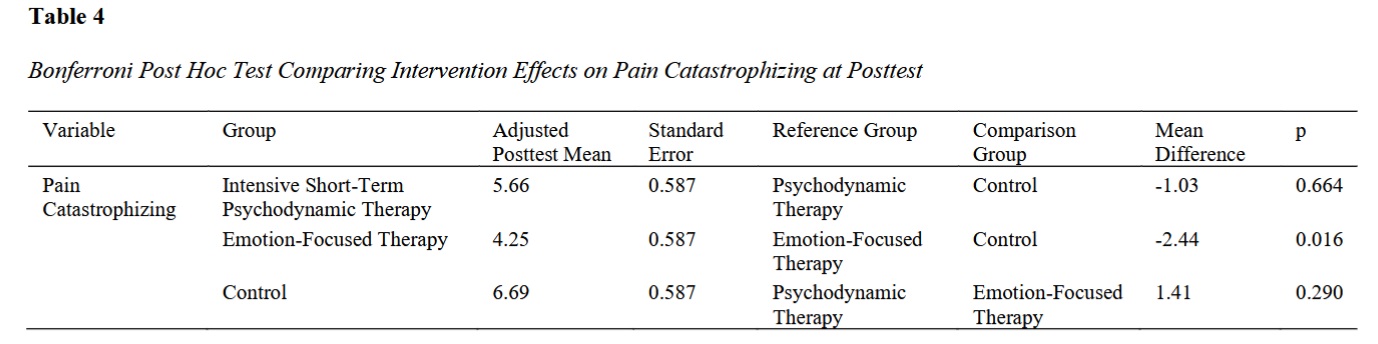
The present study aimed to compare the effectiveness of Intensive Short-Term Psychodynamic Therapy and Emotion-Focused Therapy on reducing pain catastrophizing among patients diagnosed with psychosomatic disorders. This applied study employed a quasi-experimental design with a pretest–posttest control group and a three-month follow-up phase. The statistical population consisted of patients with psychosomatic disorders who referred to Niyayesh Psychiatric Hospital in Tehran during 2024–2025. Using purposive sampling, 45 eligible participants were selected and randomly assigned to three groups: Intensive Short-Term Psychodynamic Therapy, Emotion-Focused Therapy, and a control group (15 participants in each group). The experimental groups received structured therapeutic interventions across multiple weekly sessions, while the control group remained on a waiting list without intervention. Data were collected using standardized psychological instruments measuring psychosomatic symptoms and pain catastrophizing at pretest, posttest, and follow-up stages. Data analysis was conducted using SPSS-28 through descriptive statistics, analysis of covariance, mixed-design repeated measures analysis of variance, multivariate analysis of variance, and Bonferroni post hoc tests after confirming statistical assumptions. Analysis of covariance indicated that Emotion-Focused Therapy significantly reduced pain catastrophizing compared with the control group (p < 0.01), whereas Intensive Short-Term Psychodynamic Therapy did not demonstrate a statistically significant effect. Repeated-measures analysis revealed a significant main effect of time (p < 0.01) and a significant interaction effect between time and group (p < 0.05), indicating differential changes across interventions over measurement stages. Bonferroni post hoc comparisons showed that the Emotion-Focused Therapy group achieved significantly lower adjusted posttest scores than the control group (p < 0.05). Pairwise comparisons across time demonstrated significant reductions from pretest to posttest and follow-up only in the Emotion-Focused Therapy group, confirming maintenance of treatment effects, while no significant changes were observed in the psychodynamic or control groups.
Downloads
References
Bagheri Sheykhangafshe, F., Hajialiani, V., & Hasani, J. (2022). The Role of Emotion Regulation Strategies in Mental Health During the COVID-19 Pandemic: A Systematic Review. hums-jmis, 8(2), 196-207. https://doi.org/10.32598/JMIS.8.2.2
Caldiroli, A., Capuzzi, E., Riva, I., Russo, S., Clerici, M., Roustayan, C., Abbass, A., & Buoli, M. (2020). Efficacy of intensive short-term dynamic psychotherapy in mood disorders: A critical review. Journal of affective disorders, 273, 375-379. https://doi.org/10.1016/j.jad.2020.04.002
Chavooshi, B., Mohammadkhani, P., & Dolatshahee, B. (2016). Telemedicine vs. In-Person Delivery of Intensive Short-Term Dynamic Psychotherapy for Patients With Medically Unexplained Pain: A 12-Month Randomized, Controlled Trial. Journal of Telemedicine and Telecare, 23(1), 133-141. https://doi.org/10.1177/1357633x15627382
Derakhshan, M., Alizadeh, M., & Zareei, R. (2022). The Prediction of Pain Severity and Catastrophizing among Patients with Chronic Pain based on Resilience and Emotion Regulation. Iranian Journal of Clinical Psychology News, 8(1), 49-58.
Ebrahimkhani, M., Norouzi, E., Hosseini, A., & Jamshidi, F. (2024). A Randomized Controlled Trial on Cognitive Therapy’s Role in Enhancing Pain Self-Efficacy and Reducing Catastrophizing in Breast Cancer Patients. Psychology of Woman Journal, 5(2), 114-123. https://doi.org/10.61838/kman.pwj.5.2.15
Erbildim, E., & Nweke, G. E. (2025). The Mediator Role of Difficulties in Emotion Regulation in the Relationship Between Guilt and Shame-Proneness and Somatic Symptoms. https://doi.org/10.21203/rs.3.rs-5930990/v1
Fazeli Sani, F., Salehi, M., Rafieipour, A., & Khalatbari, J. (2020). Comparing the effectiveness of emotion-focused therapy and cognitive-behavioral therapy on pain coping strategies and pain catastrophizing in patients with pain disorder. Iranian Journal of Health Psychology, 4(1), 29-46. https://ijohp.journals.pnu.ac.ir/article_8349_fa.html?lang=fa
Ghanavati, A., Joharifard, S., & Ehteshamzadeh, P. (2025). The Effectiveness of Group Emotion-Based Family Therapy on Self-Differentiation and Alexithymia in Adolescent Girls with Psychosomatic Disorders. Rooyesh-e-Ravanshenasi Journal, 13(9), 121-130. https://frooyesh.ir/article-1-5385-en.html
Ghavanati, J. F., Ehteshami, Z., & Parvin. (2025). Effectiveness of Emotion-Based Group Family Therapy on Self-Differentiation and Alexithymia in Adolescent Girls with Psychosomatic Disorders. Scientific Journal of Ruyesh Psychology, 13(9), 121-130. https://frooyesh.ir/article-1-5385-fa.html
Hadadian, F., Tehranizadeh, M., & Pakdel, M. (2020). The Roles of Family, Emotion Regulation Strategies, and Mental Health in the Problematic Internet Use. Journal of Adolescent and Youth Psychological Studies, 1(1), 317-327. https://www.magiran.com/paper/2538487
Kang, S., Park, C. I., Kim, S. J., & Kang, J. I. (2025). Associations Between Emotional Awareness Deficits and Somatic Symptoms in a Community and Clinical Populations: A Cross-Sectional Study. BMC psychology, 13(1). https://doi.org/10.1186/s40359-025-03087-z
Karimi, M., Belyad, M., Peymani, J., Havasi Somar, N., & Zhian Bagheri, M. (2023). Comparing the Effectiveness of Intensive Short-Term Dynamic Psychotherapy with Mindfulness-Based Cognitive Therapy on Anxiety Sensitivity and its Components in Women with Chronic Pain. Community Health, 17(3), 1-13. https://chj.rums.ac.ir/article_187141.html?lang=en
Leonard, M. T., Krajewski-Kidd, K., Shuler, R., Wesolowicz, D., Miller, C., & Chatkoff, D. K. (2019). The Impact of Emotional Regulation Strategies on Pain Catastrophizing in the Context of Interpersonal Relationships. Clinical Journal of Pain, 35(12), 925-932. https://doi.org/10.1097/ajp.0000000000000764
McLean, C. P., Zang, Y., Gallagher, T., Suzuki, N., Yarvis, J. S., Litz, B. T., Mintz, J., Young-McCaughan, S., Peterson, A. L., & Foa, E. B. (2019). Trauma-Related Cognitions and Cognitive Emotion Regulation as Mediators of PTSD Change Among Treatment-Seeking Active-Duty Military Personnel With PTSD. Behavior therapy, 50(6), 1053-1062. https://doi.org/10.1016/j.beth.2019.03.006
Mir Ahmadi, Z., Khezri Moghadam, N., & Rahmati, A. (2022). Predicting pain catastrophizing based on psychological resilience and mindfulness in patients with cancer: mediating role of positive emotions [Research]. Shenakht Journal of Psychology and Psychiatry, 9(5), 130-141. https://doi.org/10.32598/shenakht.9.5.130
Nakhaei Moghadam, R., Bahrainian, S. A., & Nasri, M. (2024). The effectiveness of intensive and short-term dynamic psychotherapy on attachment styles, somatization and health anxiety in patients with chronic pain. Journal of Assessment and Research in Applied Counseling (JARAC), 6(1). https://journals.kmanpub.com/index.php/jarac/article/view/1287
Shokrolahi, M., Hashemi, S. E., Mehrabizadeh Honarmand, M., Zargar, Y., & Naaimi, A. (2022). Comparison of the effectiveness of Emotion Focused Therapy (EFT) and Cognitive Analytic Therapy (CAT) on anxiety sensitivity, pain catastrophizing, experiential avoidance and cognitive emotion regulation in patients with chronic pain and alexithymia [Research]. Journal of Research in Behavioural Sciences, 19(4), 739-752. https://doi.org/10.52547/rbs.19.4.739
Shokrolahi, M. S., Hashem, S. E., Mehrabizadeh Honarmand, M., Zargar, Y., & Naaimi, A. (2023). Effectiveness of emotion-focused therapy on anxiety sensitivity and pain catastrophizing in patients with chronic pain and alexithymia. ijpn, 11(3), 46-56.
Ursu, A., & Măirean, C. (2022). Cognitive Emotion Regulation Strategies as Mediators between Resilience and Stress during COVID-19 Pandemic. International journal of environmental research and public health, 19(19).
Ying Zhou, B. S. N. (2024). Relationship between pain resilience and pain catastrophizing in older patients after total knee arthroplasty: Chain-mediating effects of cognitive emotion regulation and pain management self-efficacy. Geriatric Nursing, 59, 571-580. https://doi.org/10.1016/j.gerinurse.2024.08.011
Downloads
Additional Files
Publication Timeline
- Submitted
- Revised
- Accepted