Predicting Marital Conflict Based on Mindfulness, Communication Patterns, and Emotional Intelligence in Married Students
Keywords:
marital conflict, mindfulness, communication patterns, emotional intelligence, married studentsAbstract
The present study aimed to predict marital conflict based on mindfulness, communication patterns, and emotional intelligence among married students.
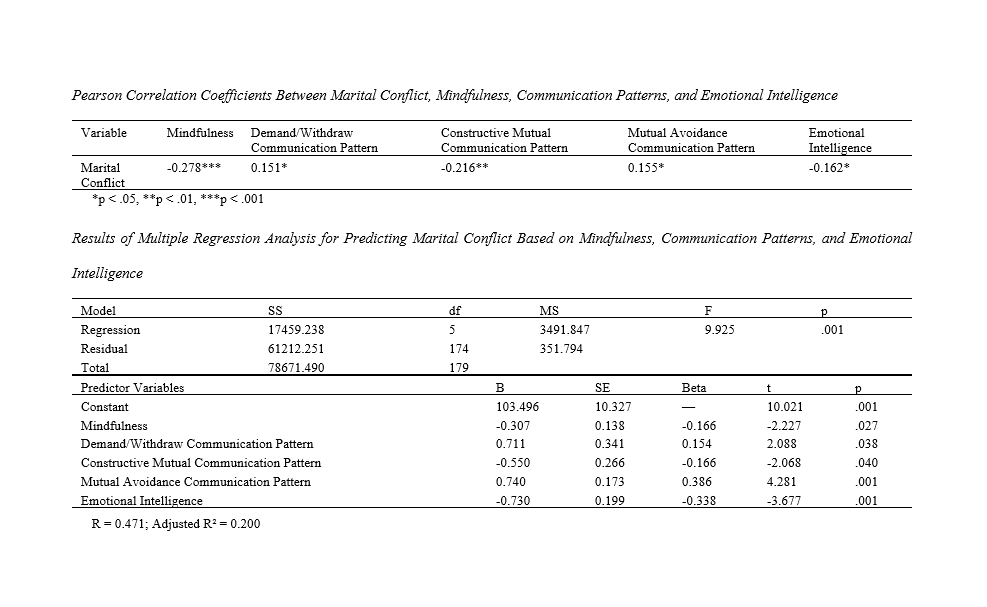
Methods and Materials: The present study employed an applied descriptive-correlational design. The statistical population consisted of all married students at Islamic Azad University during the 2024–2025 academic year. Using convenience sampling, 195 participants were initially selected, and after excluding incomplete questionnaires, data from 180 participants were analyzed. Data collection instruments included the Marital Conflicts Questionnaire developed by Barati and Sanaei (1996), the short form of the Freiburg Mindfulness Inventory (2006), the Communication Patterns Questionnaire developed by Christensen and Sullaway (1984), and the Schering Emotional Intelligence Questionnaire (1995). Data were analyzed using Pearson’s correlation coefficient and multivariate regression analysis in SPSS. The results indicated that mindfulness (r = -0.278, p < .001), constructive mutual communication patterns (r = -0.216, p < .01), and emotional intelligence (r = -0.162, p < .05) were significantly and negatively associated with marital conflict. In contrast, demand/withdraw communication patterns (r = 0.151, p < .05) and mutual avoidance communication patterns (r = 0.155, p < .05) showed significant positive relationships with marital conflict. Furthermore, the regression analysis demonstrated that mindfulness (β = -0.166, p < .05), demand/withdraw communication pattern (β = 0.154, p < .05), constructive mutual communication pattern (β = -0.166, p < .05), mutual avoidance communication pattern (β = 0.386, p < .001), and emotional intelligence (β = -0.338, p < .001) significantly predicted marital conflict. The overall regression model was statistically significant (F = 9.925, p < .001) and explained 20% of the variance in marital conflict among married students (Adjusted R² = 0.200). The findings suggest that mindfulness, emotional intelligence, and constructive communication patterns function as protective factors against marital conflict among married students, whereas maladaptive communication patterns such as demand/withdraw interactions and mutual avoidance increase the likelihood of relational tension.
Downloads
References
Asgarzadeh, S., Baradaran, M., & Ranjbar Noushari, F. (2024). Correlates of Marital Conflict: Cognitive Fusion, Mindfulness, and Early Maladaptive Schema. Contemporary psychology, 19(1), 103-111.
Babaei Nadinluye, K., Mikaeli Manee, F., Pezeshki, H., Bafande, H., & Abdi, H. (2017). Relationship between Mindfulness and Metaemotion on Predicting Emotional Adjustment of Novice Nurses. Iran Journal of Nursing, 30(105), 11-22.
Bahramian, A., Kazemi, S., Javidi, H., & Barzegar, M. (2024). The Relationship between Conflict Resolution Styles, Irrational Beliefs, and Communication Patterns with Marital Conflicts. Scientific Quarterly of Psychological Methods and Models, 15(55), 1-20.
Evans, T. R., Hughes, D. J., & Steptoe-Warren, G. (2020). A Conceptual Replication of Emotional Intelligence as a Second-Stratum Factor of Intelligence. Emotion, 20(3), 507.
Frye, N., Ganong, L., Jensen, T., & Coleman, M. (2020). A Dyadic Analysis of Emotion Regulation as a Moderator of Associations between Marital Conflict and Marital Satisfaction among First-Married and Remarried Couples. Journal of Family Issues, 0192513X20935504.
Hooman, H. A. (2019). Understanding the Scientific Method in Behavioral Sciences. SAMT.
Jankowski, T., & Bak, W. (2019). Mindfulness as a Mediator of the Relationship between Trait Anxiety, Attentional Control and Cognitive Failures: A Multi-Model Inference Approach. Personality and individual differences, 142, 62-71.
Kalhor, A., Davoodi, H., Taghvael, D., & Heidari, H. (2020). Effectiveness of Cognitive Therapy Based on Mindfulness on Inefficient Attitudes and Marital Burnout in Women with Marital Conflict. Journal of Clinical Psychology, 12(2), 19-30.
Li, P. F., & Johnson, L. N. (2025). Couples' Depression and Relationship Satisfaction: Examining the Moderating Effects of Demand/Withdraw Communication Patterns. Journal of Family Therapy, 40, 63-85.
Mandal, E., & Lip, M. (2022). Mindfulness, Relationship Quality, and Conflict Resolution Strategies Used by Partners in Close Relationships. Current Issues in Personality Psychology, 10(2), 135-146.
Navabinejad, S., Rostami, M., & Parsakia, K. (2023). The Mediating Role of Emotional Intelligence in the Relationship between Marital Conflicts and Tendency toward Marital Infidelity in Couples. Assessment and Research in Applied Counseling, 5(1), 1-8.
Rahbari, S., Naeimi, E., & Esmaeili, M. (2021). Communication Patterns in Women with Marital Conflict: A Qualitative Study. Cultural-Educational Quarterly of Women and Family, 16(55), 83-113.
Ryan, R. M., & Brown, K. W. (2003). The Benefits of Being Present: Mindfulness and Its Role in Psychological Well-Being. Journal of personality and social psychology, 84, 822-848.
Sadeghi, I., Salahian, A., & Salehi, M. (2022). Modeling Marital Conflicts Based on Self-Knowledge, Love, and Emotional Intelligence with the Mediation of Differentiation. Family Research, 18(2), 309-332.
Shahmoradi, S., Zendedel Kalati, E., & Roshan, F. (2021). Lived Experiences of Married Students at the University of Tehran Regarding the Simultaneity of Education and Marriage: A Phenomenological Study. Cultural Psychology, 5(2), 43-62.
Sharafati, R., & Eltiamjoo, P. (2025). The Relationship of Emotional Intelligence with Conflict and Emotional Divorce in Married Women. Second National Conference on Social, Cultural, and Behavioral Harms, Islamshahr.
Uhlich, M., Nouri, N., Jensen, R., Meuwly, N., & Schoebi, D. (2022). Associations of Conflict Frequency and Sexual Satisfaction with Weekly Relationship Satisfaction in Iranian Couples. Journal of Family Psychology, 36(1), 140.
Downloads
Additional Files
Publication Timeline
- Submitted
- Revised
- Accepted