Predicting the Quality of Life of Mothers of Children with Special Needs Based on Stress-Coping Strategies and Level of Acceptance
Keywords:
quality of life, acceptance, coping with stress, mothers, children with special needs, coping strategiesAbstract
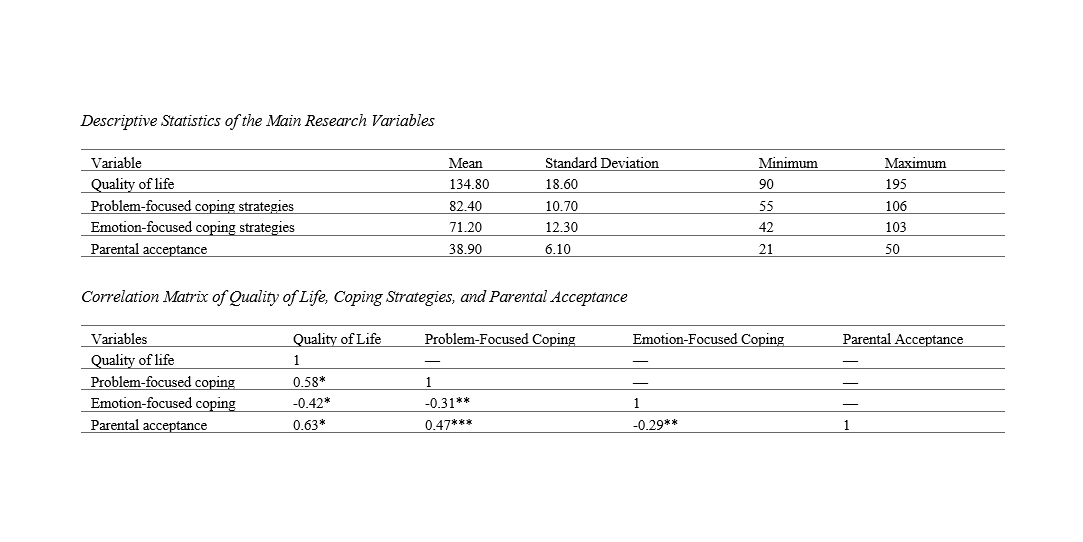
The aim of the present study was to predict the quality of life of mothers of children with special needs based on stress-coping strategies and parental acceptance. This study was descriptive-correlational and was conducted using a cross-sectional method. The statistical population included all mothers of children with special needs, among whom 270 individuals were accessible, and 159 were selected as the research sample. The instruments used included the Quality of Life Questionnaire for Families of Children with Intellectual Disabilities, the Coping Strategies Questionnaire by Lazarus and Folkman (1988), and the Parental Acceptance Questionnaire (2002). Data were analyzed using descriptive statistics, Pearson correlation coefficient, and multivariate regression analysis. The results showed that problem-focused coping strategies and parental acceptance had a positive and significant relationship with quality of life, whereas emotion-focused coping strategies had a negative and significant relationship with quality of life. The results of the regression analysis also indicated that parental acceptance, problem-focused coping strategies, and emotion-focused coping strategies significantly predicted mothers’ quality of life, with parental acceptance being the strongest predictor of quality of life. Based on the findings, it can be concluded that strengthening psychological acceptance and teaching adaptive coping strategies can play an important role in improving the quality of life of mothers of children with special needs. Therefore, designing and implementing educational programs and psychological interventions aimed at increasing acceptance and enhancing coping skills can contribute to improving the mental health and quality of life of these mothers.
Downloads
References
Ali Sari Nasirlo, K., Naderi, F., Homaei, R., & Makvandi, B. (2024). Efficacy of Mentalization-Based Treatment on the Self-Conscious Affect and Quality of Life among Mothers of Children with Intellectual Developmental Disorder. Journal of Applied Psychological Research, 14(4), 285-300. https://doi.org/10.22059/japr.2023.336809.644157
Bahrani Tanha, S., Torkan, H., & Kalahdozian, S. A. (2024). The effectiveness of Acceptance and Commitment Therapy on anhedonia, meaning in life, emotional empathy, parent-child relationship, and the quality of life of children and mothers of children with cancer. Journal of Applied Research in Counseling. https://www.jarci.ir/article_721087.html?lang=en
Bee Wah, Y., Mohd Nasir, N. N., Hadrawi, M. F., Kamaruddin, A. A., Jannoo, Z., & Afthanorhan, A. (2024). Effects of stress and self-efficacy on quality of life of mothers with autistic children: Covariance-based structural equation modeling approach. Belitung Nurs J, 10(2), 201-208. https://doi.org/10.33546/bnj.3096
Carreiro, J. P., Cardoso, S., Teques, P., Teques, A. P., & Ribeiro, J. L. P. (2025). Satisfaction With Social Support and Quality of Life Among Portuguese Patients With Breast Cancer: Mediating Effects of Coping Styles—Cross-Sectional Study. Healthcare, 13(3), 297. https://doi.org/10.3390/healthcare13030297
Dulai, S., Nurmohamed, R., & Hassan, Y. (2025). Religious coping strategies among Muslim mothers of children with autism spectrum disorder in Indonesia. Journal of Islamic Health Psychology, 14(2), 115-132. https://www.knepublishing.com/index.php/Kne-Social/article/view/2349/5191
Elemo, A. S., & Can, E. (2024). Depression and psychological help-seeking attitude among Turkish mothers of children with autism: problem-focused coping as a mediator. Psychol Health Med, 30(3), 540-554. https://doi.org/10.1080/13548506.2024.2440655
Elemo, A. S., & Can, E. (2025). Depression and psychological help-seeking attitude among Turkish mothers of children with autism: problem-focused coping as a mediator. Psychology, Health & Medicine, 30(3), 540-554. https://doi.org/10.1080/13548506.2024.2440655
Koukabi, A., & Jahangiri, M. M. (2023). Comparison of cognitive-behavioral therapy and acceptance and commitment therapy on sleep disorders and quality of life in mothers of children with learning disabilities. Journal of Faculty of Medicine, Mashhad University of Medical Sciences, 66(6). https://mjms.mums.ac.ir/article_24750.html
Malekzadeh, L., Nik Khoo, F., Torkhan, R. A., & Najafi Pazuki, M. (2024). The Effectiveness of Mindfulness-Based Cognitive Therapy on Resilience and Quality of Life of Mothers with Children with Learning Disabilities. Journal Name Not Provided. https://japr.ut.ac.ir/article_94709_fc994ebe2659d82a1cde218652c0de0f.pdf
Mo'tamedi, S., & Sajadian, I. (2024). The Mediating Role of Job Stress in the Relationship Between Coping Strategies and Job Burden with the Quality of Professional Life of Nurses in Psychiatric Emergency Departments
Novianti, L. E., Purba, F. D., Karremans, J. C., & Agustiani, H. (2024). Financial Strain Among West-Javanese Parents: Its Association With Marital Satisfaction and Quality of Life, and the Role of Dyadic Coping. Frontiers in psychology, 15. https://doi.org/10.3389/fpsyg.2024.1434426
Pavon, M. V., Jakab, A. W., & Löw, A. (2024). Exploring Relationship Satisfaction in Mothers of Children With Disabilities: The Predictive Role of Interparental Conflicts and Moderating Role of Dyadic Coping. Frontiers in Psychiatry, 14. https://doi.org/10.3389/fpsyt.2023.1307827
Qashqai, M., Emadian, S. O., & Ghanadzadegan, H. (2023). Effectiveness of Schema-based Parenting Training on Mothers' Parental Self-Efficacy, Self-Concept, and Parental Acceptance Children with Internalized disorders. Journal of Family Relations Studies. 3 (11), 31-40. https://journal.uma.ac.ir/article_2170_288d29c9db0eebe066650e0b55343646.pdf
Saadi Doost, M., Pour Agha Roodbar, F., & Mashkebid Haghighi, M. (2024, February 19). The Effectiveness of Self-Compassion Training on Guilt Feelings and Acceptance and Action of Mothers with Children with Intellectual Disabilities. Fourth National Conference and First International Conference on Clinical Psychology for Children and Adolescents, Ardabil.
Sajadipour, F. S., Dehghan Manshadi, M., Sedrpushan, N., & Fallah, M. H. (2024). Phenomenological Examination of Spiritual and Religious Coping Styles of Mothers Grieving a Child with Cancer. Psychology of Woman Journal, 5(1), 52-58. https://doi.org/10.61838/kman.pwj.5.1.6
Shoji, K., Noguchi, N., Waki, F., Saito, T., Kitano, M., Edo, N., Koga, M., Toda, H., Kobayashi, N., Sawamura, T., & Nagamine, M. (2024). Empathy and Coping Strategies Predict Quality of Life in Japanese Healthcare Professionals. Behavioral Sciences, 14(5), 400. https://doi.org/10.3390/bs14050400
Wah, Y. B., Nasir, N. N. M., Hadrawi, M. F., Kamaruddin, A. A., Jannoo, Z., & Afthanorhan, A. (2024). Effects of Stress and Self-Efficacy on Quality of Life of Mothers With Autistic Children: Covariance-Based Structural Equation Modeling (CB-SEM) Approach. Belitung Nursing Journal, 10(2), 201-208. https://doi.org/10.33546/bnj.3096
Downloads
Additional Files
Publication Timeline
- Submitted
- Revised
- Accepted