The Effectiveness of Acceptance and Commitment Therapy on Psychological Symptoms and Dysfunctional Attitudes in Maladjusted Couples Referred to Counseling and Psychological Services Centers
Keywords:
Acceptance and Commitment Therapy, psychological symptoms, dysfunctional attitudes, maladjusted couplesAbstract
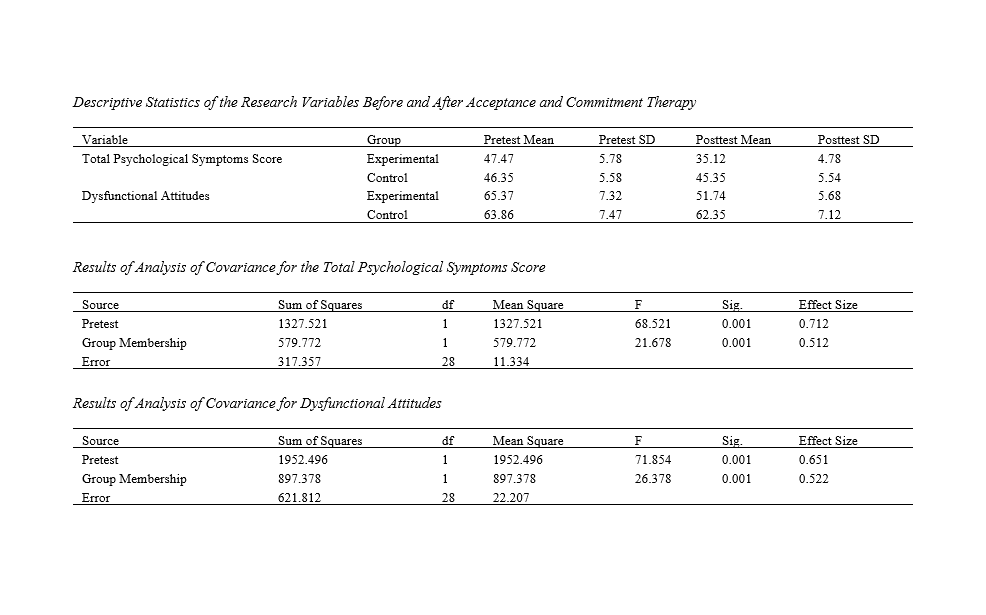
The present study aimed to investigate the effectiveness of Acceptance and Commitment Therapy (ACT) on psychological symptoms and dysfunctional attitudes among maladjusted couples referred to counseling and psychological services centers. The present study employed a quasi-experimental design with a pretest-posttest control group. The statistical population consisted of maladjusted couples referred to counseling centers in Tehran in 2026. A total of 32 participants were selected through convenience sampling and randomly assigned to an experimental group (n = 16) and a control group (n = 16). Data were collected using the Depression, Anxiety, and Stress Scale (DASS-21) developed by Lovibond and Lovibond and the Dysfunctional Attitudes Questionnaire developed by Weissman and Beck. The experimental group received Acceptance and Commitment Therapy over 8 weeks in the form of weekly 90-minute sessions, while the control group received no intervention. Data were analyzed using descriptive statistics and analysis of covariance (ANCOVA) in IBM SPSS Statistics version 27. The results of covariance analysis demonstrated that, after controlling for pretest scores, Acceptance and Commitment Therapy had a statistically significant effect on psychological symptoms among maladjusted couples (F = 21.678, p < 0.001, η² = 0.512). The findings also indicated that ACT significantly reduced dysfunctional attitudes in the experimental group compared to the control group (F = 26.378, p < 0.001, η² = 0.522). The posttest mean scores of psychological symptoms and dysfunctional attitudes in the experimental group were significantly lower than the corresponding pretest scores, whereas no significant changes were observed in the control group. The findings of the present study suggest that Acceptance and Commitment Therapy is an effective intervention for reducing psychological symptoms and dysfunctional attitudes among maladjusted couples.
Downloads
References
Arhin, S. M., Mensah, K. B., Agbeno, E. K., Yirdong, F., Opoku-Agyeman, K., & Ansah, C. (2023). Psychological Distress of Ghanaian Couples After Unsuccessful Treatment for Infertility. Ghana Medical Journal, 57(4), 275-283. https://doi.org/10.4314/gmj.v57i4.4
Bazyari, K., Hooman, F., Shoushtari, M. T., & Saadi, Z. E. (2024). Effectiveness of Emotionally Focused Therapy for Couples in Improving Emotion Regulation and Relationship Distress of Emotionally Divorced Couples. Zahedan Journal of Research in Medical Sciences, 26(2). https://doi.org/10.5812/zjrms-142128
Carr, A. (2025). Couple Therapy and Systemic Interventions for Adult‐focused Problems: The Evidence Base. Journal of Family Therapy, 47(1). https://doi.org/10.1111/1467-6427.12481
Dattilio, F. M., & Epstein, N. B. (2021). Cognitive Behavioral Couple and Family Therapy. 513-548. https://doi.org/10.1037/0000219-016
Eyfarniyan, M., Arshadi, F. K., Golshani, F., Hassani, F., & Dolatshahee, B. (2024). Effectiveness of Dialectical Behavior Therapy-Based Skill Training on Distress Tolerance, Emotional Cognitive Regulation, and Marital Quality of Life in Women With Recurrent Miscarriages. Aftj, 5(2), 129-138. https://doi.org/10.61838/kman.aftj.5.2.15
Farahdel, S., Mahdian, H., & Motlagh, M. G. (2023). Comparing the Effectiveness of Intensive Short-Term Dynamic Psychotherapy (ISTDP) and Acceptance and Commitment Therapy Enriched With Compassion on the Components of Marital Burnout in Women Seeking Divorce. PWJ, 4(2), 62-72. https://doi.org/10.61838/kman.pwj.4.2.8
Ghahari, S., Jamil, L., Farrokhi, N., & Davoodi, S. M. R. (2021). Comparing the Effects of Emotion-Focused Couple Therapy and Acceptance and Commitment Therapy on Marital Conflict and Emotion Regulation. Practice in Clinical Psychology, 9(2), 121-132. https://doi.org/10.32598/jpcp.9.2.718.1
Giani, L., Amico, C., Crepaldi, C., Caputi, M., Scaini, S., Michelini, G., & Forresi, B. (2025). Adolescent-Reported Interparental Conflict and Related Emotional–Behavioral Difficulties: The Mediating Role of Psychological Inflexibility. Pediatric Reports, 17(2), 33. https://doi.org/10.3390/pediatric17020033
Hong, B., Yang, S., Hyeon, S., Kim, S., & Lee, J. (2023). Third-Wave Cognitive Behavioral Therapies for Caregivers of Cancer Patients: A Scoping Review. BMC Complementary Medicine and Therapies, 23(1). https://doi.org/10.1186/s12906-023-04186-3
Jamali, M., Heidari, H., Davoodi, H., & Ghaffari, K. (2024). Comparison of the Effectiveness of the Satir Communication Model and Compassion-Based Cognitive Behavioral Therapy on Behavioral Flexibility and Anxiety Sensitivity in Couples With Marital Conflict. Jarac, 6(1), 45-55. https://doi.org/10.61838/kman.jarac.6.1.5
Joseph, B., Joseph, V., & Rajan, S. K. (2025). Effectiveness of Couple Interventions in Marital Distress: A Systematic Review and Meta-Analysis. Iranian Journal of Public Health. https://doi.org/10.18502/ijph.v54i1.17581
Lohan, A., Cao, Y., Petch, J., Murray, J., & Howe, E. T. (2021). Does Relationship Counselling for One Work? An Effectiveness Study of Routine Relationship Counselling Services Where Only One Individual Attends. Australian and New Zealand Journal of Family Therapy, 42(3), 320-335. https://doi.org/10.1002/anzf.1458
Meamar, F. Z., Kohan, S., & Taebi, M. (2025). Psychosexual Empowerment Strategies in Infertile Women: A Systematic Review. Journal of education and health promotion, 14(1). https://doi.org/10.4103/jehp.jehp_1831_23
Mohammadian, S., Asgari, P., Makvandi, B., & Naderi, F. (2021). Effectiveness of Acceptance and Commitment Therapy on Anxiety, Cognitive Avoidance, and Empathy of Couples Visiting Counseling Centers in Ahvaz City, Iran. Journal of Research and Health, 11(6), 393-402. https://doi.org/10.32598/jrh.11.6.1889.1
Oveisi, A. A., Shahabizadeh, F., Bakhshani, N., & Shakiba, M. (2024). The Effectiveness of ACT and DBT-Based Interventions With and Without Exercise on Pain Outcomes and Desire for Treatment in Substance-Dependent Patients With Chronic Pain. Medical - Surgical Nursing Journal, 12(3). https://doi.org/10.5812/msnj-147053
R.O, A., C.A, O., & I.Y, A. (2023). Psychological Distress of Infertility and Assisted Reproductive Technology: Psychosocial Management Modalities of Clients. African Journal of Health Nursing and Midwifery, 6(3), 46-55. https://doi.org/10.52589/ajhnm-rizww5kd
Rady, A., Molokhia, T., Elkholy, N., & Abdelkarim, A. (2021). The Effect of Dialectical Behavioral Therapy on Emotion Dysregulation in Couples. Clinical Practice and Epidemiology in Mental Health, 17(1), 121-127. https://doi.org/10.2174/1745017902117010121
Ripley, J. S., Solfelt, L., Ord, A. S., Garthe, R. C., Worthington, E. L., & Channing, T. (2023). Short- And Long-Term Outcomes of Hope Focused Couple Therapy. Spirituality in Clinical Practice, 10(4), 271-288. https://doi.org/10.1037/scp0000286
Ripley, J. S., Worthington, E. L., Kent, V. M., Loewer, E., & Chen, Z. J. (2022). Spiritually Incorporating Couple Therapy in Practice: Christian-Accommodated Couple Therapy as an Illustration. Psychotherapy, 59(3), 382-391. https://doi.org/10.1037/pst0000411
Ripoll‐Núñez, K., & Gordon, K. C. (2024). Dealing With Couple Infidelity in Romantic Relationships: A Group Intervention Feasibility Study. Family Process, 63(4), 1907-1925. https://doi.org/10.1111/famp.13029
Rokach, A., & Chan, S. H. (2023). Love and Infidelity: Causes and Consequences. International journal of environmental research and public health, 20(5), 3904. https://doi.org/10.3390/ijerph20053904
South, S. C. (2021). Pathology in Relationships. Annual Review of Clinical Psychology, 17(1), 577-601. https://doi.org/10.1146/annurev-clinpsy-081219-115420
Sun, Q., Xu, P., Li, L., Wang, Z., Chen, Y., Wen, C., Wu, Z., & Peng, J. (2025). A Systematic Review and Meta‐Analysis of the Effects of Couple‐Based Dyadic Intervention on the Psychological Distress of Cancer Patients and Their Partners. Journal of clinical nursing, 34(10), 4074-4094. https://doi.org/10.1111/jocn.17677
Suresh, S., Das, A., Lokesh, S., Shah, A., & Satyanarayana, V. A. (2025). Couple Enrichment Clinic as a Model of Promotive and Preventive Mental Health Care in South India. Journal of marital and family therapy, 51(4). https://doi.org/10.1111/jmft.70067
Talib, M. A., Guo, J., Nordin, N. M., & Anne Noor Sri Juwaneeta, J. (2025). Integrative Behavioral Couple Therapy (IBCT) for Marital Reconciliation: A Systematic Review of Outcomes. The Family Journal, 34(1), 54-64. https://doi.org/10.1177/10664807251384198
Thompson, J. (2021). The Effectiveness of Couple Therapy on Psychological and Relational Variables and Pregnancy Rates in Couples With Infertility: A Systematic Review. Australian and New Zealand Journal of Family Therapy, 42(2), 120-144. https://doi.org/10.1002/anzf.1446
Vioreanu, A.-M. (2021). Psychological Impact of Infertility. Directions for the Development of Interventions. Mental Health Global Challenges Journal, 4(1). https://doi.org/10.32437/mhgcj.v4i1.113
Whisman, M. A., & Gilmour, A. L. (2023). Marriage and Relationship Issues. 157-180. https://doi.org/10.1037/0000332-008
Wu, Q., Su, T., McWey, L. M., & Ledermann, T. (2021). Individual’s Pretreatment Psychological Symptoms and Progress in Couples Therapy: A Person‐centered Analysis. Family Process, 61(2), 591-608. https://doi.org/10.1111/famp.12713
Xu, M., Johnson, L. N., Anderson, S. R., Hunt, Q. A., Bradford, A. B., Witting, A. B., Bean, R. A., & Miller, R. B. (2022). Emotion Dysregulation and Couple Relationship Satisfaction of Clinical Couples: An Actor‐partner Interdependence Model. Family Process, 62(4), 1555-1573. https://doi.org/10.1111/famp.12828
Yousefpouri, M., Zomorodi, S., & Bazzāziān, S. (2024). Effectiveness of Acceptance and Commitment-Based Couples Therapy on Attitudes Towards Marital Infidelity and Emotional Regulation in Married Women. Aftj, 5(2), 103-111. https://doi.org/10.61838/kman.aftj.5.2.12
Downloads
Additional Files
Publication Timeline
- Submitted
- Revised
- Accepted