The Effectiveness of Cognitive Behavioral Therapy on Distress Tolerance and Psychological Hardiness in Adolescents Experiencing Parental Bereavement
Keywords:
Cognitive behavioral therapy, distress tolerance, psychological hardiness, adolescents, parental bereavement experience.Abstract
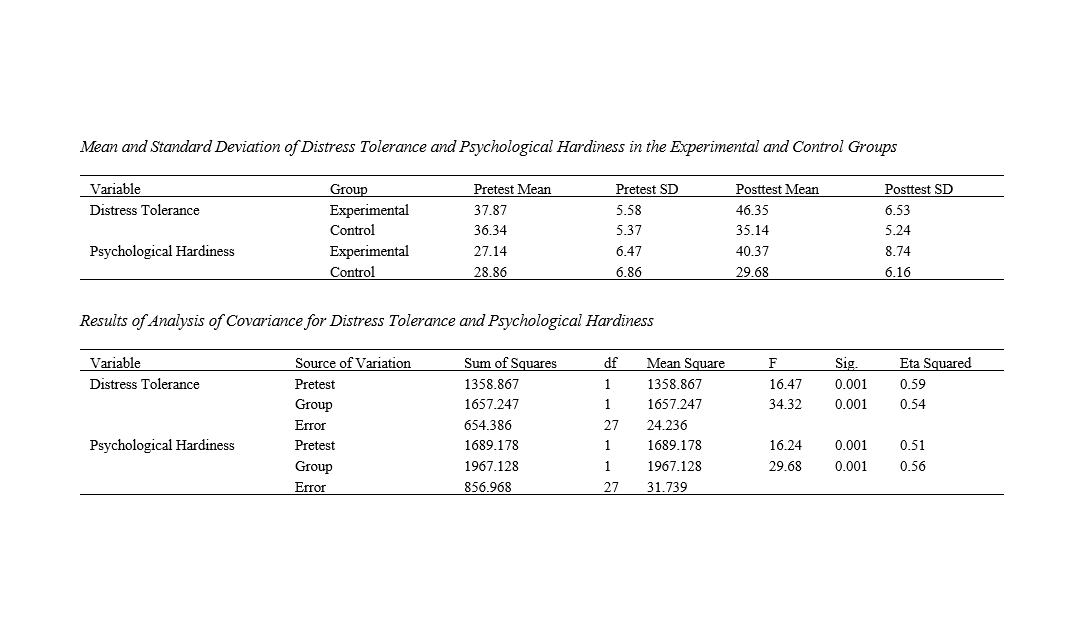
The present study was conducted to determine the effectiveness of cognitive behavioral therapy on distress tolerance and psychological hardiness in adolescents experiencing parental bereavement. The research method was quasi-experimental with a pretest–posttest design and a control group. The statistical population of the present study consisted of adolescents experiencing parental bereavement who were referred to the Arsam Psychological Services and Counseling Center in the city of Tonekabon in 2026. First, the Barrett and Scott Grief Experience Questionnaire (1998) was distributed among all participants. Then, 30 individuals with moderate grief experience (scores between 68 and 102) were selected through purposive and convenience sampling methods and were randomly assigned to two groups: an experimental group of 15 participants and a control group of 15 participants. Data were collected using the Distress Tolerance Questionnaire and the Psychological Hardiness Questionnaire. Subsequently, cognitive behavioral therapy was implemented for the experimental group in 8 sessions of 90 minutes each. After the completion of the cognitive behavioral therapy sessions, posttests were administered to both the experimental and control groups. The findings indicated a significant difference between the mean pretest and posttest scores of the experimental and control groups in terms of distress tolerance and psychological hardiness. Therefore, cognitive behavioral therapy has an effect on distress tolerance and psychological hardiness in adolescents experiencing parental bereavement.
Downloads
References
Allahmoradi, M., Yaghoubi, M., Ebrahimi, F., Pourmohammadghouchani, K., & Norouziani, Z. (2026). Comparison of the Effectiveness of Cognitive Behavioral Therapy and Acceptance and Commitment Therapy on Referential Thoughts, Cognitive Flexibility, and Distress Tolerance in Patients with Major Depression. Psychological Dynamics in Mood Disorders, 1-18. https://maherpub.com/pdmd/article/view/628
Bayat, B., Tavakoli, B., & Ghanadi, N. (2019). The effectiveness of cognitive-behavioral stress management training on rumination and psychological distress in women exposed to spousal infidelity. Applied Family Therapy Quarterly, 3(10), 22-77.
Bermpohl, F. M. g., & Martin, A. (2025). Efficacy of Cognitive Behavioral Therapy and Acceptance- And Mindfulness-Based Treatments in Adults With Bodily Distress: A Network Meta-Analysis. Psychotherapy and psychosomatics, 94(3), 207-224. https://doi.org/10.1159/000544825
Boelen, P. A., Eisma, M. C., Smid, G. E., & Lenferink, L. I. (2020). Prolonged grief disorder in section II of DSM-5: A commentary. European Journal of Psychotraumatology, 11(1), 1771008.
Colich, N. L., Hanford, L. C., Weissman, D. G., Allen, N. B., Shirtcliff, E. A., Lengua, L. J., Sheridan, M. A., & McLaughlin, K. A. (2023). Childhood trauma, earlier pubertal timing, and psychopathology in adolescence: The role of corticolimbic development. Developmental Cognitive Neuroscience, 59, 101187.
Dugal, C., Bigras, N., Godbout, N., & Belanger, C. (2016). Childhood interpersonal trauma and its repercussions in adulthood: An analysis of psychological and interpersonal sequelae.
Malek Varansfaderani, H., Mohammadpanah Ardakan, A., & Manfi, S. (2022). Predicting emotional self-efficacy based on family communication patterns with the mediating roles of anger rumination and ego strength in adolescents. Seventh International Conference on Psychology, Educational Sciences, and Child Rights in the Islamic World, Tehran.
Mattingley, S., Youssef, G. J., Manning, V., Graeme, L., & Hall, K. (2022). Distress tolerance across substance use, eating, and borderline personality disorders: A meta-analysis. Journal of affective disorders, 300, 492-504.
Mirjani, R., & Valadkhani, F. (2024). The role of childhood trauma in predicting attitudes toward romantic relationships. Fourth National and First International Conference on Child and Adolescent Clinical Psychology, Ardabil.
Neimeyer, R. A., Keesee, N. J., & Fortner, B. V. (2016). Loss and meaning reconstruction: Propositions and procedures. In R. Malkinson, S. Rubin, & E. Witztum (Eds.), Traumatic and nontraumatic loss and bereavement: Clinical theory and practice (pp. 197-230). Psychosocial Press.
Pandey, D., & Shrivastava, P. (2017). Mediation effect of social support on the association between hardiness and immune response. Asian Journal of Psychiatry, 26, 52-55.
Pouri, S. (2016). Comparison of psychological capital, hardiness, and quality of life between divorced and normal women in Aqqala County. Provincial Conference on Women's Health, Aliabad Katoul.
Prigerson, H. G., Kakarala, S., Gang, J., & Maciejewski, P. K. (2021). History and status of prolonged grief disorder as a psychiatric diagnosis. Annual Review of Clinical Psychology, 17, 109-126.
Rosner, R., Comtesse, H., Vogel, A., & Doering, B. K. (2021). Prevalence of prolonged grief disorder. Journal of affective disorders, 287, 301-307.
Sadock, B. J., Sadock, V. A., & Ruiz, P. (2015). Kaplan and Sadock's synopsis of psychiatry (M. Ganji, Trans.; 2 ed.). Savalan.
Selvapandiyan, J. (2019). Status of cognitive behaviour therapy in India: Pitfalls, limitations and future directions-A systematic review and critical analysis. Asian Journal of Psychiatry, 41, 1-4.
Taukeni, S. G. (2015). Orphan adolescents' lifeworlds on school-based psychosocial support. Health Psychology and Behavioral Medicine, 3(1), 12-24.
Treml, J., Kaiser, J., Plexnies, A., & Kersting, A. (2020). Assessing prolonged grief disorder: A systematic review of assessment instruments. Journal of affective disorders, 274, 420-434.
Veilleux, J. C. (2019). The relationship between distress tolerance and cigarette smoking: A systematic review and synthesis. Clinical psychology review, 71, 78-89.
Yaghoubi, M., Ebrahimi, F., Pour Mohammad Ghochani, K., & Noorouziani, Z. (2026). A Comparison of the Effectiveness of Cognitive Behavioral Therapy and Acceptance and Commitment Therapy on Referential Thoughts, Cognitive Flexibility, and Distress Tolerance in Patients with Major Depression. Psychological Dynamics in Mood Disorders, 1-18. https://doi.org/10.1002/da.22878
Zhang, L. F. (2011). Hardiness and the Big Five personality traits among Chinese university students. Learning and Individual Differences, 21(1), 109-113.
Zhong, Z. M., Jiang, H., Wang, H., & Liu, Y. (2025). The Association Between Mindfulness and Athletes' Distress Tolerance: The Mediating Roles of Cognitive Reappraisal and Mental Toughness. Behavioral Sciences, 15(3), 298. https://doi.org/10.3390/bs15030298
Downloads
Additional Files
Publication Timeline
- Submitted
- Revised
- Accepted