
Structural Model of Predicting Rumination in Individuals with Generalized Anxiety Disorder Based on Integrative Self-Knowledge and Mentalization: The Mediating Roles of Psychological Flexibility and Distress Tolerance
Keywords:
Generalized Anxiety Disorder, Rumination, Integrative Self-Knowledge, Mentalization, Psychological Flexibility, Distress Tolerance, Structural Equation ModelingAbstract
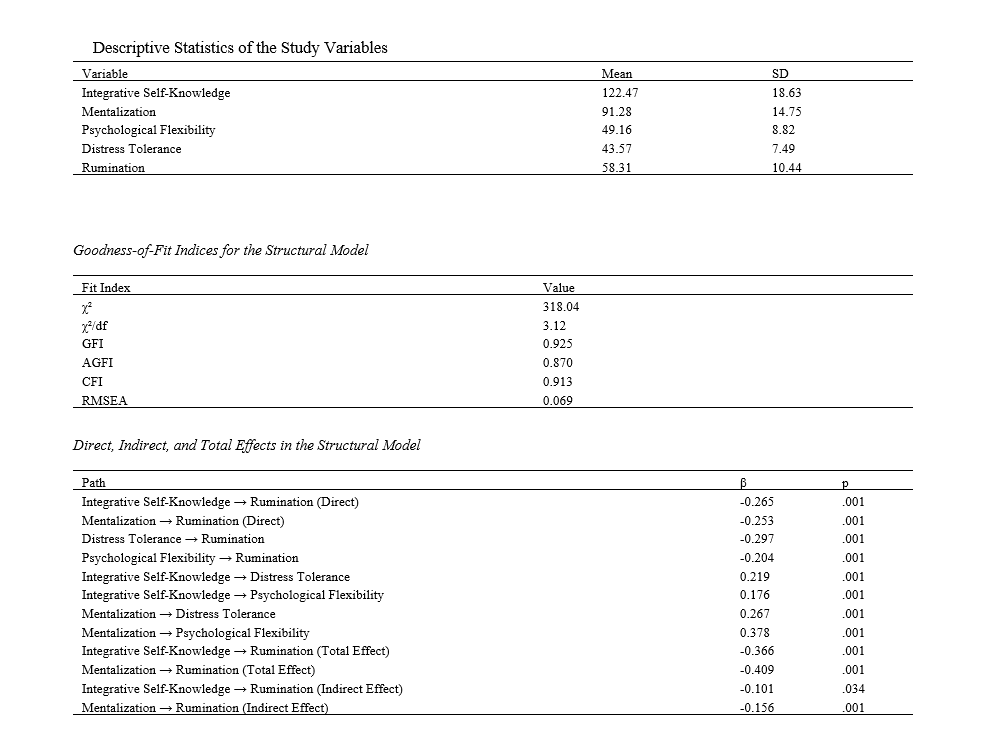
The present study aimed to develop and test a structural model for predicting rumination among individuals with Generalized Anxiety Disorder (GAD) based on integrative self-knowledge and mentalization, considering the mediating roles of psychological flexibility and distress tolerance. This applied, descriptive-correlational study was conducted among university students diagnosed with Generalized Anxiety Disorder in Qom, Iran, during 2025. A purposive sample of 270 participants was selected based on predefined inclusion criteria. Data were collected using the Integrative Self-Knowledge Scale, Mentalization Scale, Acceptance and Action Questionnaire-II, Distress Tolerance Scale, and Ruminative Responses Scale. Structural equation modeling and path analysis were performed using SPSS-23 and AMOS-23 to examine the direct and indirect relationships among the study variables and to evaluate the proposed structural model. The findings indicated that rumination was directly and negatively predicted by integrative self-knowledge (β = −0.265, p = .001), mentalization (β = −0.253, p = .001), distress tolerance (β = −0.297, p = .001), and psychological flexibility (β = −0.204, p = .001). Integrative self-knowledge positively predicted distress tolerance (β = 0.219, p = .001) and psychological flexibility (β = 0.176, p = .001). Similarly, mentalization positively predicted distress tolerance (β = 0.267, p = .001) and psychological flexibility (β = 0.378, p = .001). Significant indirect effects were observed for integrative self-knowledge (β = −0.101, p = .034) and mentalization (β = −0.156, p = .001) on rumination through the mediating variables. The results suggest that higher levels of integrative self-knowledge and mentalization contribute to lower levels of rumination among individuals with GAD both directly and indirectly through enhanced psychological flexibility and distress tolerance.
Downloads
References
American Psychiatric, A. (2022). Diagnostic and Statistical Manual of Mental Disorders (5th ed.). American Psychiatric Publishing. https://doi.org/10.1176/appi.books.9780890425787
Bateman, A. W., & Fonagy, P. (2016). Mentalization-Based Treatment for Personality Disorders: A Practical Guide. Oxford University Press. https://doi.org/10.1093/med:psych/9780199680375.001.0001
Costa, J., Maroco, J., Pinto-Gouveia, J., & Galhardo, A. (2014). Validation of the Psychometric Properties of Acceptance and Action Questionnaire-II in Clinical and Nonclinical Groups of Portuguese Population. International journal of psychology and psychological therapy, 14(3), 353-364.
Dimitrijevic, A., Hanak, N., Dimitrijevic, A., & Marjanovic, Z. (2017). The Mentalization Scale (MentS): A Self-Report Measure for the Assessment of Mentalizing Capacity. Journal of Personality Assessment, 100(3), 1-14. https://doi.org/10.1080/00223891.2017.1310730
Esmailnezhad, M., & Mazrae, A. (2025). The Mediating Role of Rumination in Coping with Emotional Distress and Cognitive Flexibility with Existential Anxiety in Adolescent Athletes. Child Emotional Development Psychology, 1(3).
Kessler, R. C., Petukhova, M., Sampson, N. A., Zaslavsky, A. M., & Wittchen, H. U. (2012). Twelve-Month and Lifetime Prevalence and Lifetime Morbid Risk of Anxiety and Mood Disorders in the United States. International Journal of Methods in Psychiatric Research, 21(3), 169-184. https://doi.org/10.1002/mpr.1359
Levin, M. E., Hildebrandt, M. J., Lillis, J., & Hayes, S. C. (2014). The Impact of Treatment Components Suggested by the Psychological Flexibility Model: A Meta-Analysis of Laboratory-Based Component Studies. Behavior therapy, 45(6), 741-756. https://doi.org/10.1016/j.beth.2012.05.003
Luyten, P., Campbell, C., & Fonagy, P. (2020). The Mentalizing Approach to Psychopathology: State of the Art and Future Directions. Annual Review of Clinical Psychology, 16, 297-325. https://doi.org/10.1146/annurev-clinpsy-071919-015355
Mahmoudpour, A., Shariatmadar, A., Borjali, A., & Shafiabadi, A. (2021). Psychometric Properties of the Distress Tolerance Scale (DTS) in the Elderly. Quarterly of Educational Measurement, 12(46), 49-64. https://doi.org/10.22054/jem.2022.65915.3341
McEvoy, P. M., Watson, H., Watkins, E. R., & Nathan, P. (2013). The Relationship between Worry, Rumination, and Comorbidity: Evidence for Repetitive Negative Thinking as a Transdiagnostic Construct. Journal of affective disorders, 151(1), 313-320. https://doi.org/10.1016/j.jad.2013.06.014
Newman, M. G., Llera, S. J., Erickson, T. M., Przeworski, A., & Castonguay, L. G. (2013). Worry and Generalized Anxiety Disorder: A Review and Theoretical Synthesis of Evidence on Nature, Etiology, Mechanisms, and Treatment. Annual Review of Clinical Psychology, 9, 275-297. https://doi.org/10.1146/annurev-clinpsy-050212-185544
Patel, A., Daros, A. R., Irwin, S. H., Lau, P., Hope, I. M., Perkovic, S. J. M., Laposa, J. M., Husain, M. I., Levitan, R. D., Kloiber, S., & Quilty, L. C. (2023). Associations between Rumination, Depression, and Distress Tolerance during CBT Treatment for Depression in a Tertiary Care Setting. Journal of affective disorders, 339, 74-81. https://doi.org/10.1016/j.jad.2023.06.063
Ruscio, A. M., Hallion, L. S., Lim, C. C. W., Aguilar-Gaxiola, S., Al-Hamzawi, A., Alonso, J., & Scott, K. M. (2017). Cross-Sectional Comparison of the Epidemiology of DSM-5 Generalized Anxiety Disorder across the Globe. JAMA Psychiatry, 74(5), 465-475. https://doi.org/10.1001/jamapsychiatry.2017.0056
Safari Mousavi, S. S., Sadeghi, M., & Sepahvandi, M. A. (2020). Factor Structure and Psychometric Properties of the Mentalization Questionnaire (MZQ): A Self-Report Instrument for Assessing Mentalizing Capacity. Research in cognitive and behavioral sciences, 10(1), 123-134. https://doi.org/10.22108/CBS.2021.127401.1492
Schwartz, S. J., Luyckx, K., & Vignoles, V. L. (2011). Handbook of Identity Theory and Research. Springer. https://doi.org/10.1007/978-1-4419-7988-9
Zetsche, U., Buerkner, P. C., & Schulze, L. (2018). Shedding Light on the Association between Repetitive Negative Thinking and Psychopathology: A Meta-Analysis. Clinical psychology review, 63, 56-68. https://doi.org/10.1016/j.cpr.2018.06.001
Downloads
Additional Files
Publication Timeline
- Submitted
- Revised
- Accepted