Assessing the Effectiveness of a Game-Based Educational Package for the Tenth-Grade English Language Course on Students’ Higher-Order Cognitive Levels
Keywords:
Educational package, gamification, English language course, tenth gradeAbstract
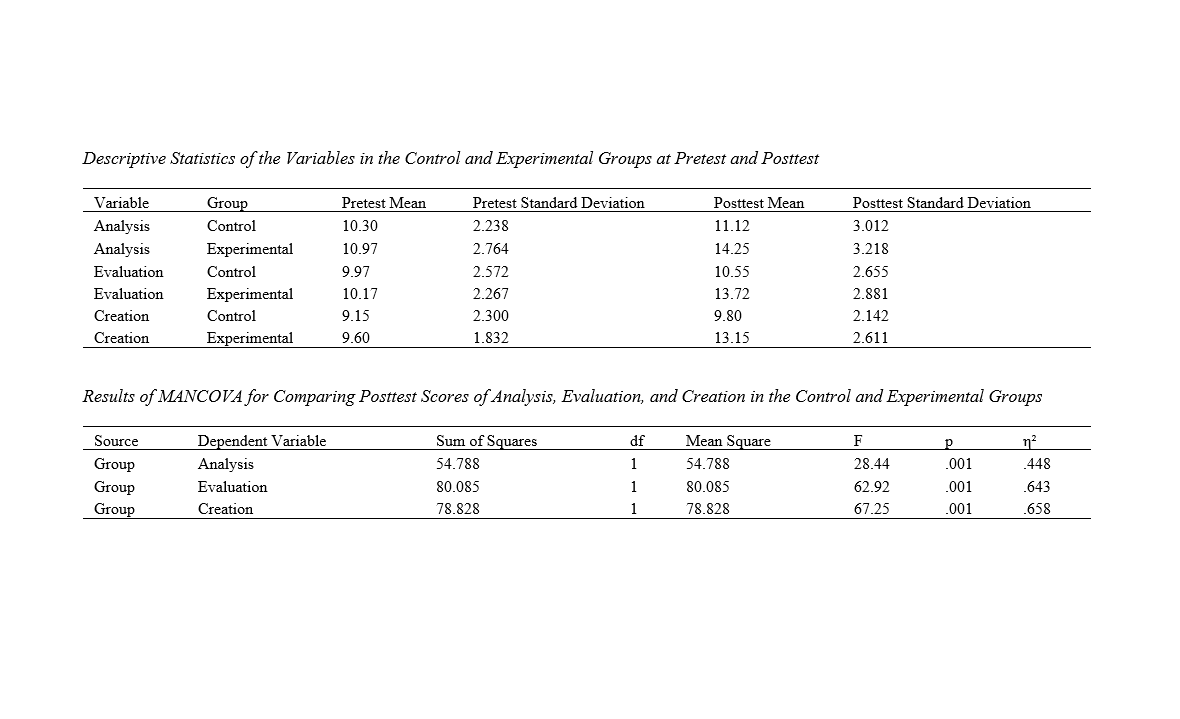
The present study was conducted to assess the effectiveness of a game-based educational package for the tenth-grade English language course on students’ higher-order cognitive levels. A quasi-experimental method with a pretest–posttest design and a control group was employed. The statistical population consisted of all tenth-grade students in Rafsanjan during the 2024–2025 academic year. For the screening phase, a sample of 384 students who experienced difficulties in learning English (i.e., obtained scores below 14 in each of the higher-order cognitive levels—analysis, evaluation, and creation—on a researcher-developed English language test) and were willing to cooperate with the researcher was selected. The students were then randomly assigned to two groups of 20 participants each. Subsequently, one group was designated as the experimental group and received English language instruction based on the developed game-based educational package for eight weeks, three sessions per week (from January 4 to March 5, 2025). During the same period, members of the control group received traditional English language instruction and did not participate in any supplementary educational programs or extracurricular instructional activities. Upon completion of the intervention, the English language test was administered to both groups. Data were analyzed using Multivariate Analysis of Covariance (MANCOVA) in SPSS version 25. The findings indicated that the game-based English language educational package had a simultaneous effect on the linear combination of analysis, evaluation, and creation in the tenth-grade English language course. The effect size of the game-based educational package on the combined linear construct of analysis, evaluation, and creation among students was 0.819. Furthermore, the effect sizes for analysis, evaluation, and creation were 0.448, 0.643, and 0.658, respectively.
Downloads
References
Abdolmaleki, N., & Saeedi, Z. (2024). Brain-Based CALL in Flipped Higher Education GE Courses Held Through LMS: Boosting Vocabulary Learning and Reading Comprehension. International Journal of Educational Technology in Higher Education, 21(1). https://doi.org/10.1186/s41239-024-00442-9
Ahmed, A. A. A., Ampry, E. S., Komariah, A., Hassan, I., Thahir, I., Ali, M. H., Faisal, A. F., & Zafarani, P. (2022). Investigating the Effect of Using Game-Based Learning on EFL Learners’ Motivation and Anxiety. Education Research International, 2022, 1-9. https://doi.org/10.1155/2022/6503139
Charunin, W., Yunus, M. M., & Hashim, H. (2024). New Digital Gamification Perception in STEAM Approach: Secondary ESL Teachers' Perspectives in STEAM-oriented ESL Classrooms. International Journal of Academic Research in Business and Social Sciences, 14(6). https://doi.org/10.6007/ijarbss/v14-i6/21718
Dallasheh, W. (2024). Content Analysis of the EFL Textbook Units According to Bloom’s Taxonomy: Between Theory and Practice. Journal of Higher Education Theory and Practice, 24(4). https://doi.org/10.33423/jhetp.v24i4.6960
Doğan, C., Taraf, H. U., & Demirel, E. E. (2023). Examining Pre-Service Elt Teachers’ Questioning Strategies. Nevşehir Hacı Bektaş Veli Üniversitesi SBE Dergisi, 13(2), 1002-1014. https://doi.org/10.30783/nevsosbilen.1268684
Du, X., & Zhang, L. (2022). Investigating EFL Learners’ Perceptions of Critical Thinking Learning Affordances: Voices From Chinese University English Majors. Sage Open, 12(2). https://doi.org/10.1177/21582440221094584
Duresa, M. (2023). Active Learning: EFL Teachers’ Role in ELT Classrooms of Ebantu District Secondary Schools. https://doi.org/10.21203/rs.3.rs-3757678/v1
Hasnah, Y., Ginting, P., Supiatman, L., Kharisma, A. J., & Siahaan, H. S. (2023). How Do Locally Produced EFL Textbooks Endorse Critical Thinking Skills in Indonesia? A Content Analysis. Journal of Language Teaching and Research, 15(1), 190-200. https://doi.org/10.17507/jltr.1501.21
Hastuti, D., Kristina, D., & Setyaningsih, E. (2022). Developing Thinking Reading Classrooms: Insight From Pre-Service EFL Teachers’ Lesson Plans and Classroom Instructions. Register Journal, 15(2), 201-221. https://doi.org/10.18326/rgt.v15i2.201-221
Inayati, N., & Waloyo, A. A. (2022). The Influence of Quizziz-Online Gamification on Learning Engagement and Outcomes in Online English Language Teaching. Journal on English as a Foreign Language, 12(2), 249-271. https://doi.org/10.23971/jefl.v12i2.3546
Işıklı, C. (2021). İngilizce Öğretiminde Eleştirel Yaklaşım: Öğrencilerde Eleştirel Düşünmeyi Geliştirmek. Rumelide Dil Ve Edebiyat Araştırmaları Dergisi(Ö9), 364-373. https://doi.org/10.29000/rumelide.984809
Kaur, R., Sarkar, R., Lalitha, M. K., Chandra, S., & Anand, T. (2025). The Effect of AI-Enhanced Gamification on Learning Outcomes in Higher Education. 75-104. https://doi.org/10.4018/979-8-3373-5077-6.ch004
Kshetree, A. K. (2023). Pedagogical Content Knowledge and the Nepali English Language Teacher Training. Journal of Tilottama, 1(1), 1-23. https://doi.org/10.3126/jtilottama.v1i1.64512
Li, X., Kangas, M., & Zhang, J. (2025). Comparing the effects of playful pedagogical activities and traditional methods on EFL vocabulary learning. International Journal of Game-Based Learning, 15(1). https://doi.org/10.4018/IJGBL.389046
Lo, N., & Shi, H. (2024). The Perceptions of Undergraduate Students Toward Reading Contemporary Fiction in English: A Case Study of Content-Based ESL Instruction at a Self-Financed Tertiary Institution in Hong Kong. Frontiers in Education, 9. https://doi.org/10.3389/feduc.2024.1395168
Mahdi, D. A. (2024). Effectiveness of LEP Activities in Enhancing EFL Students' Oral Communication Skills at King Khalid University. Saudi Journal of Language Studies, 4. https://doi.org/10.1108/sjls-10-2023-0047
Muthmainnah, M., Riswanto, R., Santiana, S., Fadhillah, N., Apriani, E., & Syafryadin, S. (2022). Developing Elt Materials-Ict Based Amid Covid-19. English Review Journal of English Education, 10(2), 713-728. https://doi.org/10.25134/erjee.v10i2.6331
Ng, Q. Y., & Jeyaraj, J. J. (2023). Evaluating Critical Thinking Elements in a Secondary School English Language Textbook in Malaysia. International Journal of Academic Research in Progressive Education and Development, 12(2). https://doi.org/10.6007/ijarped/v12-i2/17454
Qiao, S., Yeung, S. S., Shen, X., & Chu, S. K. W. (2022). The Effects of a Gamified Morphological Awareness Intervention on Students' Cognitive, Motivational and Affective Outcomes. British Journal of Educational Technology, 53(4), 952-976. https://doi.org/10.1111/bjet.13178
Rutkienė, A., Kaçar, I. G., Karakuş, E., Baltacı, H. Ş., Altun, M., Şahintaş, Z. A., Barendsen, R., Wierda, R., & Crespo, B. (2022). The Impact of Flipped Learning on Students’ Engagement and Satisfaction Development: A Cross-Country Action Research Study. Pedagogika, 147(3), 253-281. https://doi.org/10.15823/p.2022.147.12
Sayed, E. R. E. (2022). The Impact of Utilizing Competitive Digital Games on Developing Vocabulary Retention of Primary Stage Pupils. مجلة کلية التربية بنها, 33(130), 41-78. https://doi.org/10.21608/jfeb.2022.275328
Shafie, B., Selvakumaran, Y., Hashim, H., & Yunus, M. M. (2024). From Clues to Conclusion: Using ‘A Bloody Reunion’ to Enhance Inferring Skills Among University EFL Learners. International Journal of Academic Research in Business and Social Sciences, 14(8). https://doi.org/10.6007/ijarbss/v14-i8/22434
Shafiei Sarvestani, M., Mirani Sargazi, N., Hafezi, A., Jami, M., & Mirgol, A. (2025). Explaining the Role of Gamification in Developing Creative Thinking Skills and Research Tendencies in Virtual Education among Medical Sciences Students in Yazd during the Post-Corona Period. Jundishapur Education Development Journal, 16(1), 26-38.
Shahid, M. A., Hafiz, M. S., & Mazhar, R. (2024). The Role of Graphic Organizer Technique in Constructing English Vocabulary of Secondary Level Language Learners. Jep. https://doi.org/10.7176/jep/15-6-14
Soe, T. (2024). Investigating Critical Thinking in ELT Textbooks: A Systematic Literature Review of Textbook Evaluation Studies. Theory and Practice of Second Language Acquisition, 10(1), 1-29. https://doi.org/10.31261/tapsla.13882
Taherkhani, R., & Gholizadeh, M. (2024). A Meta-Synthesis Study on the Effect of Critical Thinking on Improving Language Skills. Forum for Linguistic Studies, 5(3). https://doi.org/10.59400/fls.v5i3.1687
Temel, T., & Cesur, K. (2024). The Effect of Gamification With Web 2.0 Tools on EFL Learners’ Motivation and Academic Achievement in Online Learning Environments. Sage Open, 14(2). https://doi.org/10.1177/21582440241247928
Tuxtayevich, K. I., Ahmatovna, P. S., Turgunbayevna, M. N., Rasulovna, R. M., Qizi, T. F. R., & qizi, Y. N. A. (2024). Different Approaches to Enhance Critical Thinking in Digital Education. Spast Reports, 1(7). https://doi.org/10.69848/sreports.v1i7.5086
Ulum, Ö. G. (2021). A Critical Approach to the Inclusion of the Revised Bloom’s Taxonomy in Active Skills for Reading: Book 1. Rumelide Dil Ve Edebiyat Araştırmaları Dergisi(25), 273-296. https://doi.org/10.29000/rumelide.1037134
Zakaria, N., Hussain, M. N. M., Jalil, N. A., Yunus, M. M., Hashim, H., & Rafiq, K. R. M. (2023). Redefine Reading Comprehension With Tarsia: An Innovative Approach in Understanding Reading Text. International Journal of Academic Research in Business and Social Sciences, 13(12). https://doi.org/10.6007/ijarbss/v13-i12/20128
Downloads
Additional Files
Publication Timeline
- Submitted
- Revised
- Accepted