Testing a Causal Model of Avoidant Insecure Attachment and Marital Conflict Through Self-Differentiation and Cognitive Emotion Regulation: The Moderating Role of Emotional Intelligence in Married Students
Keywords:
Avoidant insecure attachment, marital conflict, self-differentiation, cognitive emotion regulation, emotional intelligence, married studentsAbstract
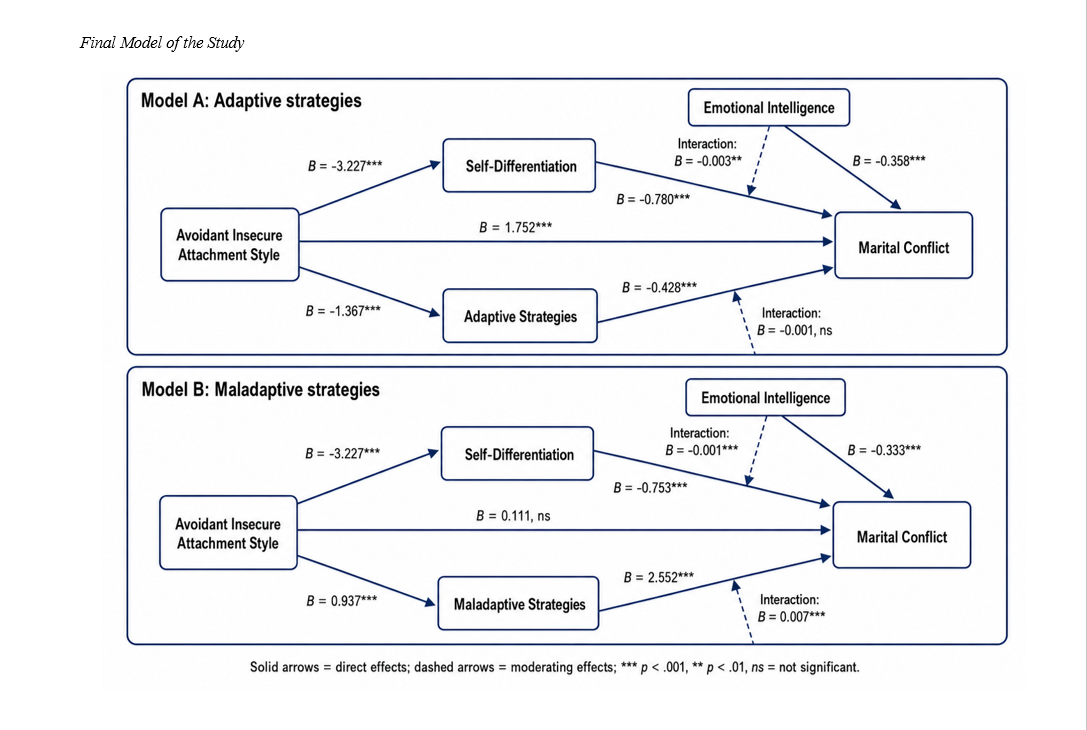
This study aimed to test a causal moderated mediation model explaining marital conflict based on avoidant insecure attachment, with self-differentiation and cognitive emotion regulation as mediators and emotional intelligence as a moderator among married university students. This descriptive-correlational study was conducted using structural equation modeling and conditional process analysis. The statistical population included married undergraduate students at Islamic Azad University, Ahvaz Branch, during the 2025–2026 academic year. A total of 720 married students, including 360 women and 360 men, were selected through multistage random sampling. Data were collected using the Adult Attachment Scale, Marital Conflict Questionnaire, Differentiation of Self Inventory–Short Form, Cognitive Emotion Regulation Questionnaire–Short Form, and Schutte Emotional Intelligence Scale–Revised. Data were analyzed using SPSS, AMOS, and PROCESS Model 14. The results showed that avoidant insecure attachment had a significant positive direct effect on marital conflict in both tested models. Avoidant attachment significantly and negatively predicted self-differentiation and adaptive cognitive emotion regulation, while it significantly and positively predicted maladaptive cognitive emotion regulation. Self-differentiation and emotional intelligence had significant negative direct effects on marital conflict. Adaptive cognitive emotion regulation significantly and negatively predicted marital conflict, whereas maladaptive cognitive emotion regulation significantly and positively predicted marital conflict. The interaction between self-differentiation and emotional intelligence was significant in both models, indicating that emotional intelligence moderated the association between self-differentiation and marital conflict. The interaction between maladaptive cognitive emotion regulation and emotional intelligence was also significant, whereas the interaction involving adaptive strategies was not significant. Conditional indirect effects of avoidant attachment on marital conflict through self-differentiation and maladaptive strategies were significant across different levels of emotional intelligence.
Downloads
References
Asadi, M., Pour Ebrahim, T., Farrokhi, N., & Davaei, M. (2022). Modeling marital burnout based on attachment styles in married individuals: The mediating role of differentiation of self. Applied Family Therapy, 3(1), 445-460. https://doi.org/10.61838/kman.aftj.3.1.22
Bagheri-Sheikhangafsheh, F., Hajialiani, V., & Hassani, J. (2022). The role of emotion regulation strategies in mental health during the 2019 coronavirus disease (COVID-19) pandemic: A systematic review. Journal of Modern Medical Information Sciences, 8(2), 196-207.
Buttar, F., Haq, I. U., & Malik, A. A. (2022). Adult attachment styles, spousal support and marital satisfaction in newly married men and women. Journal of Applied Business and Social Sciences, 1(1), 107-142.
Carolus, A. E., & Starr, L. R. (2025). Negative Emotion Differentiation in Adolescents: Unpacking Linkages With Emotion Regulation Traits and Behaviours, Rumination, and Depression. Cognition and Emotion, 1(2), 1-7. https://doi.org/10.1080/02699931.2025.2523812
Dorabi Ammari, A., & Mahmoodi, F. (2025). The role of mothers' stress in children's behavioral-emotional problems: The mediating role of family educational-cultural functioning. New Studies in Educational Sciences, 1(1), 49-66. https://doi.org/10.30473/ns.2025.76262.1005
Falahzade, H., & Sivandian, M. (2025). Investigating the Mediating Role of Self-Differentiation and Emotion Regulation in the Relationship between Dyadic Perfectionism and Marital Satisfaction. American Journal of Family Therapy, 53(1), 66-79. https://doi.org/10.1080/01926187.2024.2356853
Fischer, V. J., Andersson, G., Billieux, J., & Vogele, C. (2022). The relationship between emotion regulation and sexual function and satisfaction: A scoping review. Sexual Medicine Reviews, 10(2), 195-208. https://doi.org/10.1016/j.sxmr.2021.11.004
Frydman, S., & Tena, M. A. M. (2023). Attachment styles and customers' long-term relationships in a service context. International Journal of Consumer Studies, 47(1), 267-284. https://doi.org/10.1111/ijcs.12834
Ghanavati, A., Joharifard, S., & Ehteshamzadeh, P. (2025). The Effectiveness of Group Emotion-Based Family Therapy on Self-Differentiation and Alexithymia in Adolescent Girls with Psychosomatic Disorders. Rooyesh-e-Ravanshenasi Journal, 13(9), 121-130. https://frooyesh.ir/article-1-5385-en.html
Ghavanati, J. F., Ehteshami, Z., & Parvin. (2025). Effectiveness of Emotion-Based Group Family Therapy on Self-Differentiation and Alexithymia in Adolescent Girls with Psychosomatic Disorders. Scientific Journal of Ruyesh Psychology, 13(9), 121-130. https://frooyesh.ir/article-1-5385-fa.html
Joqratian, D., Bolghan Abadi, M., & Esfahani, M. S. (2026). The Mediating Role of Emotion Regulation in the Relationship between Differentiation of Self and Marital Conflicts. Journal of Child and Family Studies, 35, 291-301. https://doi.org/10.1007/s10826-025-03146-4
Kohanmooei, S., Fattahi Andabil, A., & Mirhashemi, M. (2022). The effect of self-differentiation, attachment styles, and family functioning on marital boredom with the mediating role of emotional intelligence. Knowledge and research in applied psychology, 23(2), 63-76.
Kohanmouei, S., Fattahi-Andabil, A., & Mir-Hashemi, M. (2022). The effect of differentiation of self, attachment styles, and family functioning on marital burnout with the mediating role of emotional intelligence. Knowledge & Research in Applied Psychology, 23(2), 63-76.
Koval, P., Kalokerinos, E. K., Greenaway, K. H., Medland, H., Kuppens, P., Nezlek, J. B., Hinton, J. D. X., & Gross, J. J. (2023). Emotion regulation in everyday life: Mapping global self-reports to daily processes. Emotion, 23(2), 357. https://doi.org/10.1037/emo0001097
Kumar, R. M., & Singh, R. M. (2024). Couple identity in Indian arranged marriages: Perceived partner responsiveness as the mediator of attachment styles and couple identity. Couple and family psychology: Research and practice, 13(2), 143. https://doi.org/10.1037/cfp0000220
Liu, D., & Vazsonyi, A. T. (2024). Longitudinal links between parental emotional distress and adolescent delinquency: The role of marital conflict and parent-child conflict. Journal of youth and adolescence, 53(1), 200-216. https://doi.org/10.1007/s10964-023-01921-4
Lusiyah Simanjuntak, H. (2022). The effect of project method and self-concept on emotional intelligence of children age 5-6 years. Jurnal Obsesi: Jurnal Pendidikan Anak Usia Dini, 6(6), 6006-6016. https://doi.org/10.31004/obsesi.v6i6.2819
Parsakia, K., Rostami, M., & Saadati, S. M. (2023). The relationship between emotional intelligence and marital conflicts using actor-partner interdependence model. Journal of Psychosociological Research in Family and Culture, 1(1), 23-28. https://doi.org/10.61838/kman.jprfc.1.1.6
Ramos-Cejudo, J., Salguero, J. M., García-Sancho, E., & Gross, J. J. (2024). Emotion Regulation Frequency and Self-Efficacy: Differential Associations with Affective Symptoms. Behavior therapy, 55(5), 1004-1014.
Sadeghi, I., Salahyan, A., & Salehy, M. (2022). The role of self-knowledge, love and emotional intelligence in predicting marital conflicts. Counseling Culture and Psychotherapy, 13(50), 69-97.
Schlosser, G. (2023). From self-differentiation to organoids: The quest for the units of development. Development Genes and Evolution, 234(2), 57-64. https://doi.org/10.1007/s00427-023-00711-z
Shafiee Sourak, S., & Shamsoddinpour, A. (2026). The effectiveness of emotional intelligence training on social anxiety and perfectionism of art students in Kerman city. Motaleat-e Novin dar Olum-e Tarbiati, 1(2), 9-25. https://doi.org/10.30473/ns.2026.77125.1038
Shahnoushfaroshani, M., Hemmati, Z., & Dehghan-Zadeh, M. (2022). Structural equation modeling of the relationship between emotional intelligence and self-differentiation with marital stability: The mediating role of marital intimacy. Journal of Psychological Studies, 18(1), 133-155.
Sochos, A., & Aleem, S. (2022). Parental attachment style and young persons' adjustment to bereavement. Child and Youth Care Forum, 51(1), 161-179. https://doi.org/10.1007/s10566-021-09621-5
Stuck, E., Briken, P., & Brunner, F. (2022). Changes in the risk of sexual reoffending: The role and relevance of perceived self-efficacy and adult attachment styles in correctional treatment. Sexual Abuse, 34(8), 891-922. https://doi.org/10.1177/10790632211054048
Tarifi, F., Moenian, D., & Mallazadeh, A. (2022). Predicting marital conflicts based on emotion regulation strategies with the mediation of health locus of control in women. Islamic-Iranian Family Studies, 2(4), 32-49.
Tasew, A. S., & Getahun, K. K. (2021). Marital conflict among couples: The case of Durbete town, Amhara Region, Ethiopia. Cogent Psychology, 8(1), 1903127. https://doi.org/10.1080/23311908.2021.1903127
Tatkin, S. (2024). Wired for Love: How Understanding Your Partner's Brain and Attachment Style Can Help You Defuse Conflict and Build a Secure Relationship. New Harbinger Publications.
Wang, X., & Zhao, K. (2023). Partner phubbing and marital satisfaction: The mediating roles of marital interaction and marital conflict. Social Science Computer Review, 41(4), 1126-1139. https://doi.org/10.1177/08944393211072231
Willis, K., Miller, R. B., Yorgason, J., & Dyer, J. (2021). Was Bowen correct? The relationship between differentiation and triangulation. Contemporary Family Therapy, 43, 1-11. https://doi.org/10.1007/s10591-020-09557-3
Zhang, H., Gao, T., Hu, Q., Zhao, L., Wang, X., Sun, X., & Li, S. (2023). Parental marital conflict, negative emotions, phubbing, and academic burnout among college students in the postpandemic era: A multiple mediating models. Psychology in the Schools, 60(5), 1488-1498. https://doi.org/10.1002/pits.22707
Downloads
Additional Files
Publication Timeline
- Submitted
- Revised
- Accepted