Evaluation of a Conceptual Model of the Relationships of Communication Patterns and Love Styles with Marital Burnout: The Mediating Roles of Forgiveness and Self-Worth among Married Women
Keywords:
marital burnout model, communication patterns, forgiveness, self-worth, love stylesAbstract
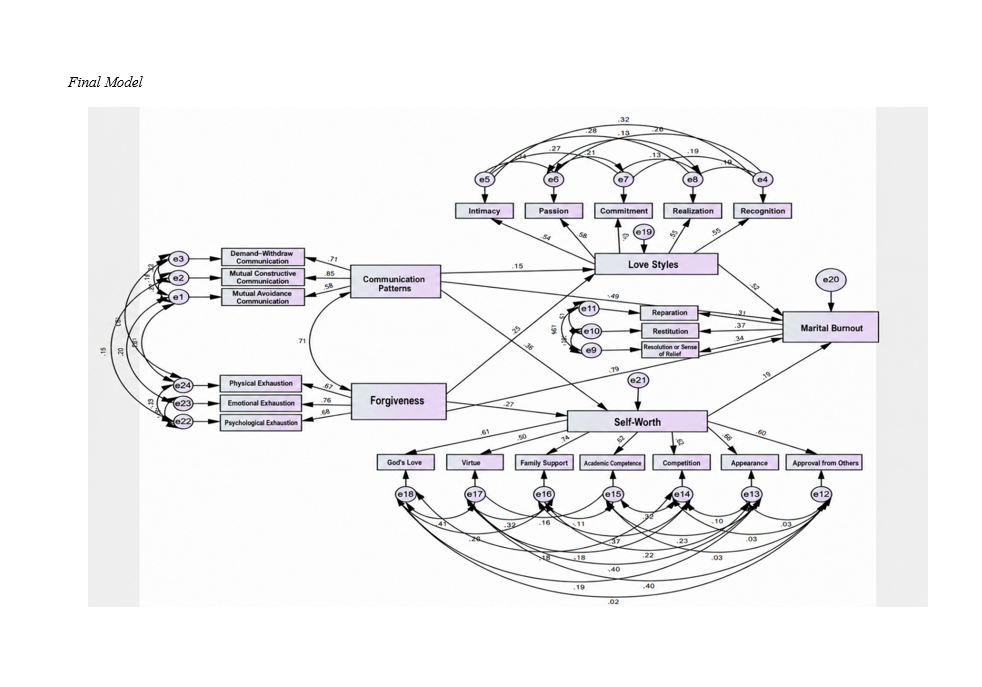
The present study aimed to evaluate the fit of a conceptual model explaining the relationships of communication patterns and love styles with marital burnout, considering the mediating roles of forgiveness and self-worth among married women. The research employed a descriptive design based on correlational modeling. The statistical population consisted of all married women residing in Tehran. The sample size was determined using the formula N ≥ 50 + 8M, recommended by Tabachnick and Fidell, as well as Cochran’s formula. Accordingly, 385 married women were included in the analysis. Participants were selected through convenience sampling from five geographical areas of Tehran: north, south, east, west, and central Tehran. The data collection instruments included a demographic information form assessing age, occupation, educational attainment, and duration of marriage; the Pines Couple Burnout Measure (1996); the Communication Patterns Questionnaire developed by Christensen and Shenk (1991); Sternberg’s Triangular Love Scale (1986); the Family Forgiveness Scale developed by Pollard, Anderson, and Jennings (1998); and the Contingencies of Self-Worth Scale developed by Crocker et al. (2003). Following data collection, the data were analyzed using descriptive and inferential statistical methods. Minimum and maximum scores, means, and standard deviations were calculated in the descriptive statistics section. Pearson’s correlation analysis was used in the inferential statistics section, and structural equation modeling was conducted to assess the fit of the conceptual model. Data analyses were performed using SPSS version 25 and AMOS version 26. The hypothesized research model demonstrated an acceptable fit. Communication patterns had a significant negative effect on marital burnout, and love styles had a significant negative effect on marital burnout. Communication patterns had significant positive effects on forgiveness and self-worth, while love styles had significant positive effects on self-worth and forgiveness among married women. Furthermore, communication patterns influenced marital burnout through the joint mediating roles of forgiveness and self-worth, and love styles influenced marital burnout through these two mediators. Communication patterns also influenced marital burnout through forgiveness alone, and love styles influenced marital burnout through forgiveness alone. In addition, communication patterns influenced marital burnout through self-worth, and love styles influenced marital burnout through self-worth among married women.
Downloads
References
Adams, K. E., Tyler, J. M., Calogero, R., & Lee, J. (2017). Appearance-Contingent Self-Worth and Self-Esteem: The Roles of Self-Objectification and Appearance Anxiety. Body Image, 23, 176-182. https://doi.org/10.1016/j.bodyim.2017.10.004
Afsari Gorgari, Z. (2022). Examining the Relationship between Components of Love and Marital Burnout with the Mediating Role of Family Communication Patterns. Iranian Quarterly Journal of Psychology and Behavioral Sciences, 14(30), 78-92.
Asgari, A., & Goodarzi, K. (2019). The Effectiveness of Emotional Schema Therapy on Marital Burnout in Couples on the Verge of Divorce. Disability Studies, 6(2), 174-185.
Chekani, M. (2020). Examining the Effectiveness of Schema Therapy on Marital Conflicts and Marital Burnout in Couples Seeking Divorce [Master's thesis in clinical psychology, Naser Khosrow Non-Profit University of Saveh].
Christensen, A., & Heavey, C. L. (2019). Gender and Social Structure in the Demand/Withdraw Pattern of Marital Conflict. Journal of personality and social psychology, 59(1), 73-81. https://doi.org/10.1037/0022-3514.59.1.73
Enright, R. D., & The Human Development Study, G. (2011). The Moral Development of Forgiveness. In W. Kurtines & J. Gewirtz (Eds.), Handbook of Moral Behavior and Development (Vol. 1, pp. 123-152).
Epstein, N. B., Chen, F., & Beyder-Kamjou, I. (2015). Relationship Standards and Marital Satisfaction in Chinese and American Couples. Journal of marital and family therapy, 31(1), 59-74. https://doi.org/10.1111/j.1752-0606.2005.tb01543.x
Fatemi, M., Diarian, M. M., & Mousavi, S. E. (2024). The Effectiveness of an Educational Package for Reducing Marital Burnout Based on Couples' Lived Experiences on Marital Burnout in Couples Experiencing Burnout in Married Life. Journal of Cognitive Sciences, 23(144), 254-274.
Flanagan, K. S., Hoek, K. K. V., Ranter, J. M., & Reich, H. A. (2012). The Potential of Forgiveness as a Response for Coping with Negative Peer Experiences. Journal of adolescence, 35(5), 1215-1223. https://doi.org/10.1016/j.adolescence.2012.04.004
Gottman, J. M. (2013). A Theory of Marital Dissolution and Stability. Journal of Family Psychology, 57-75. https://doi.org/10.1037//0893-3200.7.1.57
Hafiza, T. H., Loona, M., & Nawaz, A. (2025). Effect of Communication Patterns and Emotional Distress on Relationship Dissatisfaction among Married Individuals. Pakistan Journal of Psychological Research, 40(1), 135-154. https://doi.org/10.33824/PJPR.2025.40.1.09
Hazare, C., Arora, K., ReddyMula, M., Maguluri, S., Bindhu, H., & Varsha, H. (2025). The Role of Forgiveness in Conflict Resolution and Relationship Satisfaction in Romantic Relationships. 3(13), 1745-2769.
Kasprzak, A., Diaz, M., & Giraldez, C. (2025). Forgiveness in Romantic Relationships: The Moderating Role of Differentiation of Self in the Relationship between Offense Severity and Post-Offense Distress. 5(10), 1-11. https://doi.org/10.1111/famp.70082
Li, M., & Mustillo, S. (2020). Linking Mother and Offspring Depressive Symptoms: The Mediating Role of Child Appearance Contingent Self-Worth. Journal of affective disorders, 273, 113-121. https://doi.org/10.1016/j.jad.2020.03.117
Modarresi, F. (2016). Examining Marital Burnout and Marital Conflicts Based on Perfectionism and Gender [Master's thesis in psychology, Alzahra University].
Muturi, E. (2023). The Impact of Boredom in Marriage on Marital Satisfaction. International journal of psychology. https://doi.org/10.47604/ijp.2120
Naderi, H., & Ramazanzadeh Ali Zamini, R. (2015). A Comparison of Early Maladaptive Schemas in Patients with Obsessive-Compulsive Personality Disorder and a Nonclinical Group. Clinical Psychology Studies, 5(18), 127-142.
Pokorska, J. (2022). Relationship Fading in Business-to-Consumer Context Internet Aston University].
Saffarinia, M., & Moghaddasi, S. (2023). The Effectiveness of Couples' Communication Skills Training on Social Exchange Styles and Psychological Distress among Women with Marital Burnout. Rooyesh-e-Ravanshenasi Quarterly, 12(11), 109-118.
Sharifi, B., Raeisi, F., & Haji Hasani, M. (2024). The Relationship of Self-Compassion and Forgiveness with Marital Burnout with the Mediating Role of Self-Criticism in Married Individuals. Rooyesh-e-Ravanshenasi Quarterly, 13(9), 21-30.
Tahmasbi, H., & Khorramabadi, Y. (2024). Examining the Predictive Power of Agreeableness, Marital Empathy, and Marital Forgiveness for Marital Satisfaction in Married Women. Journal of Psychology, 28(1), 3-11.
Zare, F., Manshei, G., & Keshti Araei, N. (2021). The Effectiveness of Quality-of-Life Enrichment Training on Self-Worth and Psychological Capital among Female Heads of Household. Applied Family Therapy Quarterly, 2(4), 310-331.
Downloads
Additional Files
Publication Timeline
- Submitted
- Revised
- Accepted