Enhancing Emotional Awareness in Children with Symptoms of Oppositional Defiant Disorder: A Comparison of the Effectiveness of Parent–Child Interaction Therapy and the Coping Cat Program
Keywords:
emotional awareness, oppositional defiant disorder, Coping Cat programAbstract
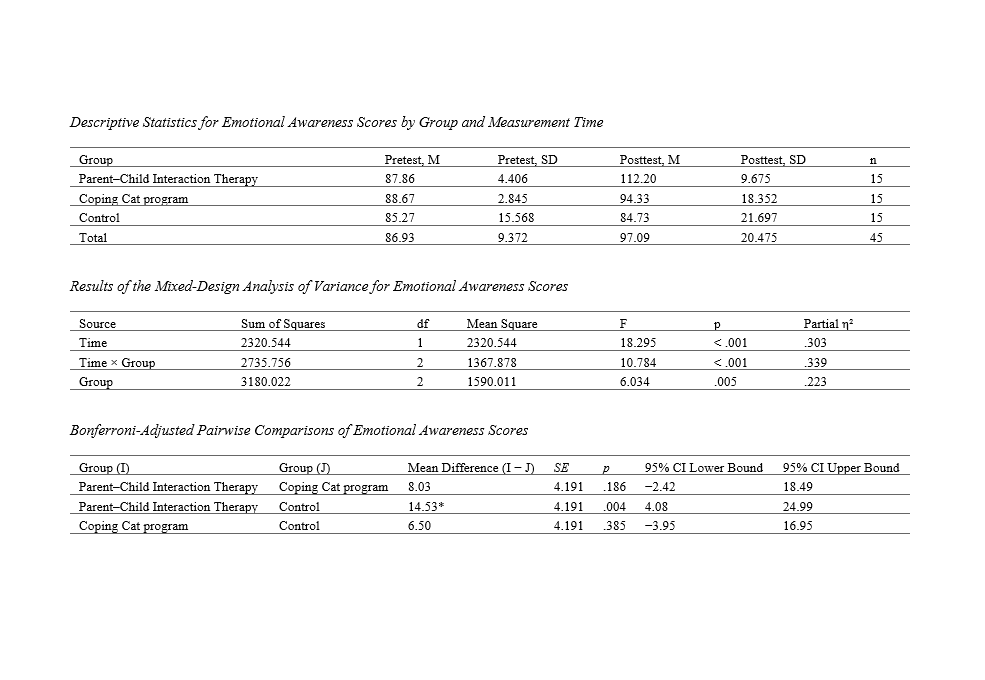
Children with symptoms of oppositional defiant disorder commonly experience difficulties in identifying, understanding, and regulating their emotions. These difficulties may negatively affect the quality of parent–child relationships, social adjustment, and emotional development. Therefore, identifying effective interventions for improving emotional awareness in this population is of particular importance. This study aimed to examine and compare the effectiveness of Parent–Child Interaction Therapy and cognitive behavioral therapy based on the Coping Cat program in improving emotional awareness among children with symptoms of oppositional defiant disorder. The study employed a sequential explanatory mixed-methods design. In the quantitative phase, a quasi-experimental pretest–posttest design with a control group was used. The statistical population comprised all children with symptoms of oppositional defiant disorder in District 2 of Tehran during the 2025–2026 academic year. From this population, 45 children were selected through convenience sampling and randomly assigned to three groups: Parent–Child Interaction Therapy, the Coping Cat program, and a control group. Data were collected using Rieffe’s Emotional Awareness Questionnaire and analyzed using mixed-design analysis of variance. In the qualitative phase, 21 parent–child dyads from the two intervention groups participated in semi-structured interviews, and the data were examined using deductive content analysis. The quantitative findings indicated that the interaction effect of time and group on emotional awareness was statistically significant. Compared with the control group, Parent–Child Interaction Therapy produced a significant improvement in emotional awareness, whereas the Coping Cat program did not differ significantly from the control group. Moreover, the direct difference between the two interventions was not statistically significant. The qualitative findings further indicated that the two interventions contributed to the enhancement of emotional awareness through different mechanisms.
Downloads
References
Bengtsson, H., & Arvidsson, A. (2022). The Distinction between Self-Concept and Self-Esteem in Adolescent Development. Journal of youth and adolescence, 51(3), 445-460.
Cheng, T. W., Mills, K. L., & Pfeifer, J. H. (2024). The Social and Cultural Processing of Adolescence: Developmental Changes and Implications. Current opinion in psychology, 56, 101765.
Cho, H. J., & Lee, J. S. (2021). The Impact of Social Media on Physical Self-Concept among Adolescents. Computers in human Behavior, 114, 106570.
Delgado, M. Y. (2022). Links between Parent-Child Attachment and Peer Relationships. Attachment & Human Development, 24(2), 123-145.
Goebbels, A. F. G. (2024). Protective Factors against Antisocial Behavior. Clinical psychology review, 104, 102300.
Hajmohammadi, Z., & Hajializadeh, K. (2019). The Effectiveness of the Coping Cat Program on Symptoms of Generalized Anxiety Disorder and Social Phobia in Children. Journal of Clinical Psychology, 11(4), 77-95.
Harter, S. (2020). Developmental Changes in Self-Understanding and Self-Evaluation during Adolescence. Child Development Perspectives, 14(1), 30-36.
Javadi, F., Hassanzadeh, S., Afrooz, G., & Ghasemzadeh, S. (2020). The Effect of Parent-Child Interaction Therapy on Family Relationships with Children with Autism Spectrum Disorder. Applied Psychological Research Quarterly, 11(3), 37-54.
Kim, S., & Choi, Y. (2022). The Protective Role of Positive Self-Concept in Adolescent Mental Health. Journal of affective disorders, 298, 110-120.
Luby, J. L., Barch, D. M., Whalen, D., Tillman, R., & Freedland, K. E. (2018). A Randomized Controlled Trial of Parent-Child Psychotherapy Targeting Emotion Development for Early Childhood Depression. American Journal of Psychiatry, 175(11), 1102-1110. https://doi.org/10.1176/appi.ajp.2018.18030321
Masjedsaraei, F., Ghasemi, M., & Karimi, L. (2021). The Effectiveness of Parent-Child Interaction Therapy on the Mother-Child Relationship and Behavioral Problems in Children with Attention-Deficit/Hyperactivity Disorder. Empowering Exceptional Children Quarterly, 12(2), 45-64.
Mohamed, S. M., Marzouk, S. A., Ahmed, F. A., Nashaat, N. A. M., & Omar, R. A. E. A. T. (2022). Cognitive Behavioral Program on Aggression and Self-Concept among Institutionalized Children with Conduct Disorder. Archives of Psychiatric Nursing, 39, 84-90. https://doi.org/10.1016/j.apnu.2022.03.012
Mukund, B., Sharma, R., & Singh, P. (2025). A Randomized Trial of the Coping Cat Program for Anxious Children in India. Journal of Clinical Child & Adolescent Psychology, 54(1), 45-58.
Mukund, B., Tiwari, R., & Jena, S. P. K. (2025). Coping Cat: A CBT Modality for Indian Children with High Anxiety. Clinical Child Psychology and Psychiatry, 30(3). https://doi.org/10.1177/13591045251324672
Roest, J. J., Van der Helm, G. H. P., Stams, G. J. J. M., & Hoeve, M. (2023). A Three-Level Meta-Analysis of the Alliance-Outcome Association in Child and Adolescent Psychotherapy. Research in Child and Adolescent Psychopathology, 51(3), 275-293. https://doi.org/10.1007/s10802-022-00986-2
Shakerimanesh, L., Ghasemi, M., & Akbari, S. (2021). The Effectiveness of Coping Cat-Based Training in Reducing Anxiety Symptoms and Increasing Cognitive Emotion Regulation and Resilience in Children Aged 7 to 12 Years. Journal of Internal Medicine Today, 27(3), 265-282.
Shiroud Aghaei, P., Narimani, M., & Barzegar, A. (2020). A Comparative Study of the Effectiveness of Cognitive Behavioral Play Therapy and Parent-Child Interaction Therapy on Executive Functions and Parent-Child Interaction in Children with Oppositional Defiant Disorder. Journal of Clinical Psychology, 12(4), 35-53.
Shokri Mirhosseini, A., Sanaei, B., & Hajializadeh, K. (2021). The Effectiveness of Coping Cat Cognitive Behavioral Therapy on Assertiveness in Children with Anxiety Disorders. Journal of Clinical Psychology, 13(2), 55-70.
Skowron, E. A., Nekkanti, A. K., Skoranski, A. M., Scholtes, C. M., Lyons, E. R., Mills, K. L., Bard, D., Rock, A., Berkman, E., Bard, E., & Funderburk, B. W. (2024). Randomized Trial of Parent-Child Interaction Therapy Improves Child-Welfare Parents' Behavior, Self-Regulation, and Self-Perceptions. Journal of consulting and clinical psychology, 92(2), 75-92. https://doi.org/10.1037/ccp0000859
Thomas, R., & Zimmer-Gembeck, M. J. (2017). Parent-Child Interaction Therapy: A Meta-Analysis. Pediatrics, 140(3), e20170352. https://doi.org/10.1542/peds.2017-0352
Zhang, H., Wang, W., & Li, Z. (2024). Effectiveness of Parent-Child Interaction Therapy for Maltreated Families: A Meta-Analysis of Randomized Controlled Trials. Trauma, Violence, & Abuse, 25(3), 2024-2040. https://doi.org/10.1177/15248380231222041
Zimmer-Gembeck, M. J., Kerin, J. L., Webb, H. J., & Gardner, A. A. (2019). Improved Perceptions of Emotion Regulation and Reflective Functioning in Parents: Two Additional Positive Outcomes of Parent-Child Interaction Therapy. Behavior therapy, 50(2), 340-352. https://doi.org/10.1016/j.beth.2018.07.002
Downloads
Additional Files
Publication Timeline
- Submitted
- Revised
- Accepted