Designing and Validating a Model for Emotional Agility
Keywords:
emotional agility, instrument development, validation, Delphi method, factor analysisAbstract
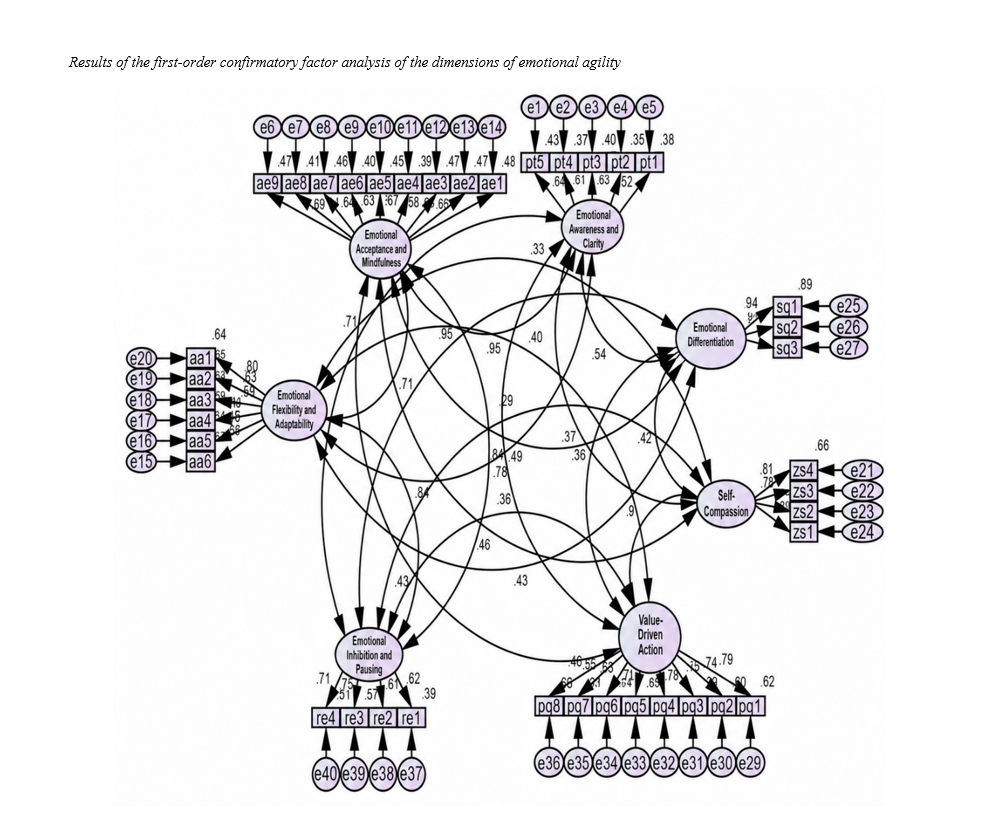
The present study aimed to design and validate an indigenous, valid, and reliable instrument for assessing emotional agility in the Iranian population. This study was conducted within an exploratory mixed-methods instrument-development design in two qualitative and quantitative phases. In the qualitative phase, using a three-round Delphi method with the participation of 18 psychology experts, 39 items were extracted across seven main dimensions, including Emotional Awareness and Clarity, Emotional Acceptance and Mindfulness, Emotional Flexibility and Adaptability, Emotional Inhibition and Pausing, Value-Driven Action and Emotional Meaning-Making, Self-Compassion and Emotional Integration, and Emotional Differentiation and Interaction. In the quantitative phase, the researcher-developed questionnaire was administered to a sample of 208 participants, and the data were analyzed using factor analysis and AMOS software. The findings indicated that the measurement model demonstrated satisfactory fit, and all items had significant factor loadings greater than 0.50. The seven dimensions were subsumed under the higher-order construct of emotional agility, and all path coefficients were statistically significant. Cronbach’s alpha coefficients for the overall instrument and all dimensions were above 0.80, indicating satisfactory reliability. The dimension of Value-Driven Action and Emotional Meaning-Making, with the highest path coefficient, constituted the central core of emotional agility. The findings emphasize that emotional agility in the Iranian population is a multidimensional and culturally adaptable construct that places particular emphasis on interpersonal and self-compassionate aspects. The developed instrument can be used in organizations and counseling centers for the assessment and enhancement of emotional agility; however, further studies are recommended to examine its criterion-related and convergent validity.
Downloads
References
Aldao, A., Nolen-Hoeksema, S., & Schweizer, S. (2010). Emotion-Regulation Strategies across Psychopathology: A Meta-Analytic Review. Clinical psychology review, 30(2), 217-237. https://doi.org/10.1016/j.cpr.2009.11.004
Aldao, A., Sheppes, G., & Gross, J. J. (2015). Emotion Regulation Flexibility. Cognitive therapy and research, 39, 263-278. https://doi.org/10.1007/s10608-014-9662-4
Bonanno, G. A., & Burton, C. L. (2013). Regulatory Flexibility: An Individual Differences Perspective on Coping and Emotion Regulation. Perspectives on Psychological Science, 8(6), 591-612. https://doi.org/10.1177/1745691613504116
David, S. (2016). Emotional Agility: Get Unstuck, Embrace Change, and Thrive in Work and Life. Avery.
David, S., & Congleton, C. (2013). Emotional Agility. Harvard business review, 91(11), 125-128.
Gross, J. J. (2015). Emotion Regulation: Current Status and Future Prospects. Psychological Inquiry, 26(1), 1-26. https://doi.org/10.1080/1047840X.2014.940781
Hayes, S. C., Strosahl, K. D., & Wilson, K. G. (2012). Acceptance and Commitment Therapy: The Process and Practice of Mindful Change (2nd ed.). Guilford Press.
Kamilah, N., & Hanifah, N. (2021). Development and Validation of Emotional Agility Scale. Journal of Educational, Health and Community Psychology, 10(4), 567-582.
Kashdan, T. B., & Rottenberg, J. (2010). Psychological Flexibility as a Fundamental Aspect of Health. Clinical psychology review, 30(7), 865-878. https://doi.org/10.1016/j.cpr.2010.03.001
Keltner, D., & Lerner, J. S. (2010). Emotion. In D. T. Gilbert, S. T. Fiske, & G. Lindzey (Eds.), The handbook of social psychology (5th ed., pp. 317-352). Wiley.
Pourgholi, F. (2025). The impact of digital culture on organizational behavior in public organizations: The mediating role of emotional intelligence and organizational agility. Proceedings of the 9th National Conference on Management and Tourism Industry,
Sahafzadeh, A., & Haghighi, M. (2023). Designing a Model for Empowering Iranian Brands with an Emphasis on the Open Innovation Approach in the Home Appliances Industry. New Marketing Research Journal, 12(4), 91-112. https://doi.org/10.22108/nmrj.2023.135031.2756
Shoeib, A. (2022). A Constructive Model for the Relationship Between Emotional Agility, Resilience and Emotional Intelligence Among University Students. International Journal of Research in Educational Sciences, 5(2), 41-62. https://doi.org/10.29009/ijres.5.2.1
Southwick, S. M., Bonanno, G. A., Masten, A. S., Panter-Brick, C., & Yehuda, R. (2014). Resilience Definitions, Theory, and Challenges: Interdisciplinary Perspectives. European Journal of Psychotraumatology, 5(1), 25338. https://doi.org/10.3402/ejpt.v5.25338
Varshney, D., & Varshney, N. K. (2020). Workforce agility and its links to emotional intelligence and workforce performance: A study of small entrepreneurial firms in India. Global Business and Organizational Excellence, 39(5), 35-45. https://doi.org/10.1002/joe.22012
Downloads
Additional Files
Publication Timeline
- Submitted
- Revised
- Accepted