Developing a Structural Model of Anxiety and Internet Addiction Through the Mediating Role of Alexithymia Among University Students
Keywords:
Anxiety, Alexithymia, Internet Addiction, Problematic Internet Use, University Students, Mediation, Structural ModelAbstract
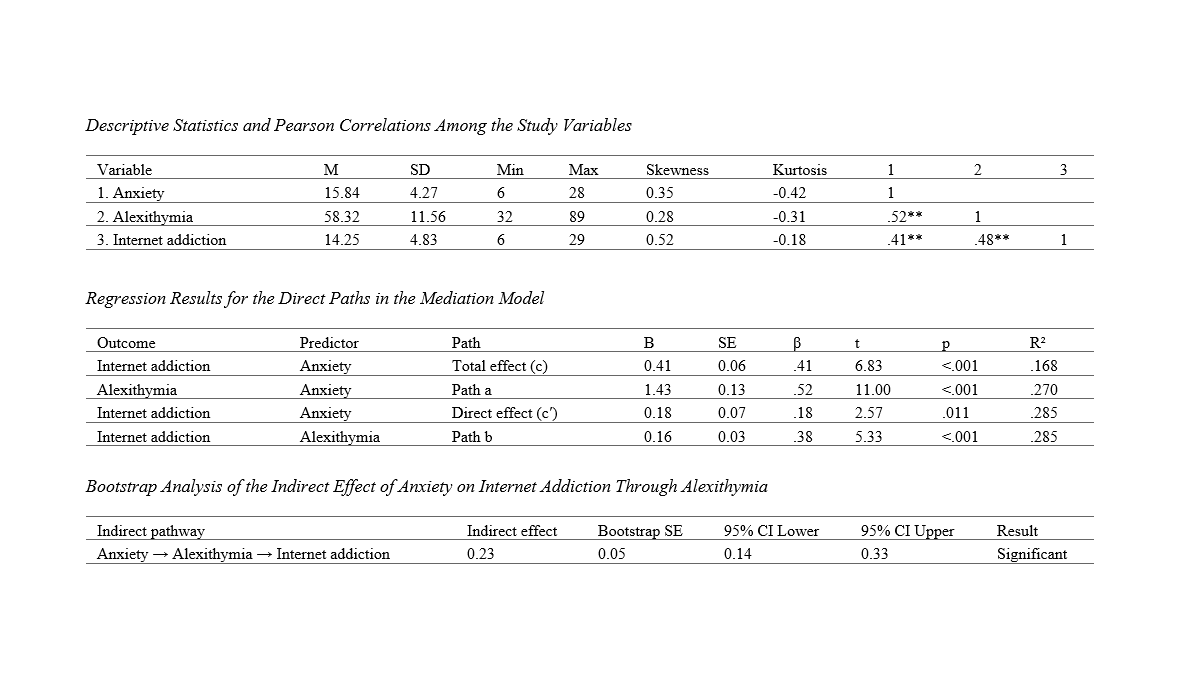
This study aimed to develop and test a structural model of the relationship between anxiety and Internet addiction through the mediating role of alexithymia among university students in Sirjan. This applied, quantitative, cross-sectional correlational study was conducted using structural equation modeling. The statistical population consisted of students enrolled at universities in Sirjan during the 2025–2026 academic year. Using multistage cluster random sampling, 209 students were included in the final analysis. Data were collected using the six-item PROMIS Anxiety Short Form, the Toronto Alexithymia Scale-20, and the six-item Problematic Internet Use Questionnaire Short Form. Data analysis was performed using SPSS and AMOS. Pearson correlation, regression analysis, and mediation analysis with 5,000 bootstrap resamples were used to examine the direct and indirect relationships among the variables. Anxiety was positively and significantly correlated with alexithymia (r = .52, p < .01) and Internet addiction (r = .41, p < .01), while alexithymia was positively correlated with Internet addiction (r = .48, p < .01). Anxiety significantly predicted Internet addiction (β = .41, p < .001) and explained 16.8% of its variance. Anxiety also significantly predicted alexithymia (β = .52, p < .001), accounting for 27.0% of its variance. When anxiety and alexithymia were entered simultaneously, alexithymia significantly predicted Internet addiction (β = .38, p < .001), while the direct effect of anxiety remained significant but decreased to β = .18 (p = .011). The indirect effect of anxiety on Internet addiction through alexithymia was significant (effect = .23, SE = .05, 95% CI [.14, .33]), confirming partial mediation. Alexithymia partially mediates the relationship between anxiety and Internet addiction, indicating that anxiety contributes to problematic Internet use both directly and indirectly through greater difficulty in identifying and processing emotions.
Downloads
References
Abdel-Khalek, A. M. (2026). Internet addiction and subjective well-being: Negative associations. Mental Health and Social Inclusion, 1. https://doi.org/10.1108/MHSI-03-2026-0091
Adiang, M. O., & Kinga, T. (2026). Evaluation of levels of self-esteem among students of public secondary schools in Kiambu County. East African Journal of Arts and Social Sciences, 9(2). https://doi.org/10.37284/eajass.9.2.4983
Agyapong-Opoku, N. A.-O. F. A. B., & Greenshaw, A. J. (2026). Anxiety and depressive symptoms among medical students—A scoping review of systematic reviews and meta-analyses. Frontiers in Public Health, 13. https://doi.org/10.3389/fpubh.2025.1710333
Awashreh, R., & Almi, H. (2026). Enhancing student outcomes through human, social, knowledge and intellectual capital in higher education. Journal of Intellectual Capital, 1. https://doi.org/10.1108/JIC-02-2026-0085
Chalghaf N, C. I. D. W. C. H. I. S. V. G. N., & Dergaa, I. (2026). Alexithymia in neurodevelopmental populations: a scoping review of Down syndrome, autism spectrum disorder, and dual diagnosis. Front. Psychol, 17, 1705694. https://doi.org/10.3389/fpsyg.2026.1705694
Chavez Sosa, J. V., & Huancahuire-Vega, S. (2026). Anxiety and depression associated with the dependent use of generative AI in medical students: Cross-sectional study. Jmir Formative Research, 10.
Chen, S. (2026). Positive and negative influencing factors of university students' anxiety and depression: Academic burnout mediates effects of school engagement on anxiety and depression. In 2026 5th International Conference on Social Sciences and Humanities and Arts (SSHA 2026). https://doi.org/10.2991/978-2-38476-577-5_42
Couette, M. C. V. T. G. J. S. M. S., & Ferreri, F. (2026). Alexithymia in patients with posttraumatic stress disorder: A meta-analysis. L'Encéphale, 52(3), 303-317. https://doi.org/10.1016/j.encep.2025.11.002
Gong, Y. Q. J. Z. Z., & Wang, S. (2026). Investigating the mediating role of depression and anxiety in the relationship between internet use and sleep duration among college students. Journal of College Student Mental Health. https://doi.org/10.1080/28367138.2026.2638959
Jacob, U. S., & Maguvhe, M. O. (2026). Global prevalence of depression among university students: a systematic literature review. Front. Educ, 11, 1809441. https://doi.org/10.3389/feduc.2026.1809441
Jin J, W. H. C. Y. W. L. C. M., & Ding, K. (2026). The neurobiology of internet addiction: a scoping review of developmental and gender-specific mechanisms. Front. Psychol, 17, 1729470. https://doi.org/10.3389/fpsyg.2026.1729470
Lei, A. F. M. C. L. W. R. H. S. M. B. S. J. J. E. L. R., & Ho, N. (2026). Individual differences in alexithymia modulate cognition-emotion interactions in daily life ongoing experiences. Communications Psychology, 4.
Li, J., & Yan, X. (2026). The association between academic self-esteem and college students’ positive psychological qualities: the mediating role of general self-efficacy. Front. Psychol, 17, 1788167. https://doi.org/10.3389/fpsyg.2026.1788167
Mersal, M. A. S., & Masaeed, M. (2026). Mental health during societal crisis: anxiety, depression, and stress among students at the Arab American University. Front. Psychol, 17, 1895781. https://doi.org/10.3389/fpsyg.2026.1895781
Nguyen, T. D., & McGregor, M. (2026). International higher education students' self-esteem: A systematic review. Journal of International Students, 16(3). https://doi.org/10.32674/84anxm91
Oribhabor, C. B. (2026). Assessing the impact of self-esteem on the academic performance of Nigerian secondary school students. BJBPR, 2(3), 65-79. https://doi.org/10.47297/ppibjbpr2026020304
Pinho, L. G. A. A. R. L. D. E. M. A. E. M. N. A. C. J. J. C. M. M. A. P. S. T., & Jacinto, G. (2026). Factors associated with depressive and anxiety symptoms, barriers, and facilitators for seeking support among European university students: A cross-sectional multicenter study. Depression and Anxiety. https://doi.org/10.1155/da/8994187
Pradubkham, T. K. J. T. P. T. C. S. K., & Phimarn, W. (2026). Prevalence of Depression, Anxiety, Stress, and Suicidal Ideation Among Pharmacy Students: An Updated Systematic Review and Meta-Analysis. International journal of environmental research and public health, 23(2), 155. https://doi.org/10.3390/ijerph23020155
Praisan, G. D. A. M. F. L. B. M., & Berchicci, M. (2026). Exercise effects on depression and anxiety in university students: A systematic review and meta-analysis within the RDoC framework. Mental Health and Physical Activity, 31. https://doi.org/10.1016/j.mhpa.2026.100809
Soriano-Molina, E. L.-G. R. M. P.-H. R. M., & Rubio-Aparicio, M. (2025). The Association Between Internet Addiction and Adolescents’ Mental Health: A Meta-Analytic Review. Behavioral Sciences, 15(2), 116.
Sun Y, W. Z., & Liu, T. (2025). Association of Internet addiction with psychiatric symptom levels and sleep disorders: a systematic review and meta-analysis. Front. Psychol, 16, 1573058. https://doi.org/10.3389/fpsyg.2025.1573058
Tie, B. Z. T. H. M. G. L. F. Q. L. C., & Zhang, Y. (2025). Smartphone and the brain: Stress and self-control mediate the association between the connectome-based predictive modeling of fMRI brain network and problematic smartphone use. Computers in human Behavior, 165, 108531. https://doi.org/10.1016/j.chb.2024.108531
Utkarsh, U., & Kanwar, P. (2025). Alexithymia and Internet Addiction: Mediating Role of Social Connectedness, Impulsivity, and Moderation by Depression. Europe’s Journal of Psychology, 21(2), 125-137. https://doi.org/10.5964/ejop.15353
Vinhais, R. S. d. S. A. N., & Roberto, M. S. (2026). Alexithymia and identity development: The moderating role of personality. Identity: An International Journal of Theory and Research. https://doi.org/10.1080/15283488.2026.2650526
Wang, X. S. F. G. F. C. C. W. J. W. X., & Liu, H. (2025). The relationship between childhood trauma and internet addiction in adolescents with depression: the mediating role of insomnia and alexithymia. BMC psychiatry, 25(1), 298. https://doi.org/10.1186/s12888-025-06739-x
Wijesinghe, C. G. T. Y. P. R. A. P. A., & Kuruppuarachchi, L. (2026). Internet addiction among school children: Cross-sectional analytical study. Mental Health and Social Inclusion, 10.
Yao, Q. Z. W. G. Y. W. J. L. C. Z. G., & Hu, Y. (2025). The impact of bullying victimization on short video addiction in adolescents: The role of emotional distress and neural mechanisms. Addiction Biology, 30, e70038. https://doi.org/10.1111/adb.70038
Zhang, S., & Li, S. (2025). How short video addiction affects risk decision-making behavior in college students based on fNIRS technology. Frontiers in human neuroscience, 19, 1542271. https://doi.org/10.3389/fnhum.2025.1542271
Zhang, X. L. D. L. J. Z. X. Z. S. E. J. D., & Yang, Y. (2025). Prefrontal cortex responses to game rewards and losses in individuals with internet gaming disorder: Insights from fNIRS during mobile gameplay. Journal of Behavioral Addictions, 14, 347-360. https://doi.org/10.1556/2006.2024.00076
Downloads
Additional Files
Publication Timeline
- Submitted
- Revised
- Accepted