Effectiveness of a Cyberspace-Based Parenting Model on Parenting Stress and Children’s Externalizing Problems
Keywords:
Cyberspace, Digital Parenting, Parenting Stress, Externalizing Problems, Aggressive Behavior, Rule-Breaking BehaviorAbstract
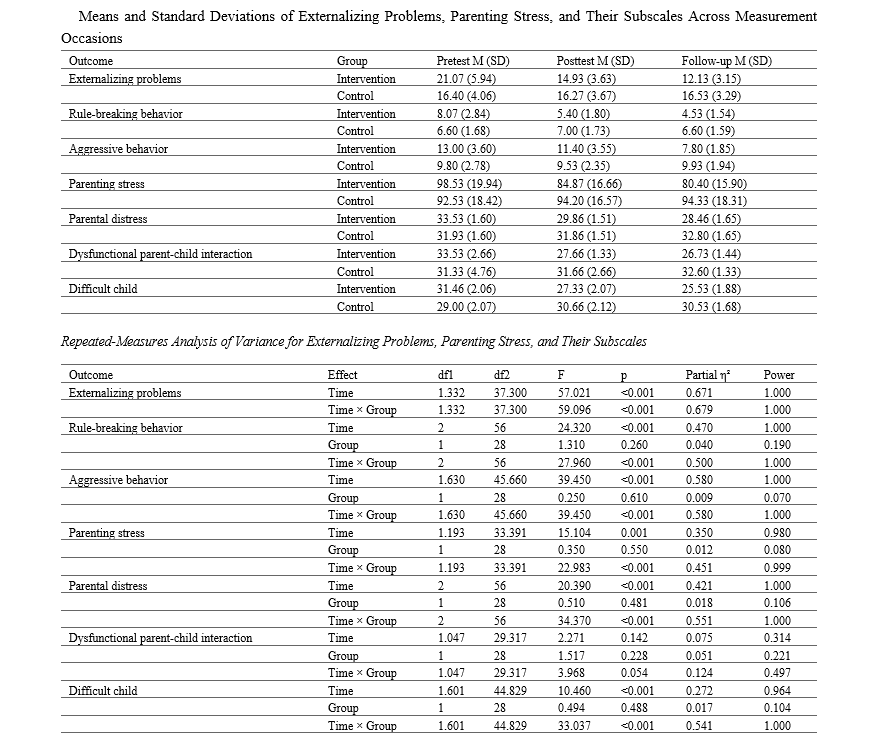
The present study aimed to determine the effectiveness of a cyberspace-based parenting model in reducing parenting stress and externalizing problems among primary-school boys. This quasi-experimental study employed a pretest-posttest design with a control group and a one-month follow-up. The participants were 30 mothers of boys aged 8-10 years enrolled in the first three grades of a primary school in Isfahan, Iran, whose children had been identified as exhibiting externalizing behavior problems. Participants were assigned to intervention and control groups, with 15 mothers in each group. The intervention group received an eight-session cyberspace-based parenting program, with each weekly session lasting 90 minutes, whereas the control group received no corresponding intervention. Parenting stress was assessed using the Parenting Stress Index-Short Form, and children’s externalizing problems were measured using the parent-report Child Behavior Checklist. Data were analyzed using repeated-measures analysis of variance and Bonferroni-adjusted pairwise comparisons in SPSS version 22. Repeated-measures analysis showed a significant Time × Group interaction for total externalizing problems, F(1.332, 37.300) = 59.096, p < 0.001, partial η² = 0.679. Significant interaction effects were also found for rule-breaking behavior, F(2, 56) = 27.960, p < 0.001, partial η² = 0.500, and aggressive behavior, F(1.630, 45.660) = 39.450, p < 0.001, partial η² = 0.580. Parenting stress also showed a significant Time × Group interaction, F(1.193, 33.391) = 22.983, p < 0.001, partial η² = 0.451. Significant interactions were observed for parental distress, F(2, 56) = 34.370, p < 0.001, partial η² = 0.551, and difficult child, F(1.601, 44.829) = 33.037, p < 0.001, partial η² = 0.541, whereas dysfunctional parent-child interaction was not significant, p = 0.054. The cyberspace-based parenting model was effective in reducing children’s externalizing problems and maternal parenting stress, with improvements maintained at one-month follow-up, indicating its potential usefulness in school- and family-based parenting interventions.
Downloads
References
Clark, L. S. (2011). Parental Mediation Theory for the Digital Age. Communication Theory, 21(4), 323-343. https://doi.org/10.1111/j.1468-2885.2011.01391.x
Eirich, R., McArthur, B. A., Anhorn, C., McGuinness, C., Christakis, D. A., & Madigan, S. (2022). Association of Screen Time with Internalizing and Externalizing Behavior Problems in Children 12 Years or Younger: A Systematic Review and Meta-Analysis. JAMA Psychiatry, 79(5), 393-405. https://doi.org/10.1001/jamapsychiatry.2022.0155
Fang, Y., Luo, J., Boele, M., Windhorst, D., van Grieken, A., & Raat, H. (2024). Parent, Child, and Situational Factors Associated with Parenting Stress: A Systematic Review. European Child & Adolescent Psychiatry, 33, 1687-1705. https://doi.org/10.1007/s00787-022-02027-1
Helsper, E. J., Veltri, G. A., & Livingstone, S. (2024). Parental Mediation of Children's Online Risks: The Role of Parental Risk Perception, Digital Skills and Risk Experiences. New Media & Society, 27(11), 5986-6005. https://doi.org/10.1177/14614448241261945
Krapf-Bar, D., Davidovitch, M., Rozenblatt-Perkal, Y., & Gueron-Sela, N. (2022). Maternal Mobile Phone Use during Mother-Child Interactions Interferes with the Process of Establishing Joint Attention. Developmental Psychology, 58(9), 1639-1651. https://doi.org/10.1037/dev0001388
Livingstone, S., & Blum-Ross, A. (2020). Parenting for a Digital Future: How Hopes and Fears about Technology Shape Children's Lives. Oxford University Press. https://doi.org/10.1093/oso/9780190874698.001.0001
McDaniel, B. T., & Radesky, J. S. (2018). Technoference: Parent Distraction with Technology and Associations with Child Behavior Problems. Child development, 89(1), 100-109. https://doi.org/10.1111/cdev.12822
Modecki, K. L., Goldberg, R. E., Wisniewski, P., & Orben, A. (2022). What Is Digital Parenting? A Systematic Review of Past Measurement and Blueprint for the Future. Perspectives on Psychological Science, 17(6), 1673-1691. https://doi.org/10.1177/17456916211072458
Navarro, J. L., & Jensen, M. (2026). Styles of Digital Parental Mediation: A Multi-Group Person-Centered Approach. Journal of Child and Family Studies, 35, 481-501. https://doi.org/10.1007/s10826-025-03229-2
Nichols, S., & Selim, N. (2022). Digitally Mediated Parenting: A Review of the Literature. Societies, 12(2), 60. https://doi.org/10.3390/soc12020060
Pinquart, M. (2021). Cultural Differences in the Association of Harsh Parenting with Internalizing and Externalizing Symptoms: A Meta-Analysis. Journal of Child and Family Studies, 30, 2938-2951. https://doi.org/10.1007/s10826-021-02113-z
Shirzadi, P., Faramarzi, S., Ghasemi, M., & Shafiei, M. (2014). Evaluation of the Validity and Reliability of the Short Form of the Parenting Stress Index (PSI-SF). Rooyesh-e-Ravanshenasi, 3(4), 91-110.
Tan, C. Y., Xu, N., Liang, M., & Li, L. (2025). Meta-Analysis of Associations between Digital Parenting and Children's Digital Wellbeing. Educational Research Review, 48, 100699. https://doi.org/10.1016/j.edurev.2025.100699
Valkenburg, P. M., Krcmar, M., Peeters, A. L., & Marseille, N. M. (1999). Developing a Scale to Assess Three Styles of Television Mediation: Instructive Mediation, Restrictive Mediation, and Social Coviewing. Journal of Broadcasting & Electronic Media, 43(1), 52-66. https://doi.org/10.1080/08838159909364474
Zhao, P., Bazarova, N. N., & Valle, N. (2023). Digital Parenting Divides: The Role of Parental Capital and Digital Parenting Readiness in Parental Digital Mediation. Journal of Computer-Mediated Communication, 28(5), zmad032. https://doi.org/10.1093/jcmc/zmad032
Downloads
Additional Files
Publication Timeline
- Submitted
- Revised
- Accepted