Effectiveness of Body Image–Focused Cognitive Behavioral Therapy on Body Image, Social Physique Anxiety, and Appearance-Related Social Comparison Among Young Women Attending Fitness Clubs and Active on Social Media
Keywords:
Cognitive behavioral therapy, body image, social physique anxiety, appearance-related social comparison, social media, young womenAbstract
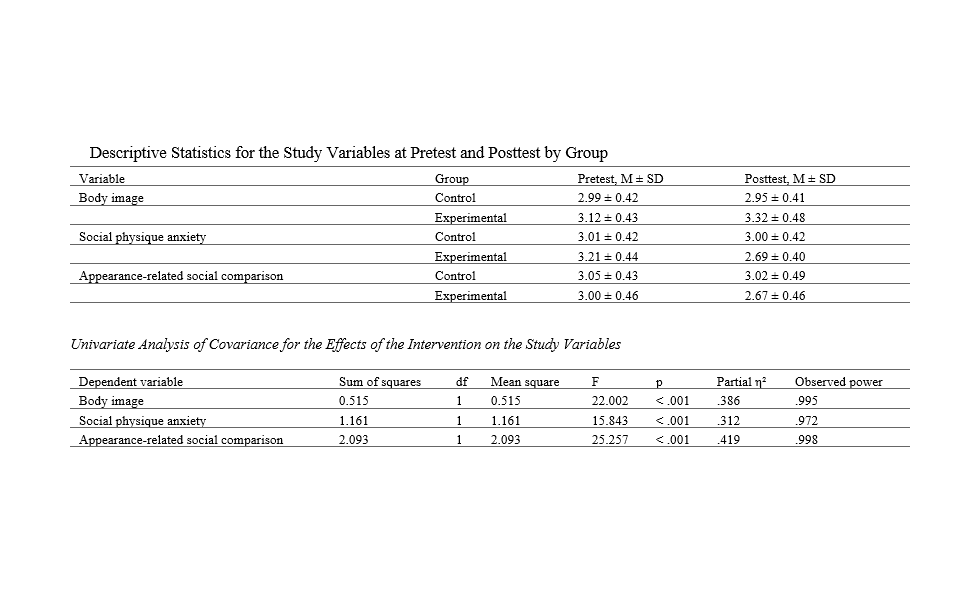
The present study aimed to determine the effectiveness of body image–focused cognitive behavioral therapy (CBT) on body image, social physique anxiety, and appearance-related social comparison among young women attending fitness clubs and active on social media. This study employed a quasi-experimental design with a pretest–posttest control group. The statistical population comprised young women aged 18–30 years who attended fitness clubs, were active on social media, and resided in Gilan-e Gharb, Iran. A total of 40 participants were selected through purposive sampling and randomly assigned to experimental and control groups (20 participants per group). Data were collected using the Multidimensional Body–Self Relations Questionnaire (MBSRQ) developed by Cash (1990), the Social Physique Anxiety Scale (SPAS) developed by Hart et al. (1989), and the Physical Appearance Comparison Scale–Revised (PACS-R) developed by Schaefer and Thompson (2014). The experimental group received a body image–focused cognitive behavioral therapy intervention consisting of eight 90-minute group sessions. Data were analyzed using multivariate and univariate analyses of covariance (MANCOVA and ANCOVA). The overall effect of the intervention on the combined dependent variables was statistically significant (Pillai’s trace = 0.638, F = 19.380, p < .001). After controlling for pretest scores, significant between-group differences were observed in body image (F = 22.002, p < .001, η²p = 0.386), social physique anxiety (F = 15.843, p < .001, η²p = 0.312), and appearance-related social comparison (F = 25.257, p < .001, η²p = 0.419). The intervention demonstrated the largest effect size for appearance-related social comparison. These findings suggest that body image–focused cognitive behavioral therapy may improve body image and reduce social physique anxiety and appearance-related social comparison among young women attending fitness clubs and active on social media by modifying dysfunctional appearance-related cognitions and behavioral patterns.
Downloads
References
Ahuja, L., Lewis-Smith, H., Hasan, F., Gentili, C., White, P., & Diedrichs, P. C. (2025). A comic-based body image intervention for adolescents in semi-rural Indian schools: A randomized controlled trial. International Journal of Clinical and Health Psychology, 25(1), 100546. https://doi.org/10.1016/j.ijchp.2025.100546
Bonfanti, R. C., Melchiori, F., Teti, A., Albano, G., Raffard, S., Rodgers, R., & Lo Coco, G. (2024). The association between social comparison in social media, body image concerns and eating disorder symptoms: A systematic review and meta-analysis. Body Image, 52, 101841. https://doi.org/10.1016/j.bodyim.2024.101841
Fioravanti, G., Bocci Benucci, S., Ceragioli, G., & Casale, S. (2022). How the exposure to beauty ideals on social networking sites influences body image: A systematic review of experimental studies. Adolescent Research Review, 7, 419-458. https://doi.org/10.1007/s40894-022-00179-4
Ghaffarinasab, A., & Rahmani, R. (2024). The impact of social media on body image: The mediating role of social comparison. Sociology of Social Institutions, 11(24), 7-39.
Harrison, A., Fernández de la Cruz, L., Enander, J., Radua, J., & Mataix-Cols, D. (2016). Cognitive-behavioral therapy for body dysmorphic disorder: A systematic review and meta-analysis of randomized controlled trials. Clinical psychology review, 48, 43-51. https://doi.org/10.1016/j.cpr.2016.05.007
Hasanpoor-Azghady, S. B., Amiri-Farahani, L., & Arbabi-Moghadam, R. (2022). Confirmatory factor analysis and psychometric properties of the Persian version of the Multidimensional Body-Self Relations Questionnaire-Appearance Scales (MBSRQ-AS) in women with polycystic ovary syndrome. Eating and Weight Disorders, 27(2), 639-649. https://doi.org/10.1007/s40519-021-01203-7
Iman, M. T., & Rahmani, R. (2025). Social media and the reconstruction of body image: Adolescent girls' mental concerns about body image. Social Continuity and Change, 4(1), 97-125.
McComb, C. A., Vanman, E. J., & Tobin, S. J. (2023). A meta-analysis of the effects of social media exposure to upward comparison targets on self-evaluations and emotions. Media Psychology, 26(5), 612-635. https://doi.org/10.1080/15213269.2023.2180647
Merino, M., Tornero-Aguilera, J. F., Rubio-Zarapuz, A., Villanueva-Tobaldo, C. V., Martín-Rodríguez, A., & Clemente-Suárez, V. J. (2024). Body perceptions and psychological well-being: A review of the impact of social media and physical measurements on self-esteem and mental health with a focus on body image satisfaction and its relationship with cultural and gender factors. Healthcare, 12(14), 1396. https://doi.org/10.3390/healthcare12141396
Shabani, F., Bakhshipour, A., Mahmoudalilou, M., Sabouri Moghaddam, H., & Ranjbar, F. (2023). The effectiveness of acceptance and commitment therapy (ACT) on perceptual and attitudinal body image in individuals with body dysmorphic disorder: A single-case design. Quarterly Journal of New Psychological Research, 19(74), 268-281.
Tamanaeifar, M. R., & Haddadi, S. (2024). The relationship between social media addiction and body image: The mediating roles of body shame and self-compassion. Quarterly Journal of New Psychological Research, 20(78), 27-42.
Tiggemann, M., & Anderberg, I. (2020). Social media is not real: The effect of "Instagram vs reality" images on women's social comparison and body image. New Media & Society, 22(12), 2183-2199. https://doi.org/10.1177/1461444819888720
Tiggemann, M., & Zaccardo, M. (2015). Exercise to be fit, not skinny: The effect of fitspiration imagery on women's body image. Body Image, 15, 61-67. https://doi.org/10.1016/j.bodyim.2015.06.003
Tylka, T. L., & Wood-Barcalow, N. L. (2015). What is and what is not positive body image? Conceptual foundations and construct definition. Body Image, 14, 118-129. https://doi.org/10.1016/j.bodyim.2015.04.001
Vandenbosch, L., Fardouly, J., & Tiggemann, M. (2022). Social media and body image: Recent trends and future directions. Current opinion in psychology, 45, 101289. https://doi.org/10.1016/j.copsyc.2021.12.002
Zargarzadeh Esfahani, M., Zamani, S., & Heidarian, A. (2022). A model of causal relationships between physical activity, social media use, attitudes toward one's body image, and ethical behaviors among Islamic Azad University students. Communication Management in Sport Media, 9(4), 41-56.
Downloads
Additional Files
Publication Timeline
- Submitted
- Revised
- Accepted