The Relationship Between Disclosure and Self-Protection: Transgender Individuals’ Lived Experiences of Managing Identity-Disclosure Boundaries in Educational Relationships
Keywords:
transgender, identity disclosure, educational relationships, relational safety, phenomenologyAbstract
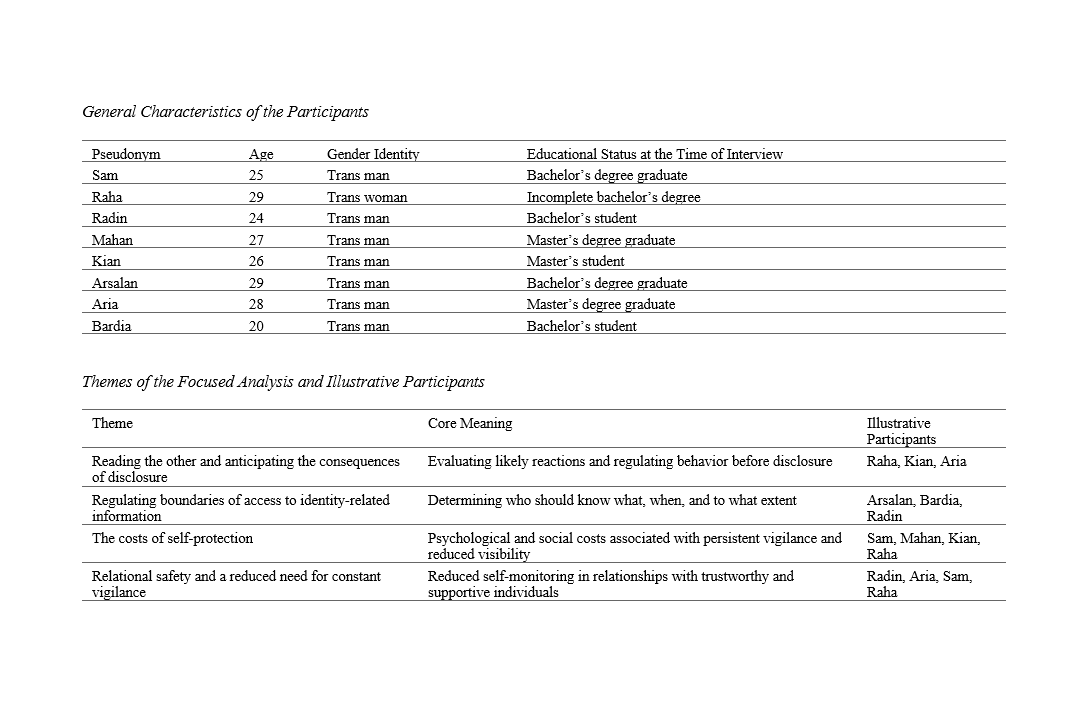
This study aimed to understand transgender individuals’ lived experiences of managing identity-disclosure boundaries in educational relationships and the role of relational safety in this process. The present article constitutes a focused analysis of a broader qualitative study conducted using Moustakas’s descriptive phenomenological approach. Participants were eight transgender individuals aged 18–30 years who had experience living and studying in Tehran and were recruited through purposive and snowball sampling. Data were collected through in-depth semi-structured interviews. For the present article, interview transcripts, meaning units, individual thematic clusters, and cross-case findings were revisited and compared with a specific focus on disclosure, concealment, appraisal of others’ reactions, and relational safety. Four themes emerged from the final analysis: “reading the other and anticipating the consequences of disclosure,” “regulating boundaries of access to identity-related information,” “the costs of self-protection,” and “relational safety and a reduced need for constant vigilance.” Nondisclosure did not carry the same meaning for all participants. In some situations, it functioned as a means of reducing the likelihood of harm, whereas in others it represented an exercise of personal control over privacy. Likewise, disclosure was not invariably experienced as liberating; depending on the quality of the relationship, it could be accompanied either by a sense of recognition or by increased vulnerability. Managing identity disclosure in educational relationships is a situational, relational, and multivalent process. What matters is not merely the extent to which an individual is “out,” but the degree of agency they retain over when, to whom, how, and to what extent others gain access to identity-related information. Trustworthy educational relationships can reduce the need for constant vigilance and explanation, even when the broader institutional environment remains restrictive.
Downloads
References
Cain, L. K., Denton, J. M., Alvarez, R., & Smith, A. (2024). Examining trans student narratives of transitioning while in college. International Journal of Qualitative Studies in Education, 37(4), 1174-1190. https://doi.org/10.1080/09518398.2023.2181422
Curry, J. R., Csaszar, I., & Shierling, T. (2023). Transgender and gender non-conforming college students' challenges, supports, and successes: An interpretative phenomenological analysis. Georgia Journal of College Student Affairs, 39(1), 69-93. https://doi.org/10.20429/gcpa.2023.390104
Ghafouri, K., Yargholi, B., & Golmohammadnejad, G. (2024). A narrative inquiry into the lived challenges of a transgender student in the school context. Quarterly Journal of Applied Psychological Research, 1(1), 1-21.
Horton, C. (2023). Gender minority stress in education: Protecting trans children's mental health in UK schools. International Journal of Transgender Health, 24(2), 195-211. https://doi.org/10.1080/26895269.2022.2081645
Johns, M. M., Zamantakis, A., Andrzejewski, J., Boyce, L., Rasberry, C. N., & Jayne, P. E. (2021). Minority stress, coping, and transgender youth in schools-Results from the Resilience and Transgender Youth Study. Journal of School Health, 91(11), 883-893. https://doi.org/10.1111/josh.13086
McGuire, J. K., Anderson, C. R., Toomey, R. B., & Russell, S. T. (2010). School climate for transgender youth: A mixed method investigation of student experiences and school responses. Journal of youth and adolescence, 39(10), 1175-1188. https://doi.org/10.1007/s10964-010-9540-7
McQuillan, M. T., Cimpian, J. R., Lebovitz, B. A., & Gill, E. K. (2024). Transgender adolescent school climate, mental health, and adult social support. JAMA Pediatrics, 178(10), 1082-1084. https://doi.org/10.1001/jamapediatrics.2024.3079
Meyer, I. H. (2003). Prejudice, social stress, and mental health in lesbian, gay, and bisexual populations: Conceptual issues and research evidence. https://doi.org/10.1037/0033-2909.129.5.674
Nolan, M. M., Blythe, I. M., & Vincent-Ruz, P. (2025). The challenges of transgender and nonbinary graduate students in chemistry: A qualitative study on trans identity, science culture, and institutional support using reflexive thematic analysis. PLoS One, 20(4), e0320493. https://doi.org/10.1371/journal.pone.0320493
Osmetti, L. A., Allen, K. R., & Kozlowski, D. (2025). Shortcomings of transgender identity concealment research: A scoping review of associations with mental health. International Journal of Transgender Health, 26(1), 25-49. https://doi.org/10.1080/26895269.2024.2367653
Pampati, S., Andrzejewski, J., Sheremenko, G., Johns, M., Lesesne, C. A., & Rasberry, C. N. (2020). School climate among transgender high school students: An exploration of school connectedness, perceived safety, bullying, and absenteeism. The Journal of School Nursing, 36(4), 293-303. https://doi.org/10.1177/1059840518818259
Parodi, K. B., Holt, M. K., Green, J. G., Katz-Wise, S. L., Shah, T. N., Kraus, A. D., & Xuan, Z. (2022). Associations between school-related factors and mental health among transgender and gender diverse youth. Journal of School Psychology, 90, 135-149. https://doi.org/10.1016/j.jsp.2021.11.004
Scrofani, S., Martin, C. L., Johnson, S. L., Low, S., & DeLay, D. (2025). A review of research on the school climate of transgender middle and high schoolers: An ecological-transactional approach. Journal of School Psychology, 110, 101459. https://doi.org/10.1016/j.jsp.2025.101459
Testa, R. J., Habarth, J., Peta, J., Balsam, K., & Bockting, W. (2015). Development of the gender minority stress and resilience measure. Psychology of Sexual Orientation and Gender Diversity, 2(1), 65. https://doi.org/10.1037/sgd0000081
Valadbeigi, E., Zamani, M., Nahalgar, P., & Safari, S. (2022). Exploring the psychosocial processes of transgender students at the University of Tehran. Social Welfare(85), 301-337.
Yaghoubi Choubari, A., & Saedi, M. (2020). A phenomenological understanding of the lived experiences of transgender people in Mashhad: A qualitative study. Contemporary Sociological Research, 9(17), 1-26.
Downloads
Additional Files
Publication Timeline
- Submitted
- Revised
- Accepted