Comparison of the Effectiveness of Emotional Schema Therapy and Dialectical Behavior Therapy on Quality of Life and Metacognitive State in Individuals with Comorbid Depression and Anxiety
Keywords:
Emotional Schema Therapy, Dialectical Behavior Therapy, Quality of Life, Metacognitive State, Depression, Anxiety, ComorbidityAbstract
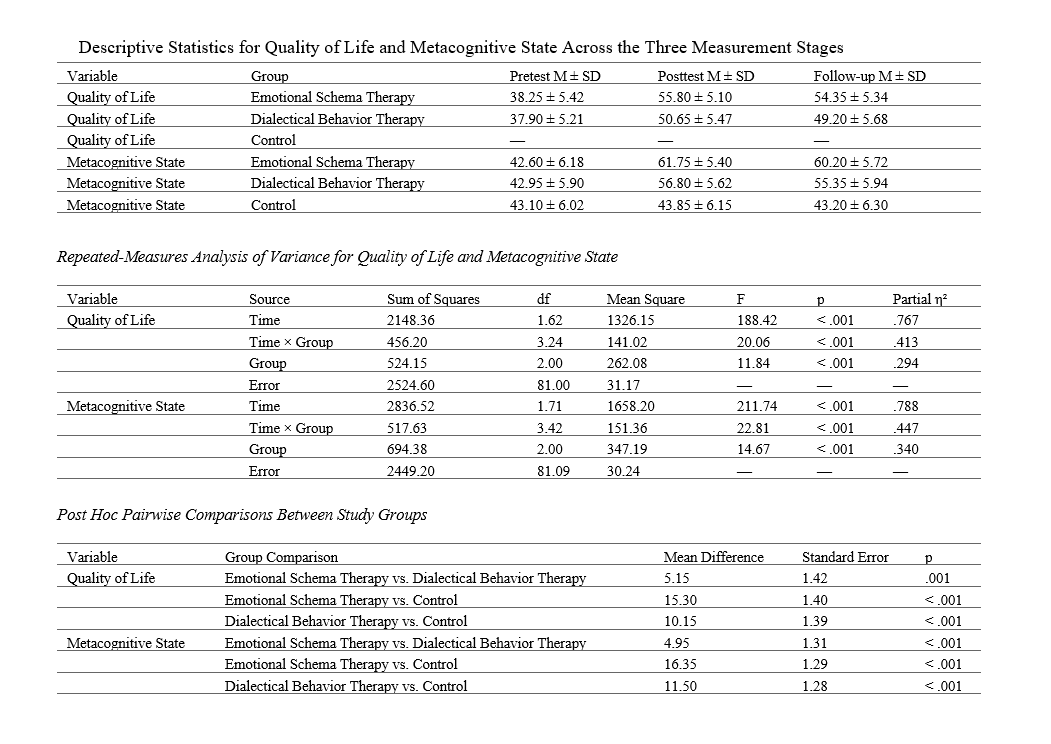
This study aimed to compare the effectiveness of Emotional Schema Therapy and Dialectical Behavior Therapy in improving quality of life and metacognitive state among individuals with comorbid depression and anxiety. The study employed a quasi-experimental pretest-posttest design with a control group and a six-month follow-up. The statistical population consisted of women aged 25–45 years with comorbid depression and anxiety who attended psychological counseling centers in Tehran in 2025 and had received clinical diagnoses from a psychiatrist and psychologist. Using purposive sampling, 60 eligible participants were selected and randomly assigned to Emotional Schema Therapy, Dialectical Behavior Therapy, and control groups, with 20 participants in each group. The Emotional Schema Therapy group received ten weekly 120-minute sessions, whereas the Dialectical Behavior Therapy group received eight weekly 90-minute sessions. The control group received no intervention during the study period. Data were collected using the 12-Item Short Form Health Survey and the Metacognitive State Questionnaire at pretest, posttest, and six-month follow-up. Data were analyzed using repeated-measures analysis of variance in SPSS version 27. Repeated-measures analysis showed significant effects of time, group, and the Time × Group interaction for quality of life, with F = 188.42, F = 11.84, and F = 20.06, respectively, all p < .001. Significant effects were also found for metacognitive state, with F = 211.74 for time, F = 14.67 for group, and F = 22.81 for the Time × Group interaction, all p < .001. Post hoc comparisons indicated that both interventions significantly outperformed the control group, while Emotional Schema Therapy produced significantly greater improvements than Dialectical Behavior Therapy in quality of life and metacognitive state. Treatment gains were largely maintained at the six-month follow-up. Both Emotional Schema Therapy and Dialectical Behavior Therapy were effective in improving quality of life and metacognitive state in individuals with comorbid depression and anxiety, although Emotional Schema Therapy demonstrated greater and relatively stable effects over time.
Downloads
References
Aali Sari Nasirloo, K., Naderi, F., Homayee, R., & Makvandi, B. (2023). The Effectiveness of Dialectical Behavior Therapy on Self-Conscious Affect and Family Quality of Life in Mothers of Children with Intellectual Disabilities. Bimonthly Scientific-Research Journal of Rehabilitation Science, 12(3), 446-459. https://doi.org/10.32598/SJRM.12.3.3
Ahmadi, F., & Kadkhodaei, M. (2023). Effects of Emotional Schema Therapy on Psychological Distress, Quality of Life, and Cognitive Emotion Regulation in Adolescents with Social Anxiety Disorder. Educational Psychology Skills Quarterly, 14(2), 1-15. https://journals.iau.ir/article_705486.html?lang=en
Ardalani Farsa, F., Shahabizadeh, F., Hashemi, S. M., & Dadkhah, P. (2021). Mood/Anxiety Symptoms and Emotional Schemas in the Model of Spiritual Quality of Life in Patients with Chronic Low Back Pain with the Mediation of Cognitive Dimensions of Perfectionism. Anesthesiology and Pain, 12(3), 115-128. https://www.sid.ir/paper/1015592/fa
Bayat, M., Basharpoor, S., Aghajani, S., & Mikaeili, N. (2025). Comparison of the Effectiveness of Emotional Schema Therapy and Acceptance and Commitment Therapy on Distress Tolerance and Emotion Regulation Difficulties in Individuals with Major Depressive Disorder. Journal of Psychological Science, 24(150), 59-81.
Bayat, M., Narimani, M., Basharpour, S., Fekri Sheeran, M., Soraya Taifee Dalai, K., & Dedar Talesh Mickaeli Ardebil, F. (2020). Comparing the effectiveness of dialectical behavioral therapy with acceptance-based therapy and commitment to quality of life and reducing symptoms of attention deficit hyperactivity disorder. medical journal of mashhad university of medical sciences, 62(5.1), 1671-1683. https://doi.org/10.22038/mjms.2019.14747
Eyfarniyan, M., Arshadi, F. K., Golshani, F., Hassani, F., & Dolatshahee, B. (2024). Effectiveness of Dialectical Behavior Therapy-Based Skill Training on Distress Tolerance, Emotional Cognitive Regulation, and Marital Quality of Life in Women With Recurrent Miscarriages. Aftj, 5(2), 129-138. https://doi.org/10.61838/kman.aftj.5.2.15
Farrokhzadian, A. A., Rezaei, F., & Sadeghi, M. (2018). Effectiveness of Combined Metacognitive Therapy and Emotional Schema Therapy Based on Childhood Adversity on Generalized Anxiety Disorder. Psychological studies, 14(3), 81-96.
Farrokhzadian, A. A., Rezaei, F., & Sadeghi, M. (2018). Effectiveness of Emotional Schema Therapy Combined with Metacognitive Therapy on Reducing Symptoms of Generalized Anxiety Disorder in the Elderly. Journal of Aging Psychology, 4(1), 83-91.
Ghasemkhanloo, A., Atadokht, A., & Sabri, V. (2022). The Effectiveness of Emotional Schema Therapy on Severity of Depression and Cognitive Emotional Regulation Strategies in Major Depression Disorder. Journal of North Khorasan University of Medical Sciences, 14(1), 38-44. https://doi.org/10.52547/nkums.14.1.38
Hassas, O., Mashhadi, A., Shamloo, Z. S., & Bordbar, M. R. F. (2024). Emotional schema therapy for bipolar disorder: Improving emotional schemas, quality of life, cognitive emotion regulation, and symptom management. International Journal of Cognitive Therapy, 17(3), 347-368. https://doi.org/10.1007/s41811-023-00196-8
Leahy, R. L., Wupperman, P., Edwards, E., Shivaji, S., & Molina, N. (2019). Metacognition and emotional schemas: Effects on depression and anxiety. International Journal of Cognitive Therapy, 12, 25-37. https://doi.org/10.1007/s41811-018-0035-8
Oguz, G., Celikbas, Z., Batmaz, S., Cagli, S., & Sungur, M. Z. (2019). Comparison between Obsessive Compulsive Disorder and Panic Disorder on Metacognitive Beliefs, Emotional Schemas, and Cognitive Flexibility. International Journal of Cognitive Therapy, 12(3), 157-178. https://doi.org/10.1007/s41811-019-00047-5
Parandeh Shirvan, S., Kamrani, M., & Asgharipour, N. (2024). The effect of emotion regulation training based on dialectic behavior therapy on aggression and quality of life in Ibn-Sina Hospital staff, Mashhad, Iran. Evidence Based Care, 14(3), 17-24. https://doi.org/10.61882/pcnm.15.1.33
Rahmani, M., & Omidi, A. (2019). The effectiveness of dialectical behavior therapy on quality of life in women with obesity, overweight, and binge eating disorder: A clinical trial. Journal of Rafsanjan University of Medical Sciences, 18(2), 133-146.
Rahmani Moghaddam, F., Bagherzadehgolmakani, Z., Touzandehjani, H., & Nejat, H. (2023). Exploring the Impact of Dialectical Behavior Therapy on Emotional Regulation and Rumination among the Physically Disabled People using the Services of the Welfare Organization of Mashhad. Research in Clinical Psychology and Counseling, 13(1), 123-138. https://doi.org/10.22067/tpccp.2023.75967.1269
Rouhi, M., Tavakoli, A. M., & Tajrobehkar, M. (2023). Comparing the Effectiveness of Acceptance and Commitment Therapy and Dialectical Behavioral Therapy on Coherent Self Knowledge, Emotional Regulation and Life Quality of Hemodialysis Patients. Shenakht Journal of Psychology and Psychiatry, 10(2), 131-146. https://doi.org/10.32598/shenakht.10.2.131
Slocum, K., & Bilican, F. I. (2025). Dialectical Behaviour Therapy Skills Training and Group Cognitive Behavioural Therapy for Hashimoto's Disease: Data on Quality of Life, Stress and Related Variables From a Randomised Controlled Trial. Counselling and Psychotherapy Research, 25(2). https://doi.org/10.1002/capr.70020
Taghvaeinia, A., Karami, M., & Azizi, A. (2024). Comparison of the effect of dialectical behavior therapy, acceptance and commitment therapy mindfulness-based Stress reduction on irritable bowel syndrome symptoms, quality of life, anxiety and depression: A pilot randomized controlled trial. The Psychiatric Quarterly, 95(1), 53-68. https://doi.org/10.1007/s11126-023-10058-3
Taheri Daghian, A., Ghasemi Motlagh, M., & Mahdian, H. (2020). Comparison of the Effectiveness of Dialectical Behavior Therapy and Metacognitive Therapy in Reducing Depression and Rumination in Patients with Depression. Journal of Mashhad University of Medical Sciences, 63(6), 2164-2174.
Veisi, S., Bahrami, A., Ghaffari, M., Ahmadifar, M., Ramezanpour, A., & Pourmohammad Ghouchani, K. (2026). The Effectiveness of Emotional Schema Therapy and Cognitive-Behavioral Interventions Focused on Intolerance of Uncertainty on Referential Thoughts, Thought-Action Fusion, and Cognitive Avoidance in Patients with Generalized Anxiety Disorder: A Quasi-Experimental Study. Journal of Cognition, Behavior, Learning, 1-12. https://journalcbl.com/index.php/jcbl/article/view/384
Yari, L., Zeini Hasanvand, N., & Yousefvand, M. (2023). Comparing the effectiveness of dialectical behavior therapy and metacognitive therapy on cognitive emotional regulation strategies in adolescents. Family and Health, 13(A), 45-59. https://
Downloads
Additional Files
Publication Timeline
- Submitted
- Revised
- Accepted