The Role of Love Languages in Enhancing Marital Communication
DOI:
https://doi.org/10.61838/kman.fct.psynexus.3.14Keywords:
Love languages, marital communication, relational satisfaction, cultural influences, qualitative studyAbstract
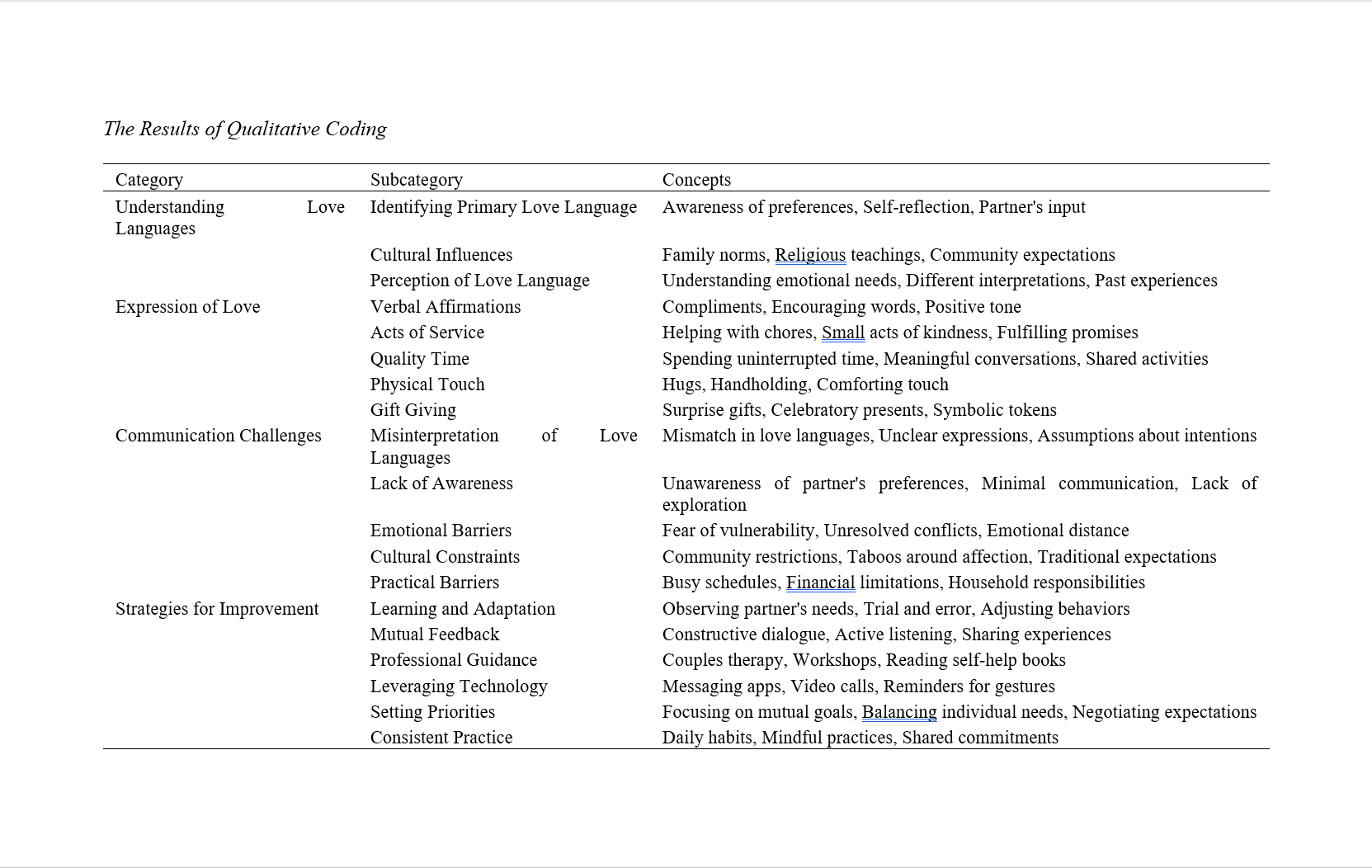
This study aims to explore the role of love languages in enhancing marital communication among couples in Tehran. This qualitative study employed semi-structured interviews with 24 participants (12 married couples) selected through purposive sampling. Data were collected until theoretical saturation was reached and analyzed using thematic analysis with NVivo software. The study identified four main themes: understanding love languages, expression of love, communication challenges, and strategies for improvement. Understanding and practicing love languages fostered emotional intimacy and relational satisfaction. Participants emphasized cultural influences, mutual adaptation, and the importance of consistent communication. However, challenges such as misinterpretation and emotional barriers highlighted the need for awareness and tailored interventions. Love languages significantly enhance marital communication and satisfaction, but their effectiveness depends on cultural context, individual differences, and mutual effort. Incorporating love languages into therapeutic practices can provide meaningful tools for couples to navigate relational challenges and strengthen their bonds.
Downloads
References
Aekwarangkoon, S., & Noonil, N. (2020). Effects of Grandchildren’s Love Language Program on Depression Among Thai Older Adults. Walailak Journal of Science and Technology (Wjst), 17(9), 924-932. https://doi.org/10.48048/wjst.2020.4979
Almohtadi, R., Aldarabah, I. T., & Hamaden, K. M. (2019). Which Love Language Do You Speak With Your Child? What Are the Effects of Your Age, Level of Education, Work Status, and the Number of Children in the Family on the Used Love Languages? International Journal of Learning and Development, 9(2), 187. https://doi.org/10.5296/ijld.v9i2.15012
Angin, Y. H. P., & Yeniretnowati, T. A. (2021). Implikasi Pemahaman Bahasa Cinta Bagi Relasi Suami Istri. Jurnal Teologi (Juteolog), 2(1), 168-183. https://doi.org/10.52489/juteolog.v2i1.17
Apriliani, T. (2024). The Reasons Why Love Languages Are Quite Influential on Marital Harmony. https://doi.org/10.4108/eai.18-7-2023.2343417
Ardakhani, N., & Seadatee Shamir, A. (2022). The effectiveness of Emotion-focused Couple Therapy on Emotional Self-Disclosure and Marital Commitment of Couples Referring to Counseling Centers. International Journal of Education and Cognitive Sciences, 3(3), 27-34. https://doi.org/10.22034/injoeas.2022.160162
Aulia, L. R., Setiadarma, A., & Supratman, S. (2022). Fenomenologi Pola Komunikasi Interpersonal Pada Pasangan Menikah (Studi Love Language Dalam Usia Pernikahan 0-5 Tahun). Ikra-Ith Humaniora Jurnal Sosial Dan Humaniora, 7(2), 103-121. https://doi.org/10.37817/ikraith-humaniora.v7i2.2297
Azarnik, M., Rafiepoor, A., Hatami, M., & Mousavi, M. S. (2022). The Effectiveness of Communication Skills Training on Marital Satisfaction of Female Students of Isfahan University of Medical Sciences, Iran [Research]. Health System Research, 18(2), 154-160. https://doi.org/10.48305/jhsr.v18i2.1459
Bahtiar, H. (2023). Love Language Expressions Among Newlyweds and Long-Married Couples: Interpersonal Communication’s Perspective. Jurnal Onoma Pendidikan Bahasa Dan Sastra, 9(2), 1642-1653. https://doi.org/10.30605/onoma.v9i2.3183
Bland, A. M., & McQueen, K. S. (2018). The Distribution of Chapman’s Love Languages in Couples: An Exploratory Cluster Analysis. Couple and Family Psychology Research and Practice, 7(2), 103-126. https://doi.org/10.1037/cfp0000102
Bunt, S., & Hazelwood, Z. (2017). Walking the Walk, Talking the Talk: Love Languages, Self‐regulation, and Relationship Satisfaction. Personal Relationships, 24(2), 280-290. https://doi.org/10.1111/pere.12182
Chen, G., & Chen, Y. (2023). The Impact of a Love Language Game Intervention on Relationship Satisfaction Among Chinese Couples in China and Malaysia: Examining the Role of Individualism-Collectivism. https://doi.org/10.21203/rs.3.rs-2788087/v1
Dinçyürek, S., & Ince, S. A. (2018). Adaptation of the Five Love Language Scale to Turkish Language. Eurasia Journal of Mathematics Science and Technology Education, 14(5). https://doi.org/10.29333/ejmste/85866
Fishbane, M. D. (2023). Couple Relational Ethics: From Theory to Lived Practice. Family Process, 62(2), 446-468. https://doi.org/10.1111/famp.12861
Hughes, J. L., & Camden, A. A. (2020). Using Chapman’s Five Love Languages Theory to Predict Love and Relationship Satisfaction. Psi Chi Journal of Psychological Research, 25(3), 234-244. https://doi.org/10.24839/2325-7342.jn25.3.234
Impett, E. (2023). Popular Psychology Through a Scientific Lens: Evaluating Love Languages From a Relationship Science Perspective. https://doi.org/10.31234/osf.io/ajcfu
Jolin, S., Lafontaine, M. F., Brassard, A., & Lussier, Y. (2024). Which Comes First? Associations Between Communication Patterns and Relationship Satisfaction in Couples Over a 1-Year Period. Canadian Journal of Behavioural Science/Revue canadienne des sciences du comportement, 56(1), 70-80. https://doi.org/10.1037/cbs0000342
Karwal, R. (2021). The Effect of Personal and Relationship Dynamics as It Relates to Customs of Gift Exchanging and Vice Versa. Canadian Journal of Family and Youth / Le Journal Canadien De Famille Et De La Jeunesse, 13(3), 76-86. https://doi.org/10.29173/cjfy29625
Mostova, O., Stolarski, M., & Matthews, G. (2022). I Love the Way You Love Me: Responding to Partner’s Love Language Preferences Boosts Satisfaction in Romantic Heterosexual Couples. PLoS One, 17(6), e0269429. https://doi.org/10.1371/journal.pone.0269429
Omoboye, M. (2024). Communication Patterns and Marital Satisfaction: A Review of English Language Discourse in Family Counseling. World Journal of Advanced Research and Reviews, 21(2), 1883-1891. https://doi.org/10.30574/wjarr.2024.21.2.0634
Polk, D. M., & Egbert, N. (2013). Speaking the Language of Love: On Whether Chapman's (1992) Claims Stand Up to Empirical Testing. The Open Communication Journal, 7(1), 1-11. https://doi.org/10.2174/1874916x20130423001
Rastgoftar, S., & Khodadadi, j. (2024). Marital compatibility predictors and implications in couples satisfied with married life. The Women and Families Cultural-Educational, 19(66), 79-110. https://cwfs.ihu.ac.ir/article_208462.html
Smith-Osborne, A., & Jani, J. (2014). Long Distance Military and Civilian Relationships: Women's Perceptions of the Impact of Communication Technology and Military Culture. Military Behavioral Health, 2(4), 293-303. https://doi.org/10.1080/21635781.2014.963759
Stępkowska, A. (2020). Language Experience of Immigrant Women in Bilingual Couples With Poles. International Journal of Bilingualism, 25(1), 120-134. https://doi.org/10.1177/1367006920940422
Surijah, E. A., Prasetyaningsih, N. M. M., & Supriyadi, S. (2021). Popular Psychology Versus Scientific Evidence: Love Languages’ Factor Structure and Connection to Marital Satisfaction. Psympathic Jurnal Ilmiah Psikologi, 7(2), 155-168. https://doi.org/10.15575/psy.v7i2.6634
Downloads
Additional Files
Publication Timeline
- Submitted
- Revised
- Accepted
Issue
Section
Categories
License
Copyright (c) 2025 Mehdi Rostami, Nadereh Saadati, Kamdin Parsakia (Author); Fatemeh Gharibian (Corresponding Author)

This work is licensed under a Creative Commons Attribution-NonCommercial 4.0 International License.