Determining the Predictive Contribution of Addiction Readiness Based on Identity Styles with the Mediation of Self-Differentiation and Social Problem-Solving in Prisoners of Isfahan Province
DOI:
https://doi.org/10.61838/kman.cp.psynexus.3.19Abstract
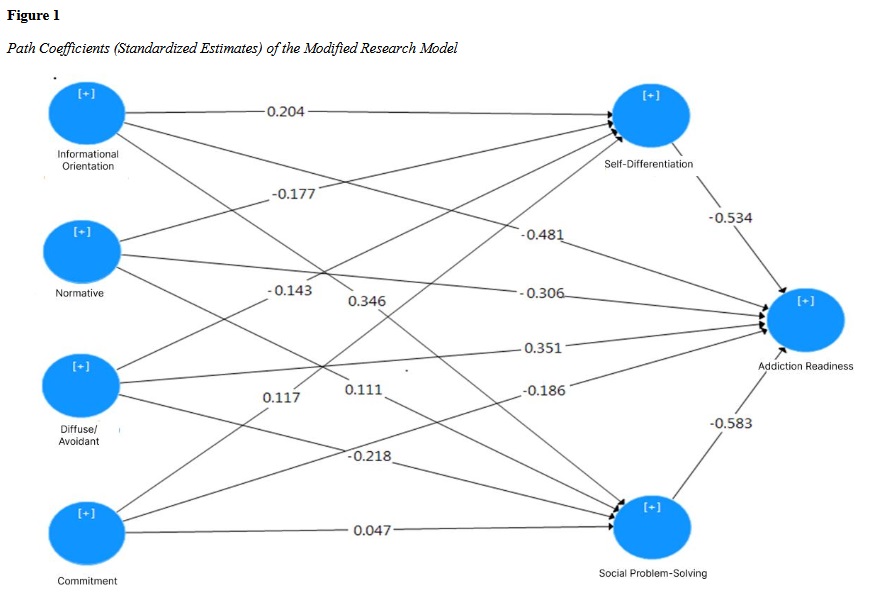
The present study aimed to determine the predictive contribution of addiction readiness based on identity styles with the mediation of self-differentiation and social problem-solving. The statistical population of this study included all male prisoners in the central prison of Isfahan Province in 2019. From this population, 120 individuals were selected using the convenience sampling method. Four standardized questionnaires were used in this study: the Addiction Readiness Questionnaire, the Identity Style Questionnaire, the Self-Differentiation Scale, and the Social Problem-Solving Inventory. The results of hypothesis testing indicated a significant direct relationship between identity styles and addiction readiness. Furthermore, in the relationship between the informational identity orientation and addiction readiness, the variable of social problem-solving played a mediating role. However, in the relationship between other identity styles (normative identity style, diffuse-avoidant identity style, and commitment) and addiction readiness, the variables of self-differentiation and social problem-solving did not have a mediating role (p > .05). Based on the study’s findings, it is recommended that family education centers, prisons, and mass media raise individuals' awareness regarding the importance of achieving a successful identity. Additionally, at-risk individuals should be encouraged to actively process information, engage with identity-related issues, and participate in problem-solving activities. Training programs should also be implemented to enhance these factors.
Downloads
References
Abaie, S. M., & Bagheri, N. (2024). Predicting the Desire for Remarriage Based on Self-Differentiation and Ego Strength Mediated by Irrational Beliefs in Divorced Youth. Jarac, 6(3), 81-89. https://doi.org/10.61838/kman.jarac.6.3.9
Abedi Pour, M., Modab Bilandi, F., Esmaeili, M., & Molaei, S. M. (2018). A Review on Predicting Addiction Readiness Based on Identity Styles and Parenting Styles. 1st Student Research Congress of Medical Universities of Khorasan, Gonabad,
Adindu, K. N., Otaniyen, P., Onochie, O. E., Oyedemi, D., Akubuiro, C. O., Nwonye, U. C., & AbdulAzeez, I. M. (2024). The Influence of Social Media on Adolescent Mental Health and Substance Abuse Patterns. World Journal of Advanced Research and Reviews, 24(2), 253-261. https://doi.org/10.30574/wjarr.2024.24.2.3296
Albal, E., & Buzlu, S. (2021). The effect of maladaptive schemas and psychological flexibility approaches on the addiction severity of drug addicts. Archives of Psychiatric Nursing, 35(6), 617-624. https://doi.org/10.1016/j.apnu.2021.09.001
Butler, A. (2013). Addiction: Physical or Psychological.
Fernández-Alarcón, S. M., Adame, M. D. C. V., Antona, C. J., Antón‐Sancho, Á., & Vergara, D. (2024). Psychological Improvement of People With Substance Addiction Through a Self-Esteem Workshop. Psychology International, 6(4), 786-795. https://doi.org/10.3390/psycholint6040050
Ghaffari, F., Rafiei, H., & Sanaei, B. (2010). Effectiveness of Family Training Using "Bowen's Systemic Theory" on Differentiation and Family Functioning in Families with an Addicted Child. Family Research Quarterly, 6(22), 227-239. https://www.sid.ir/paper/122583/en
Ghamari Givi, H., & Mojadad, A. (2016). Predicting Addiction Tendency Using Attachment Styles and Impulsivity. Journal of Health and Care, 18(1), 18-27. https://www.magiran.com/paper/1550226/prediction-of-tendency-to-addiction-using-attachment-style-and-impulsivity?lang=en
Haji Hasani, M., & Hashemi, F. (2019). Predicting Addiction Tendency in Students Based on Religious Orientation and Self-Differentiation. Journal of Psychology, 8(5), 38. https://frooyesh.ir/article-1-934-en.html
Hosseini Almadani, A., Ahadi, H., Karimi, Y., Bahrami, H., & Moazadian, A. (2011). Comparison of Resilience, Identity Styles, Spirituality, and Perceived Social Support in Addicted, Non-Addicted, and Recovered Individuals. Addiction Research Quarterly, 6(12), 47-64. https://etiadpajohi.ir/browse.php?a_id=332&slc_lang=en&sid=1&printcase=1&hbnr=1&hmb=1
Jalilian, F., Mirzaei Alaviyeh, M., Amouei, M. R., Zinat Motlagh, F., Hatamzadeh, N., & Allahverdipour, H. (2013). Prevalence and Patterns of Substance Abuse in Prisoners of Kermanshah City. Journal of Health Education and Health Promotion, 1(2), 41-48. http://journal.ihepsa.ir/article-1-87-en.html
Pirzadeh, S., & Parsakia, K. (2023). A Comparative Study of Family Structure (Cohesion and Flexibility) and Functioning in People with and without Drug Abuse. International Journal of Body, Mind & Culture, 10(1), 82-89. https://doi.org/10.22122/ijbmc.v10i1.278
Rezaei, P., & Shakerian, A. (2018). The Relationship Between Identity Styles and the Tendency Toward Substance Abuse in Students of the Islamic Azad University, Sanandaj Branch. 4th National Conference on Knowledge and Technology in Educational Sciences, Social Studies, and Psychology of Iran,
Salari Pak, S., & Azizi, M. (2018). Predicting Addiction Tendency Based on Personality Traits and Resilience in Students of Kerman Sajjad University of Medical Sciences. 2nd Conference on Social Sciences, Psychology, and Educational Sciences,
Tajeryan, Z., Afrooz, G. A., & Nouryghasemabadi, R. (2022). Social Problem Solving in Women with PTSD and Addiction. Psychology of Woman Journal, 3(4), 84-91. https://doi.org/10.61838/
Tanhaye Reshvanloo, F., Rajabi Joghortain, M., & Samadieh, H. (2024). Canonical Analysis of the Relations between Identity Styles and Self Handicapping in High School Students. Sociology of Education, 10(1), 236-245. https://doi.org/10.22034/ijes.2024.2007848.1445
Zilberman, N., Yadid, G., Efrati, Y., Neumark, Y., & Rassovsky, Y. (2018). Personality Profiles of Substance Abuse and Behavioral Addictions. Addictive behaviors, 82, 174-181. https://doi.org/10.1016/j.addbeh.2018.03.007
Downloads
Additional Files
Publication Timeline
- Submitted
- Revised
- Accepted
License
Copyright (c) 2025 Hamid Kazemi Zahrani, Elahe Ebrahimi Alavijeh (Author)

This work is licensed under a Creative Commons Attribution-NonCommercial 4.0 International License.