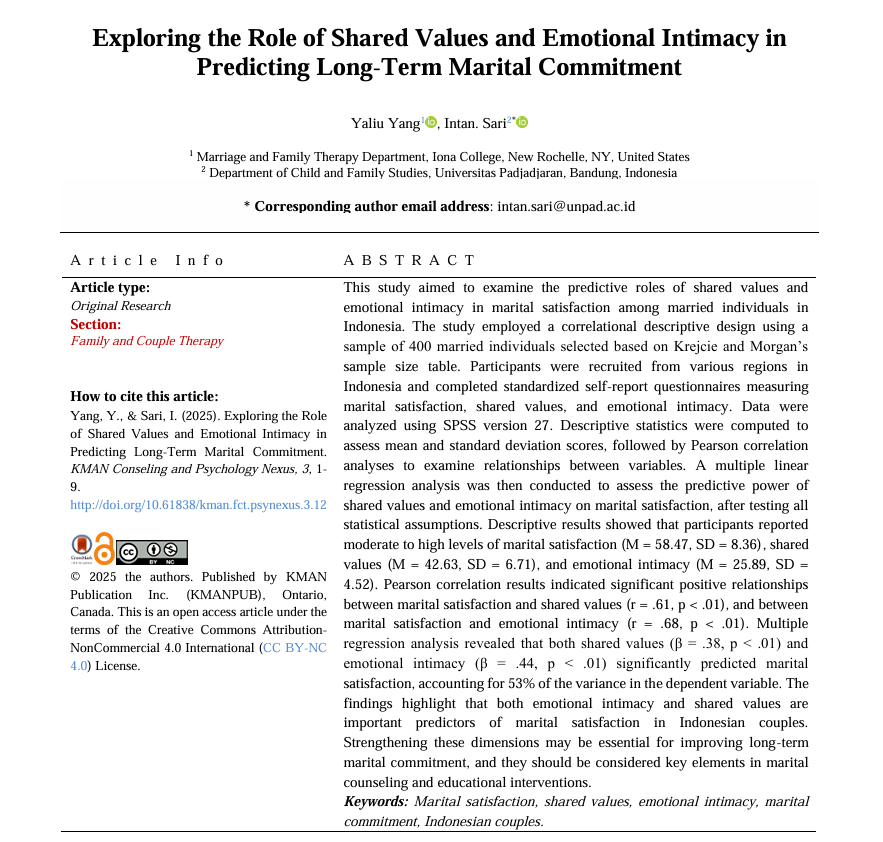
Exploring the Role of Shared Values and Emotional Intimacy in Predicting Long-Term Marital Commitment
DOI:
https://doi.org/10.61838/kman.fct.psynexus.3.12Keywords:
Marital satisfaction, shared values, emotional intimacy, marital commitment, Indonesian couplesAbstract
This study aimed to examine the predictive roles of shared values and emotional intimacy in marital satisfaction among married individuals in Indonesia. The study employed a correlational descriptive design using a sample of 400 married individuals selected based on Krejcie and Morgan’s sample size table. Participants were recruited from various regions in Indonesia and completed standardized self-report questionnaires measuring marital satisfaction, shared values, and emotional intimacy. Data were analyzed using SPSS version 27. Descriptive statistics were computed to assess mean and standard deviation scores, followed by Pearson correlation analyses to examine relationships between variables. A multiple linear regression analysis was then conducted to assess the predictive power of shared values and emotional intimacy on marital satisfaction, after testing all statistical assumptions. Descriptive results showed that participants reported moderate to high levels of marital satisfaction (M = 58.47, SD = 8.36), shared values (M = 42.63, SD = 6.71), and emotional intimacy (M = 25.89, SD = 4.52). Pearson correlation results indicated significant positive relationships between marital satisfaction and shared values (r = .61, p < .01), and between marital satisfaction and emotional intimacy (r = .68, p < .01). Multiple regression analysis revealed that both shared values (β = .38, p < .01) and emotional intimacy (β = .44, p < .01) significantly predicted marital satisfaction, accounting for 53% of the variance in the dependent variable. The findings highlight that both emotional intimacy and shared values are important predictors of marital satisfaction in Indonesian couples. Strengthening these dimensions may be essential for improving long-term marital commitment, and they should be considered key elements in marital counseling and educational interventions.
Downloads
References
Aranda, V., Ayala, M. d. L. C., Esquivel, C., Ossandón, N., & Quinteros, C. (2024). Self-Concealment and Emotional Intimacy in Chilean Adults in a Couple Relationship. Ijp&pp, 1(2), 119-140. https://doi.org/10.56754/2810-6598.2024.0012
Ghahari, S., Sheybani, F., Ghazanfari, Z., Afshar, P. F., & Jamil, L. (2023). Comparison of the Three Methods of Psychotherapy on Marital Satisfaction and Intimacy in Married Women. Clinical Psychology and Special Education, 12(1), 1-17. https://doi.org/10.17759/cpse.2023120101
Ghasemi, Y. (2023). The Relationship Between Attachment Symbols, Attachment Styles and Self-Differentiation With Marital Intimacy. Obstetrics Gynecology and Reproductive Sciences, 7(4), 01-08. https://doi.org/10.31579/2578-8965/168
Guerrero‐Molina, M., Barbosa-Torres, C., & Manso, J. M. M. (2023). Subclinical Psychopathy and Styles of Intimate Relationships. Behavioral Psychology/Psicología Conductual, 31(1), 77-91. https://doi.org/10.51668/bp.8323105n
Gurung, S. K., Chapagain, R., & Sharma, S. (2023). Exploring the Lived Experiences of Marital Intimacy Among Nepali Married Couples: A Transcendental Phenomenological Approach. Asian Journal of Population Sciences, 17-36. https://doi.org/10.3126/ajps.v2i1.51088
Guzmán-González, M., Gómez, F., Bahamondes, J., Barrientos, J., Garrido-Rojas, L., Espinoza-Tapia, R., & Casu, G. (2023). Internalized Homonegativity Moderates the Association Between Attachment Avoidance and Emotional Intimacy Among Same-Sex Male Couples. Frontiers in psychology, 14. https://doi.org/10.3389/fpsyg.2023.1148005
Homaei, F., Shahlapour, S., Omidbakhtiari, N., & Mirzaei, Z. (2023). The Effectiveness of McMaster's Systemic Couple Therapy on Self-Differentiation and Marital Boredom and Intimacy of Couples With Emotional Divorce. Jarac, 5(2), 41-47. https://doi.org/10.61838/kman.jarac.5.2.6
Jitaru, M., & Turliuc, M. N. (2022). The Moderator Role of Interpersonal Emotion Regulation on the Associations Between Commitment, Intimacy, and Couple Satisfaction. International journal of environmental research and public health, 19(17), 10506. https://doi.org/10.3390/ijerph191710506
Joy, G. V., & Nashwan, A. J. (2024). Emotional Resilience and Well-Being in Employability of Nurses: A “Triangular Theory of Love’’ Approach. 1(3). https://doi.org/10.20935/mhealthwellb7395
Knobloch‐Fedders, L. M., Knobloch, L. K., Scott, S., & Fiore, H. M. (2020). Relationship Changes of Military Couples During Reintegration: A Longitudinal Analysis. Journal of Social and Personal Relationships, 37(7), 2145-2165. https://doi.org/10.1177/0265407520917461
Lim, J. (2022). The Mediating Effect of Adaptive Cognitive Emotion Regulation Strategy on the Relationship of Marital Conflict and Marital Intimacy Among Middle-Aged Married Couples: Actor and Partner Effect. Korean Soc Cult Converg, 44(11), 901-914. https://doi.org/10.33645/cnc.2022.11.44.11.901
Nezamalmolki, M., Bahrainian, S. A., & Shahabizadeh, F. (2023). Effectiveness of Emotion-Focused Couples Therapy on Sexual Function, Marital Intimacy, and Impulsivity in Women Affected by Marital Infidelity. PWJ, 4(4), 39-47. https://doi.org/10.61838/kman.pwj.4.4.5
Obradović, J., & Obradović, M. Č. (2021). Marital Partners' Traits, Psychological Processes in Marriage, and Marriage Characteristics as Predictors of Love in Marriage. Drustvena Istrazivanja, 30(1), 1-28. https://doi.org/10.5559/di.30.1.01
Poorseyed, S. R. (2023). The Mediating Role of Hope and Resilience in the Relationship Between Corona Phobia and Emotional Intimacy in Married Women. Journal of Woman and Family Studies, 11(1), 128-155. https://journal.alzahra.ac.ir/article_6704_ad781f2a2e35f56ad922d5c20d6adced.pdf
Quyamuddin, M. (2025). Emotional Resilience and Psychological Well-Being in Junior Resident Doctor’s Professional Growth: A Conceptual Exploration Through the Lens of the “Triangular Theory of Love”. International Journal for Multidisciplinary Research, 7(2). https://doi.org/10.36948/ijfmr.2025.v07i02.39862
Rajabi, M., Hajebi, M. Z., & Monirpour, N. (2024). Explanation of the Model of Marital Commitment Based on Object Relations With the Mediating Role of Emotion Regulation. Jarac, 6(4), 181-188. https://doi.org/10.61838/kman.jarac.6.4.21
Rosen-Grandon, J. R., Myers, J. E., & Hattie, J. A. (2004). The Relationship Between Marital Characteristics, Marital Interaction Processes, and Marital Satisfaction. Journal of Counseling & Development, 82(1), 58-68. https://doi.org/10.1002/j.1556-6678.2004.tb00286.x
Salari, H., pour, R. N., & Zahrakar, K. (2022). A Comparison of the Effectiveness of Integrative Couple Therapy and Integrative Behavioral Couple Therapy on Increasing Emotional and Sexual Intimacy of Couples Traumatized by Infidelity. Journal of counseling research. https://doi.org/10.18502/qjcr.v22i81.10111
Salehi, M., Abkenar, B. N., & Sarajari, M. Y. (2023). Effectiveness of Integrated Couples Therapy on Intimacy and Marital Forgiveness Among Women Affected by Extramarital Relationships. PWJ, 4(3), 69-76. https://doi.org/10.61838/kman.pwj.4.3.9
Santri, V. S., Savitri, J., & Tjandraningtyas, J. M. (2022). The Role of Communication Quality and Intimacy on Marriage Commitment in Dual Career Couples in Serang Regency Regional Apparatus Organizations. Humanitas (Jurnal Psikologi), 6(3), 315-328. https://doi.org/10.28932/humanitas.v6i3.5539
Shrestha, P. S., Shaver, S. R., Perlman, T. T., & Walsham, W. (2023). Emotional Dimensions of Infidelity: An Analysis of Psychological and Emotional Factors Affecting Relationship Infidelity. Sosateris, 11(2), 88-103. https://doi.org/10.35335/85rbw180
Umami, E., Purwarno, P., & Manugeren, M. (2024). Emotional Intimacy in Danielle Steel's Novel Fine Things. Journal of Language, 6(1), 36-49. https://doi.org/10.30743/jol.v6i1.9114
Vakilian, K., Ebrahimi, S., Fouladvand, M., Moslemi, A., & Najdi, N. (2024). Predicting Commitment of Married Women Based on Emotional Intimacy, Cognitive Flexibility, and Irrational Beliefs of Infertile Couples in Arak City in the 2021:A Cross-Sectional Study. The Open Public Health Journal, 17(1). https://doi.org/10.2174/0118749445267020240209073345
Wang, Z. A. U. Z. X., & Ye, Y. (2024). Does marital satisfaction predict children aggression? Insights from parents' and children's psychological distress. Child & Family Social Work, 29(3), 615-624. https://doi.org/10.1111/cfs.13121
Wickrama, K. A. S., O’Neal, C. W., & Klopack, E. T. (2022). Midlife Financial Strain and Later‐life Health and Wellbeing of Husbands and Wives: Linking and Moderating Roles of Couple Intimacy Trajectories. Family Process, 61(4), 1593-1609. https://doi.org/10.1111/famp.12749
Wikle, J. S., Forbush, A., Yorgason, J., & Holmes, E. K. (2024). Family Leisure and Negative Links Between Family of Origin Adversity and Marital Satisfaction. Family Relations. https://doi.org/10.1111/fare.13055
Yang, J., & Seyed Alitabar, S. H. (2024). The Effects of School Size on Student Participation and Sense of Community [Research Article]. Iranian Journal of Educational Sociology, 7(1), 205-211. https://doi.org/10.61838/kman.ijes.7.1.20
Zadhasan, Z., & Moghadam, K. K. (2023). The Effectiveness of Emotion-Focused Couple Therapy on Positive Emotion, Marital Intimacy and Personality Abilities of Elderly Women. Aftj, 4(2), 488-502. https://doi.org/10.61838/kman.aftj.4.2.29
Downloads
Additional Files
Publication Timeline
- Submitted
- Revised
- Accepted
Issue
Section
Categories
License

This work is licensed under a Creative Commons Attribution-NonCommercial 4.0 International License.