The Effect of Emotional Blackmail on the Quality of Marital Relationships: The Mediating Role of Marital Burnout in Women Seeking Divorce
DOI:
https://doi.org/10.61838/kman.psynexus.2.2.31Keywords:
Emotional blackmail, Marital relationship quality, Marital burnout, Women seeking divorceAbstract
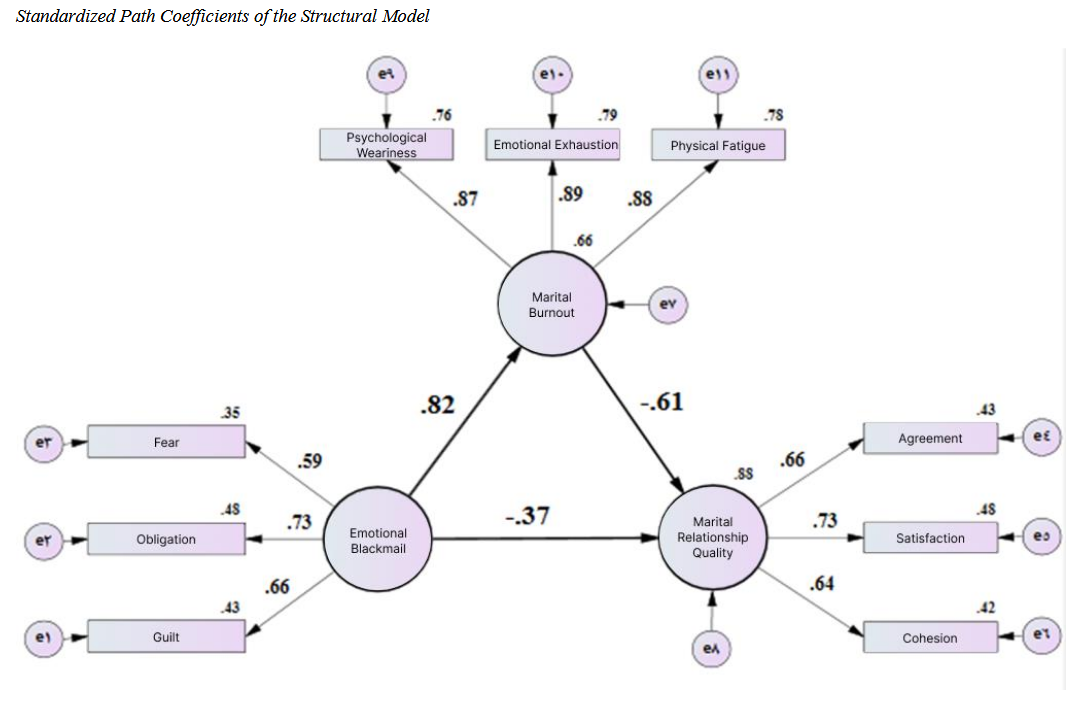
This study aimed to investigate the effect of emotional blackmail on the quality of marital relationships among women applying for divorce, with marital burnout considered as a mediating variable. This research employed a descriptive-correlational design with an applied purpose. The statistical population included all women seeking divorce who referred to licensed pre-divorce counseling centers in Ramsar and Tonekabon between February and June 2024. A purposive sample of 210 participants completed three standardized questionnaires: Rahmat’s Emotional Blackmail Inventory (2019), Pines’ Marital Burnout Questionnaire (1996), and the Marital Relationship Quality Scale by Busby et al. (1995). Data were analyzed using SPSS 25 and AMOS 24. Normality was confirmed through the Kolmogorov–Smirnov test, and structural equation modeling (SEM) was used to assess the research model. The results revealed a significant negative relationship between emotional blackmail and marital relationship quality (β = -0.37, p < 0.01). Marital burnout was also significantly and negatively associated with relationship quality (β = -0.61, p < 0.01) and positively associated with emotional blackmail (β = 0.82, p < 0.01). The Sobel test confirmed the mediating role of marital burnout (Z = 6.685), and the Variance Accounted For (VAF) indicated that 57.5% of the total effect of emotional blackmail on relationship quality was explained through indirect effects, confirming partial mediation. Emotional blackmail significantly reduces marital relationship quality both directly and indirectly by increasing marital burnout. This highlights the destructive role of emotional manipulation in intimate relationships and underscores the importance of identifying and addressing emotional burnout as a key mechanism of relational decline.
Downloads
References
Abbasi, M., SiahKamari, R., Nosrati, R., Heidari Sharaf, P., & Tarighati Maram, F. (2019). Relationship between quality of life and resiliency with marital disturbance among women teachers in Kermanshah. Rooyesh, 8(6), 79-86. https://frooyesh.ir/article-1-995-fa.html
Acquah, S., Dzakadzie, Y., & Eshun, P. (2024). Level of Education, Marital Longevity and Religion as Determinants of Marital Stability among Couples in Tamale Metropolis, Ghana. Advances in Research, 25(3), 137-147. https://doi.org/10.9734/air/2024/v25i31059
Alsawalqa, R., Abdel Rahman, Y., & Alrawashdeh, N. (2021). Jordanian Men's Experience of Emotional Abuse in Marital Relationships: The Role of Marriage Length and Motivation. Personality and Social Psychology, 12. https://doi.org/10.3389/fpsyg.2021.689235
Busby, D. M., Crane, D. R., Larson, J. H., & Christensen, C. (1995). A revision of the Dyadic Adjustment Scale for use with distressed and nondistressed couples: Construct Hierarchy and multidimensional scale. Journal of marital and family therapy, 21, 289-308. https://doi.org/10.1111/j.1752-0606.1995.tb00163.x
Glasser, W., & Sahebi, A. (2022). Reality Therapy: A New Approach to Psychiatry. Sokhan Publication. https://www.amazon.com/Reality-Therapy-Approach-Psychiatry-Colophon/dp/0060904143
Hawkins, J. M., McPhee, D. P., & Brown, C. C. (2020). Incorporating Biopsychosocial-Spiritual Resources in Emotionally Focused Couple Therapy. Contemporary Family Therapy, 42(3), 217-227. https://doi.org/10.1007/s10591-019-09523-8
Hollist, C. S., & Miller, R. B. (2005). Perceptions of attachment style and marital quality in midlife marriage. Family Relations, 54, 46-58. https://doi.org/10.1111/j.0197-6664.2005.00005.x
Hosseini, A., Rasouli, M., Davarniya, R., & Babaeigarmkhani, M. (2015). The Effect of Group Training Based on Practical Application of Intimate Relationship Skills Program on Marital Relationships Quality. Scientific Journal of Ilam University of Medical Sciences, 24(2), 8-17. https://doi.org/10.18869/acadpub.sjimu.24.2.8
Jacob, I., & Ahmed, N. (2018). Marital satisfaction and burnout in spouses of patients with Schizophrenia. Indian Journal of Psychiatric Nursing, 15(1), 43. https://doi.org/10.4103/2231-1505.262505
Jardine, B. B., Vannier, S., & Voyer, D. (2022). Emotional intelligence and romantic relationship satisfaction: A systematic review and meta-analysis. Personality and individual differences, 196, 111713. https://doi.org/10.1016/j.paid.2022.111713
Kreimeen, A., Ahmad, N., & Samawi, A. (2022). The Association of Emotional Blackmail and Adjustment to College Life Among Warned Female Students at Al-Balqa University. Health Psychology Research, 10(2). https://doi.org/10.52965/001c.34109
Mattom, D. T., & Lokesh, L. (2021). Emotional Abuse and Psychological Well-Being among Arranged Marriage Keralites. The International Journal of Indian Psychology, 9(3), 2349-3429. https://ijip.in/wp-content/uploads/2021/07/18.01.015.0210903.pdf
Mohammadipour, M., Shojaei Kalatebali, N., & Bakhshipour, A. (2021). The effect of solution focused couple therapy on marital adjustment, marital relationship quality and social health in divorce applicant couples. Journal of Social Psychology, 14(57), 75-85. https://journals.iau.ir/article_680043.html?lang=en
Neal, A. M., & Lemay, E. P. (2019). The wandering eye perceives more threats: Projection of attraction to alternative partners predicts anger and negative behavior in romantic relationships. Journal of Social and Personal Relationships, 36(2), 450-468. https://doi.org/10.1177/0265407517734398
Niknam, M., & Rikhtegar, B. A. (2022). The Moderating Role of Emotional Blackmail in the Relationship between Schema Modes and Quality of Marital Life. Psychological studies, 17(4), 161-182. https://psychstudies.alzahra.ac.ir/article_6135.html
Park, T. Y., & Park, Y. (2019). Living with an In-Law and Marital Conflicts: A Family Therapy Case Study. Journal of Asia Pacific Counseling, 9(2), 73-89. https://doi.org/10.18401/2019.9.2.5
Pines, A. M., & Nunes, R. (2003). The relationship between career and couple burnout: Implications for career and couple counseling. Journal of employment counseling, 40(2), 50-64. https://doi.org/10.1002/j.2161-1920.2003.tb00856.x
Rabelani, M., Enneth, T., Nkhwashu, H., & Shilubane, N. (2022). Emotional abuse among married women at Vhembe district: Experiences and consequences. Health Sa Gesondheid, 27. https://doi.org/10.4102/hsag.v27i0.2002
Rahmat, S., Soodagar, S. H., & Jomehri, F. (2019). Design, standardize and normalize an emotional blackmail inventory. Journal of Psychometry, 8(29), 63-81. https://sanad.iau.ir/Journal/ps/Article/1112050
Saffarinia, M., Adabdoost, F., Shahandeh, M., & Zare, H. (2022). Predicting marital boredom based on social comparison and couple exchange style. Rooyesh, 11(2), 85-94. https://frooyesh.ir/article-1-3310-fa.html
Yousefi, N. (2012). Psychometric Properties of the Revised Dyadic Adjustment Scales (RDAS). Research in Clinical Psychology and Counseling, 1(2), 183-200. https://tpccp.um.ac.ir/article_29789.html
Downloads
Additional Files
Publication Timeline
- Submitted
- Revised
- Accepted
License
Copyright (c) 2024 Shirin Shahi (Author); Maryam Rostamnezhad (Corresponding Author)

This work is licensed under a Creative Commons Attribution-NonCommercial 4.0 International License.