Paradoxical Therapy in Couple and Family Therapy: Mechanisms of Change and Implications
DOI:
https://doi.org/10.61838/kman.fct.psynexus.3.19Keywords:
Paradoxical Timetable Prescription, couple therapy, family therapy, paradoxical interventionsAbstract
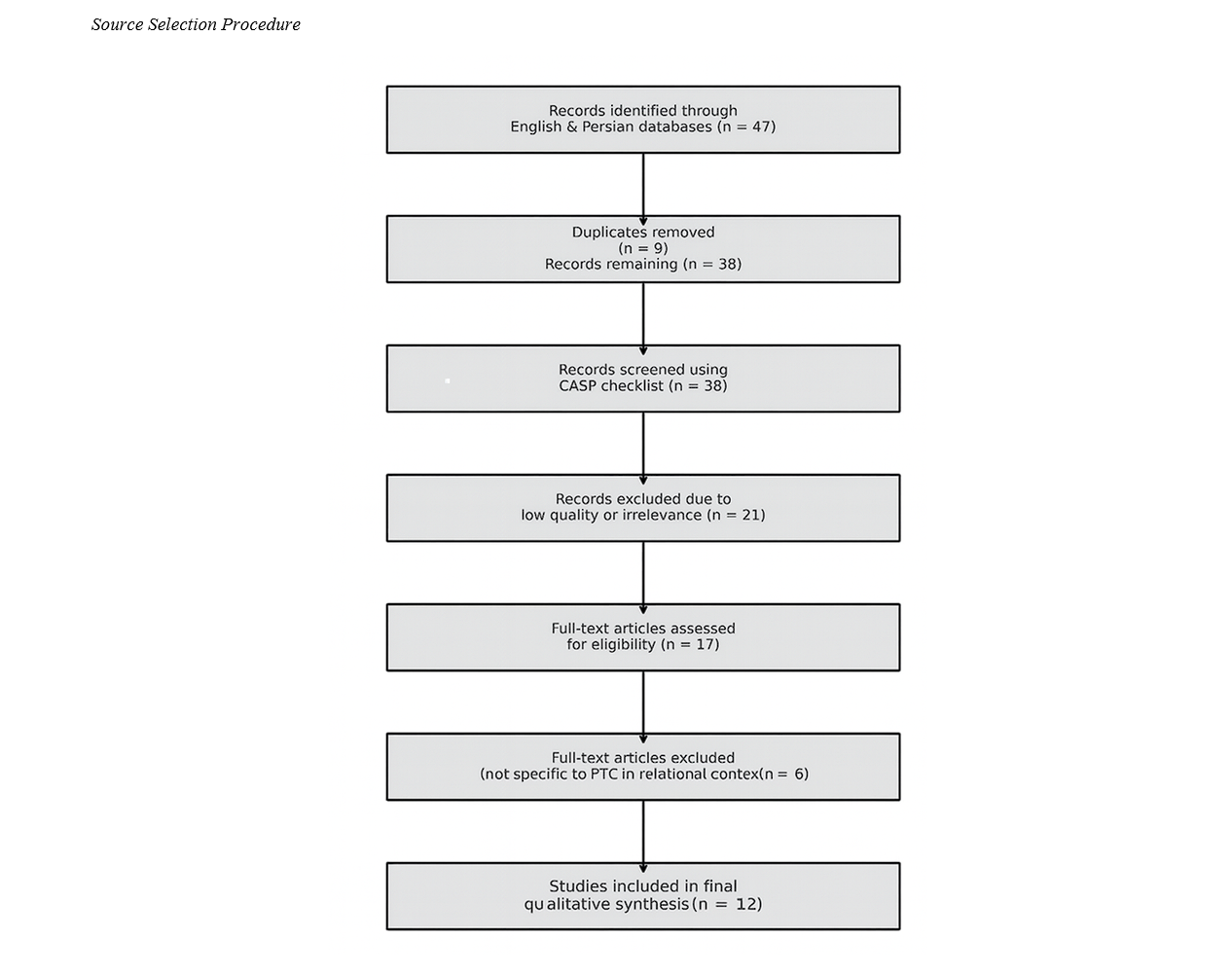
This study aimed to explore the mechanisms of change and clinical implications of the Paradoxical Therapy or Paradoxical Timetable Prescription within the context of couple and family therapy. A qualitative research design was employed using conventional content analysis of 12 high-quality sources selected through the Critical Appraisal Skills Programme (CASP) method. The sources included empirical studies, clinical case reports, and theoretical contributions published in both Persian and English. Nvivo 14 software was used to facilitate data coding and thematic synthesis. An inductive analytic approach was used to identify emergent themes related to how Paradoxical Timetable Therapy functions as an intervention within relational systems, particularly among couples and families. The analysis produced 134 open codes, later refined into 23 focused categories and ultimately organized into five overarching themes: (1) restoration of volitional control, (2) emotional regulation and deflation, (3) disruption of the symptom reinforcement loop, (4) systemic pattern recalibration, and (5) therapeutic resistance bypass. The mechanisms of treatment and change in the paradoxical timetable were: Volitional Control Restoration, Emotional Deflation through Structured Permission, Reinforcement Loop Interruption, Systemic Role Reframing, Resistance Bypass via Paradoxical Framing, Artificialization, Changing the meaning of Symptom, Ego-Ego strength in system, Strengthening interaction, Balance in the self-other cycle. These mechanisms collectively demonstrated how PTC (Paradox+Timetable=Cure) restructures relational dynamics by embedding paradoxical behavior within scheduled time frames. The findings indicate that Paradoxical Timetable Prescription not only reduces symptom intensity but also fosters meta-awareness, reflective engagement, and systemic flexibility across couples and family members. The technique’s non-confrontational and humor-enabled format was particularly effective in reducing emotional escalation and preserving therapeutic alliance. Paradoxical Timetable Therapy emerges as a strategically paradoxical and relationally adaptive intervention that addresses entrenched emotional, behavioral, and systemic patterns in couple and family contexts. Its unique combination of structured permission and symptom scheduling enables both emotional containment and volitional reactivation, making it especially useful for high-conflict or resistant relational systems. The study highlights Paradoxical therapy's theoretical coherence, practical versatility, and potential for integration into broader systemic therapeutic protocols.
Downloads
References
Ahmadi, S., Rezaei, A., Samani, S., & Kazemi, S. (2020). Comparing the Effect of Exposure and Response Prevention and Paradoxical Time Table Therapy Techniques on the Obsessive-Compulsive Disorder Patients [Original]. Internal Medicine Today, 26(3), 244-259. https://doi.org/10.32598/hms.26.3.3093.3
Asayesh, M. H., & Parsakia, K. (2025). Paradoxical Timetable Therapy and Psychological Problems: Mechanisms of Change and Implications. Mental Health and Lifestyle Journal, 3(3), 1-21. https://doi.org/10.61838/mhlj.3.3.11
Babaie, V., Abolmaali Alhosseini, K., & Hobbi, M. B. (2023). Investigating the efficacy of paradoxical time table therapy on anxiety sensitivity and focused–attention in people with social anxiety disorder. Journal-of-Psychological-Science, 22(125), 967. https://doi.org/10.52547/JPS.22.125.967
Basharat, M. A. (2023). Paradox Therapy Course + Anxiety Disorders. University of Tehran.
Besharat, M. (2018). Paradox+ Timetable= Cure (PTC): Perfect model of therapy with couples (A practical guide). Tehran: Roshd Press (Text in Persian).
Besharat, M. A. (2019). Evaluating the effectiveness of paradox therapy for the treatment of obsessive-compulsive disorder: A case study. Journal of Psychological Studies, 14(4), 7-36. https://doi.org/10.22051/psy.2019.23631.1801
Besharat, M. A. (2020). Evaluating the effectiveness of paradoxical couple therapy for the treatment of couple problems: A case study. Journal of Family Psychology, 7(1), 1-18. https://www.magiran.com/paper/2214614/
Besharat, M. A. (2023a). The Effective Mechanisms of the Paradoxical Timetable. In M. A. Besharat (Ed.), Paradoxical Psychotherapy: A Practitioner’s Guide (pp. 23-27). Springer International Publishing. https://doi.org/10.1007/978-3-031-27717-7_5
Besharat, M. A. (2023b). Paradoxical Psychotherapy: A Practitioner's Guide. Springer.
Besharat, M. A. (2023c). The PTC Perfect Model of Psychotherapy. In M. A. Besharat (Ed.), Paradoxical Psychotherapy: A Practitioner’s Guide (pp. 1-4). Springer International Publishing. https://doi.org/10.1007/978-3-031-27717-7_1
Chitgarzadeh, M. J., Asayesh, M. H., Besharat, M. A., & Hakkak, F. (2023). Investigating the effectiveness of paradoxical couple therapy (PTC) on marital conflicts and emotion regulation in conflicting couples [Research]. Rooyesh-e-Ravanshenasi Journal(RRJ), 12(2), 39-50. http://frooyesh.ir/article-1-4107-en.html
Dehaqin, V., Gholamali Lavasani, M., & Naghsh, Z. (2023). The effectiveness of paradoxical therapy on relational practical obsessive-compulsive symptoms. Journal of Adolescent and Youth Psychological Studies (JAYPS), 4(4), 118-133. https://doi.org/10.61838/kman.jayps.4.4.12
Eatesamipour, R., & Ramazanzade Moghadam, K. (2023). The Effectiveness of Paradox Therapy on Anger Rumination in People with Anxiety Caused by Corona Disease. Clinical Psychology and Personality, 21(2), 105-116. https://doi.org/10.22070/cpap.2023.17770.1370
Feyzi, F., & Anasseri, M. (2025). The Effectiveness of the Paradoxical Timetable Cure on Self-Objectification and the Experience of Close Relationships in Women with Low Psychological Capital Diagnosed with Anuptaphobia. Iranian Journal of Neurodevelopmental Disorders, 4(1), 21-27. https://doi.org/10.61838/kman.jndd.4.1.3
Ghadimi Nouran, M., Shafiabady, A., Khodabakhshi Koolaee, A., & Asgari, M. (2020). Develop a Therapy Protocol Based on the Paradoxical Timetabling Model and Its Effectiveness on Binge Eating Disorder among Women [Research]. Journal title, 14(2), 81-94. https://doi.org/10.52547/rph.14.2.81
Haley, J. (1976). Problem-solving therapy. Jossey-Bass.
Hashemizadeh, F. s., Atashpour, H., & Farhadi, H. (2025). Comparison of the Effectiveness of Paradox TimeTable Cure and Acceptance and Commitment Therapy Matrix on Family Adaptability and Mental Well-Being in Women with Marital Conflicts. Shenakht, 11(6), 106. https://doi.org/10.32598/shenakht.11.6.106
Hashemizadeh, F. S., Atashpour, S. H., & Farhadi, H. (2023). Comparison of the Effectiveness of Paradoxical Timetable Cure (PTC), Acceptance and Commitment Therapy Matrix (ACTM), and Emotion-Focused Therapy (EFT) on Self-Esteem and Marital Boredom in Women With Marital Conflict. PWJ, 4(4), 27-38. https://doi.org/10.61838/kman.pwj.4.4.4
Jesus, S., & Garrido, P. (2024). Therapeutic paradox in family therapy: A return to symptom prescription. Open Access Library Journal, 11, e12495. https://doi.org/10.4236/oalib.1112495
Joudari, R., & Anasseri, M. (2024). Effectiveness of Paradoxical Couple Therapy on Self-Differentiation and Marital Intimacy in Couples With Marital Conflict. Aftj, 5(5), 218-226. https://doi.org/10.61838/kman.aftj.5.5.25
Mohammadi, Z., Soleimani, A., Fathi Ashtiani, A., Ashrafi, E., & Mokhaberi, K. (2019). Comparing the Effectiveness of Paradoxical Time Management Therapy, Exposure Therapy, Response Prevention, and Medication on Reducing Symptoms in Patients with Obsessive-Compulsive Disorder. Disability Studies Journal, 9(63), 63. https://jdisabilstud.org/browse.php?a_id=1637&sid=1&slc_lang=fa
Nikan, A., Lotfi Kashani, F., Vaziri, S., & Mojtaei, M. (2021). Comparing Paradoxical Time Therapy and Cognitive Behavioral Therapy on Worry and Rumination in Individuals with Social Anxiety. Revival of Psychology, 10(1), 1-14. https://frooyesh.ir/browse.php?a_id=2739&slc_lang=en&sid=1&printcase=1&hbnr=1&hmb=1
Payman Pak, F., Pourshahriari, M., & Abdollahi, A. (2023). Comparing the Effectiveness of Paradoxical Time Therapy and Cognitive-Behavioral Therapy on Reducing Symptoms in Women with Generalized Anxiety Disorder.
Peluso, P. R., & Freund, R. (2023). Paradoxical interventions: A meta-analysis. Psychotherapy, 60(3), 283-294. https://doi.org/10.1037/pst0000481
Salehi, S., Vaziri, S., & Nasri, M. (2025). Comparing the Effectiveness of Acceptance and Commitment Therapy and Paradoxical Timetable Therapy on Worry in Individuals with Social Anxiety Disorder. Sadra Medical Journal, 13(1), 138-154. https://doi.org/10.30476/smsj.2025.101698.1495
Seifi, S. A. R., Besharat, M. A., & Ahmadi Mohammad Abadi, M. R. (2025). Comparison of Solution-Focused Brief Therapy (SFBT) approach with paradoxical timetable cure (PTC) approach. Applied Research in Consulting. https://www.jarci.ir/article_721876.html
Taghilo, L., Azizi Ziabari, L. S., Khajevand Khoshli, A., & Damghani Mirmahaleh, M. (2023). Comparing the effectiveness of acceptance and commitment therapy(ACT) and paradoxical time table therapy (PTC) on the psychological well-being of nurses. EBNESINA, 25(3), 14. https://doi.org/10.22034/25.3.14
Downloads
Additional Files
Publication Timeline
- Submitted
- Revised
- Accepted
Issue
Section
Categories
License
Copyright (c) 2025 Mohammad Hassan Asayesh, Kamdin Parsakia (Author)

This work is licensed under a Creative Commons Attribution-NonCommercial 4.0 International License.