
Comparison of the Effectiveness of Short-Term Psychodynamic Therapy and Mentalization-Based Therapy on Rejection Sensitivity in Individuals with Borderline Personality Structure
DOI:
https://doi.org/10.61838/kman.hp.psynexus.4587Keywords:
Borderline personality structure, short-term psychodynamic therapy, mentalization-based therapy, rejection sensitivityAbstract
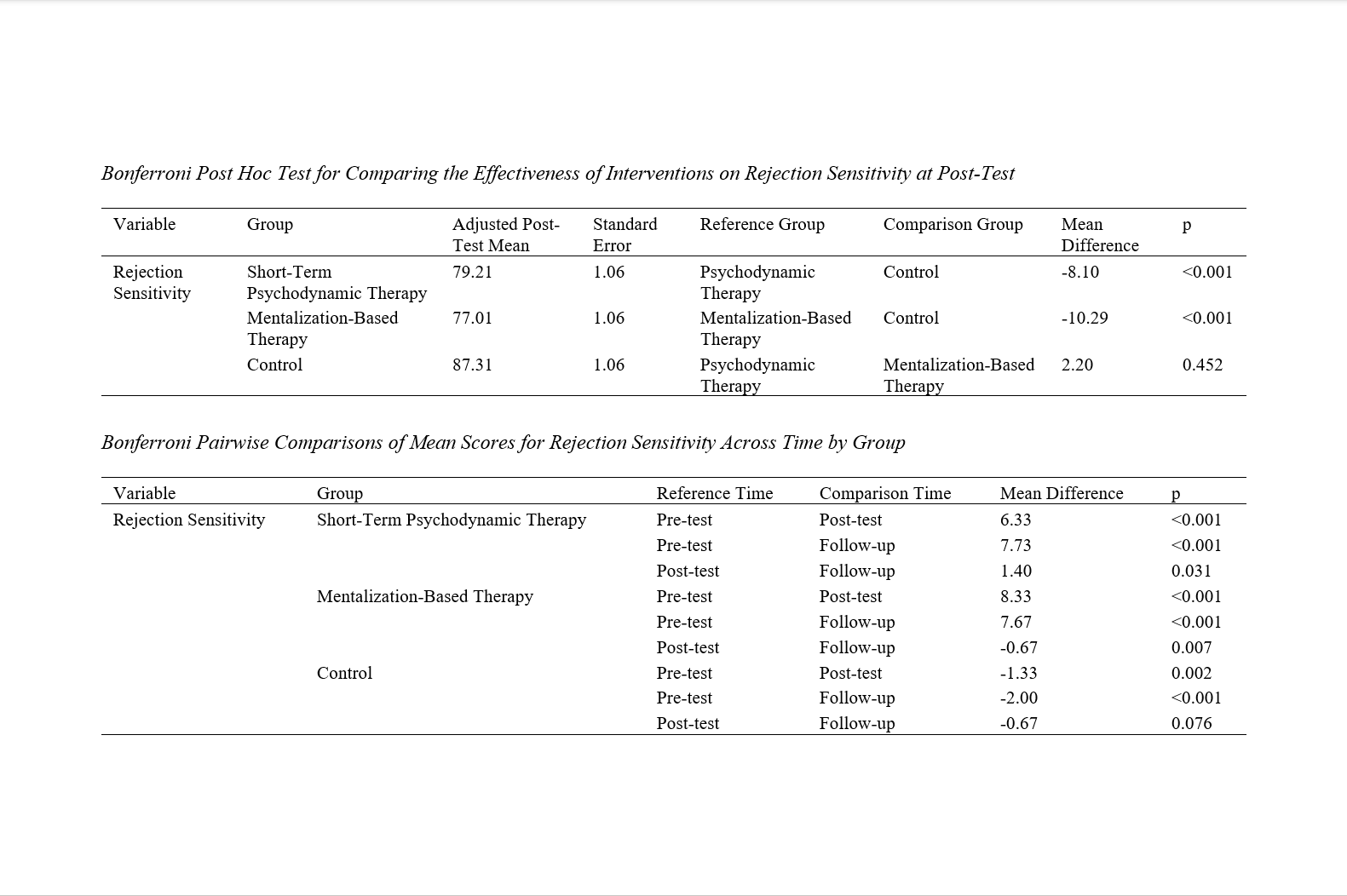
This study aimed to compare the effectiveness of short-term psychodynamic therapy (STPT) and mentalization-based therapy (MBT) in reducing rejection sensitivity among individuals with borderline personality structure. The research utilized an applied, semi-experimental design with a pre-test, post-test, control group, and a two-month follow-up. The study population comprised individuals diagnosed with borderline personality structure who attended psychotherapy clinics in western Tehran during the second half of 2024. A total of 45 participants meeting the inclusion criteria were selected through purposive sampling and randomly assigned into three groups of fifteen after matching for age and gender. The two experimental groups received nine 90-minute sessions of STPT or MBT, while the control group received no intervention during the study period. The Rejection Sensitivity Questionnaire (Downey & Feldman, 1996) was administered at three stages—pre-test, post-test, and follow-up. Data were analyzed using multivariate analysis of variance (MANOVA), repeated-measures ANOVA, and Bonferroni post hoc tests. The results showed a significant main effect of time and a significant time × group interaction on rejection sensitivity (p < 0.001), confirming that both STPT and MBT led to meaningful reductions in rejection sensitivity over time. Post hoc comparisons indicated that both intervention groups had significantly lower post-test and follow-up scores compared to the control group (p < 0.001), while no significant difference was found between the two treatment groups (p > 0.05). These therapeutic effects remained stable during the follow-up period, indicating sustained improvement. The comparable efficacy of the two approaches suggests that both emotional processing through psychodynamic mechanisms and reflective functioning through mentalization play crucial roles in decreasing interpersonal vulnerability and emotional reactivity to perceived rejection.
Downloads
References
Andrews, S. (2011). The challenges of affect-focused short-term dynamic psychotherapy with borderline patients. Psychodynamic Psychiatry, 39(1), 89-112.
Azizi, N., Rezaei, F., & Kazemi, L. (2023). The Effectiveness of Mentalization-Based Therapy on Emotion Dysregulation and Tendency to Self-Harm in Young Adults with Borderline Features. Psychotherapy Research Journal, 8(1), 43-65.
Bateman, A. W., & Fonagy, P. (2024). Mentalization-based treatment for borderline personality disorder: A practical guide. Oxford University Press. https://pmc.ncbi.nlm.nih.gov
Bateman, A. W., Fonagy, P., & Campbell, C. (2025). Enhancing mentalizing in borderline personality: Advances and challenges. Current opinion in psychology, 50, 101649. https://onlinelibrary.wiley.com/doi/abs/10.1002/cpp.70120
Debbané, M., Fonagy, P., Luyten, P., & Bateman, A. (2024). Mentalizing as a protective factor linking alexithymia and borderline personality disorder. Frontiers in Psychiatry, 15, 1361535.
Johnstone, O. K., Marshall, J. J., & McIntosh, L. G. (2022). A review comparing dialectical behavior therapy and mentalization for adolescents with borderline personality traits, suicide and self-harming behavior. Adolescent Research Review, 7(2), 187-209. https://doi.org/10.1007/s40894-020-00147-w
Kim, B., & Lee, E. (2023). The Relationship Between Adult Attachment and Emotion Dysregulation in College Students: The Mediating Effects of Mentalization and Rejection Sensitivity. Korean Association for Learner-Centered Curriculum and Instruction, 23(10), 239-253. https://doi.org/10.22251/jlcci.2023.23.10.239
Niknejad, S., Mohammadi, F., & Hashemi, A. (2023). Investigating the Effectiveness of Short-Term Psychodynamic Therapy on Self-Harm in Adolescents with Borderline Personality Structure. Journal of Adolescent Clinical Psychology, 14(2), 110-125.
Nolte, T., Hutsebaut, J., Sharp, C., Campbell, C., Fonagy, P., & Bateman, A. (2023). The role of epistemic trust in mentalization-based treatment of borderline psychopathology. Journal of personality disorders, 37(5), 633-659. https://doi.org/10.1521/pedi.2023.37.5.633
Ramadas, L., Doba, K., Mesquita, A. R., Wawrziczny, É., & Nandrino, J. L. (2024). Role of emotion regulation and mentalizing in rejection sensitivity: The specific relationship to potentially psychologically traumatic event. Personality and individual differences, 218, 112461. https://doi.org/10.1016/j.paid.2023.112461
Ryu, J., & Lee, S. (2024). The Moderated Mediating Effects of Mentalization Through Rejection Sensitivity in the Relationship Between Covert Narcissism and Relationship Addiction. Korean Association for Learner-Centered Curriculum and Instruction, 24(19), 31-46. https://doi.org/10.22251/jlcci.2024.24.19.31
Sabour, S., Zarbakhsh, M., & Khanehkeshi, A. (2023). A Structural Model of Borderline Personality Syndrome Based on Childhood Trauma Experience and Emotion Dysregulation with the Mediating Role of Mentalization. Journal of Psychological Sciences, 22(143), 55-72.
Sahi, R. S., & Eisenberger, N. I. (2021). Why don't you like me? The role of the mentalizing network in social rejection. The Neural Basis of Mentalizing, 613-628. https://doi.org/10.1007/978-3-030-51890-5_32
Shams, S., Qolich Khan, N., Yousefi, N., & Alijani, S. (2022). Comparing the effectiveness of short-term intensive psychodynamic psychotherapy and mentalization-based therapy on emotional dysregulation, defense mechanisms, and insecure attachment styles in women with experience of marital betrayal trauma. Psychiatric Nursing, 10(1), 106-121. https://ijpn.ir/article-1-1964-fa.html
Sharp, C., Venta, A., & Ha, C. (2024). Mentalizing and borderline pathology in adolescence. Journal of the American Academy of Child & Adolescent Psychiatry, 63(1), 18-28. https://www.sciencedirect.com
Shirazi, A., Ghasemi, M., Esmaeili-Shad, B., & Bakhshipour, A. (2022). Modeling Borderline Personality Symptoms Based on Attachment: The Mediating Role of Self-Differentiation and Mentalization. Scientific-Research Quarterly of Psychology, 3(4), 85-104. https://doi.org/10.61838/kman.jayps.4.3.14
Smits, M. L., Luyten, P., Feenstra, D. J., Bales, D. L., Kamphuis, J. H., Dekker, J. J. M., Verheul, R., & Busschbach, J. J. V. (2022). Trauma and Outcomes of Mentalization-Based Therapy for Individuals With Borderline Personality Disorder. American Journal of Psychotherapy, 75(1), 12-20. https://doi.org/10.1176/appi.psychotherapy.20210027
Uzar, M., Dmiterzak-Węglarz, M., & Stopien, A. (2023). Mentalization in Adolescents with Borderline Personality Disorder. https://www.mdpi.com/2076-3425/13/10/1473
Yousefi, M., & Hosseini, S. (2022). Comparing the Effectiveness of Cognitive-Emotional Therapy and Short-Term Psychodynamic Therapy in Borderline Patients with a History of Self-Harm. Scientific Research Journal of Psychiatry and Clinical Psychology, 10(3), 58-73.
Yousefi, M., & Hosseini, S. (2022). A comparison of the effectiveness of cognitive-emotional therapy and short-term psychodynamic therapy in borderline patients with a history of self-injury. Scientific-Research Journal of Psychiatry and Clinical Psychology, 10(3), 58-73. https://www.researchgate.net
Downloads
Additional Files
Publication Timeline
- Submitted
- Revised
- Accepted