Studying Divorced Couples’ Lived Experiences of Social and Psychological Factors Influencing Divorce to Propose an Appropriate Conceptual Model
DOI:
https://doi.org/10.61838/kman.fct.psynexus.4711Keywords:
lived experience, divorce, social factors, psychological factors, conceptual modelAbstract
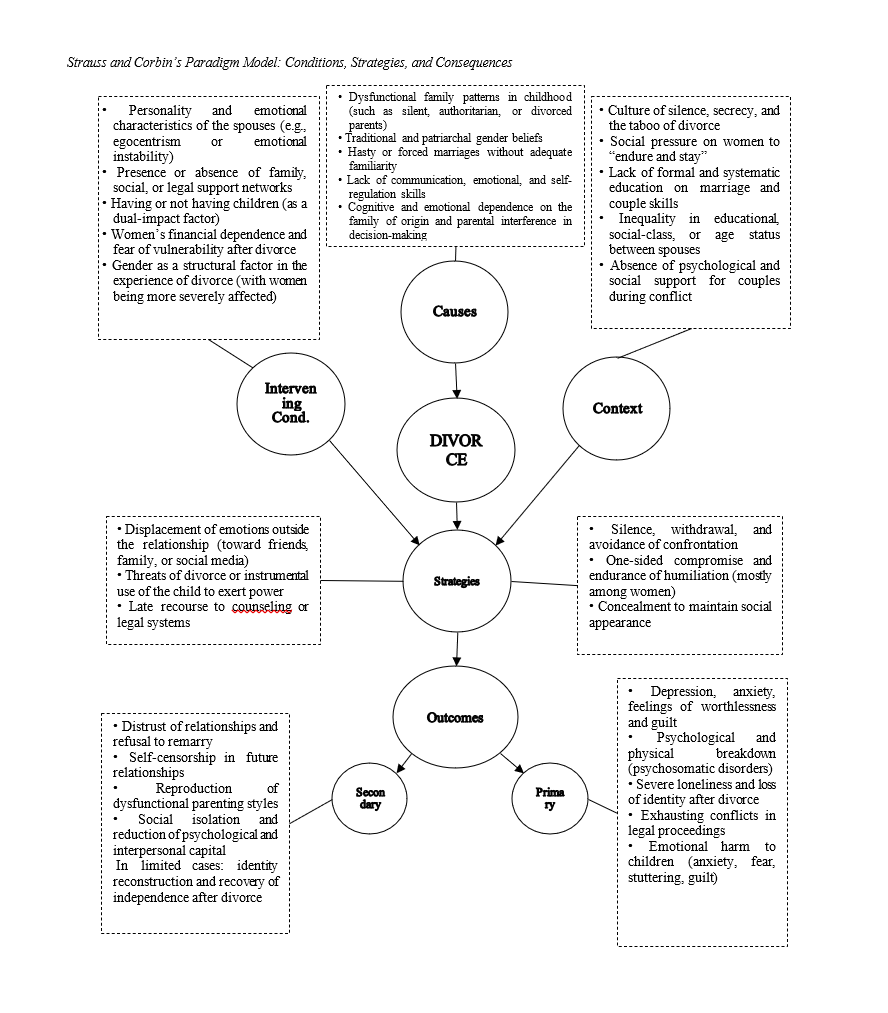
This study aimed to explore the lived experiences of divorced couples to identify the underlying social and psychological factors influencing divorce and to propose an integrative conceptual model explaining its process and outcomes. The research adopted a qualitative design using the grounded theory approach based on Strauss and Corbin’s systematic method (2008). The statistical population comprised divorced couples residing in Shiraz, Iran. Participants were selected through purposive sampling according to specific inclusion criteria: at least two months and a maximum of five years since divorce, absence of severe physical illness as the main cause of divorce, and willingness to participate. Semi-structured interviews were conducted until theoretical saturation was achieved with ten couples. Data were analyzed using three levels of coding—open, axial, and selective—to identify causal, contextual, intervening, strategic, and consequential components of the divorce process. Lincoln and Guba’s (1985) criteria of credibility, transferability, confirmability, and dependability were applied to ensure trustworthiness. The results revealed that divorce is not an instantaneous or single-cause event but a gradual, multifactorial, and structured process shaped by the interplay of individual, relational, and sociocultural dynamics. Causal factors included dysfunctional family backgrounds, patriarchal gender beliefs, emotional immaturity, and poor communication. Contextual conditions, such as cultural taboos, social pressure for endurance, and lack of premarital education, intensified the process. Intervening variables, including personality traits, economic dependence, and presence of children, acted as catalysts or inhibitors. Strategies like silence, avoidance, and concealment deepened marital alienation. Consequences spanned psychological distress, social isolation, and in rare cases, identity reconstruction. Divorce in Iranian society represents a multidimensional psychosocial phenomenon rooted in cultural, emotional, and structural inequalities, requiring multi-level interventions that integrate individual, familial, and societal support systems.
Downloads
References
Abdollahi, A., Ahadi, H., Tajeri, B., & Haji Alizadeh, K. (2020). Analysis of the experience of divorce from the perspective of divorced couples in Tehran. Women's strategic studies, 23(89), 143-162. https://www.jwss.ir/m/article_119684.html?lang=en
Amato, P. R., & Previti, D. (2003). People's reasons for divorcing : Gender, Social class, the life course, and adjustment. Journal of Family Issues, 24(5), 602-626. https://doi.org/10.1177/0192513X03024005002
Elexpuru, I. P., Dijk, R. V., Valk, I. V. D., Pampliega, A. M., Molleda, A., & Cormenzana, S. (2024). Divorce and physical health: A three-level meta-analysis. Social Science & Medicine, 352, 1-13. https://doi.org/10.1016/j.socscimed.2024.117005
Fathi- Ashtiani, A., Amiri, S., Fathi Ashtiani, M., sedghi Jalal, A., Nicknam, M. H., noorbala, A. A., & et al. (2023). Effective Factors on Divorce in the Past 10 Years in Iran. Iran J Cult Health Promot, 7(2), 289-302. https://ijhp.ir/article-1-681-en.html
Ghasemi, a., & saroukhani, b. (2014). factors related to divorce among the couples applying consensual divorce. journal of specialized social science[internet], 10(39), 69-87. https://sid.ir/paper/254994/fa
Hosseinzadeh Dashti, M., Salehi, K., Keshavarz Afshar, H., & Javadipour, M. (2024). A systematic review: Investigating the psychological damage of Iranian children in parental divorce. Rooyesh, 13(6), 41-52. https://frooyesh.ir/article-1-4856-en.html
Kalateh Sadati, A., & Sabohi Golkar, Z. (2024). The Social Construction of Post-Traditional Divorce: A Qualitative Study of Women Applying for Divorce in Tabas City (2021-2023). Ferdowsi University of Mashhad Journal of Social Sciences, 21(1), 175-205. https://social.um.ac.ir/article_44568_71e7ae461adf3c176a99574e4e70a8a1.pdf
Lehrer, E. L., & Son, Y. (2017). Marital Instability in the United States: Trends, Driving Forces, and Implications for Children. Demographic Research, 37(9), 228-250. https://doi.org/10.4054/DemRes.2017.37.9
Lin, I. F., & Brown, L. (2020). Consequences of Later Life Divorce and Widowhoo for Adult WellBeing : A Call for the Convalescence Model. Journal of Family Theory & Review, 12(2), 264-277. https://doi.org/10.1111/jftr.12366
Mentser, S., & Sagiv, L. (2025). Cultural and personal values interact to predict divorce. Communications Psychology, 3(12), 1-11. https://doi.org/10.1038/s44271-025-00185-x
Millings, A., Hirst, S. L., Sirois, F., & Houlston, C. (2020). Emotional adaptation to relationship dissolution in parents and non-parents: A new conceptual model and measure. PLoS One, 15(10), e0239712. https://doi.org/10.1371/journal.pone.0239712
Mohammad Rajabi, M., Yazdkhasti, F., Oreyzi, H. R., & Abedi, A. (2024). The Effectiveness of Unified Transdiagnostic Treatment on the Internalized Problems of Children with Emotional Divorced Parents. Journal of Applied Psychological Research, 15(3), 349-370. https://japr.ut.ac.ir/m/article_99277.html?lang=en
Saroukhani, B. (2011). Divorce: A study on understanding its reality and factors. University of Tehran Press. https://www.hovalvakil.com/product/4359/%D8%B7%D9%84%D8%A7%D9%82-%D9%BE%DA%98%D9%88%D9%87%D8%B4%DB%8C-%D8%B4%D9%86%D8%A7%D8%AE%D8%AA-%D9%88%D8%A7%D9%82%D8%B9%DB%8C%D8%AA-%D8%B9%D9%88%D8%A7%D9%85%D9%84-%D8%A7%D8%AC%D8%AA%D9%85%D8%A7%D8%B9%DB%8C
Taghavi Dinani, P., bagheri, F., & Khalatbari, J. (2020). A qualitative study of the experiences of divorced men and women on the psychological factors affecting divorce. Journal of Psychological Science, 19(86), 213-228. https://psychologicalscience.ir/browse.php?a_id=493&sid=1&slc_lang=en
Zafeer, H. M. I., Maqbool, S., & Yanping, L. (2022). Psychological and Social Factors and Their Impact on Divorced and Married Women: A Case Study from Punjab Pakistan. Journal of Divorce & Remarriage, 63(5), 352-373. https://doi.org/10.1080/10502556.2022.2048345
Downloads
Additional Files
Publication Timeline
- Submitted
- Revised
- Accepted