Effectiveness of Self-Regulation–Based Couple Therapy on Marital Adjustment and Positive Thinking Among Married Employees in Healthcare Centers
DOI:
https://doi.org/10.61838/kman.fct.psynexus.4799Keywords:
Self-regulation, Marital adjustment, Positive thinking, Couple therapy, Dyadic functioningAbstract
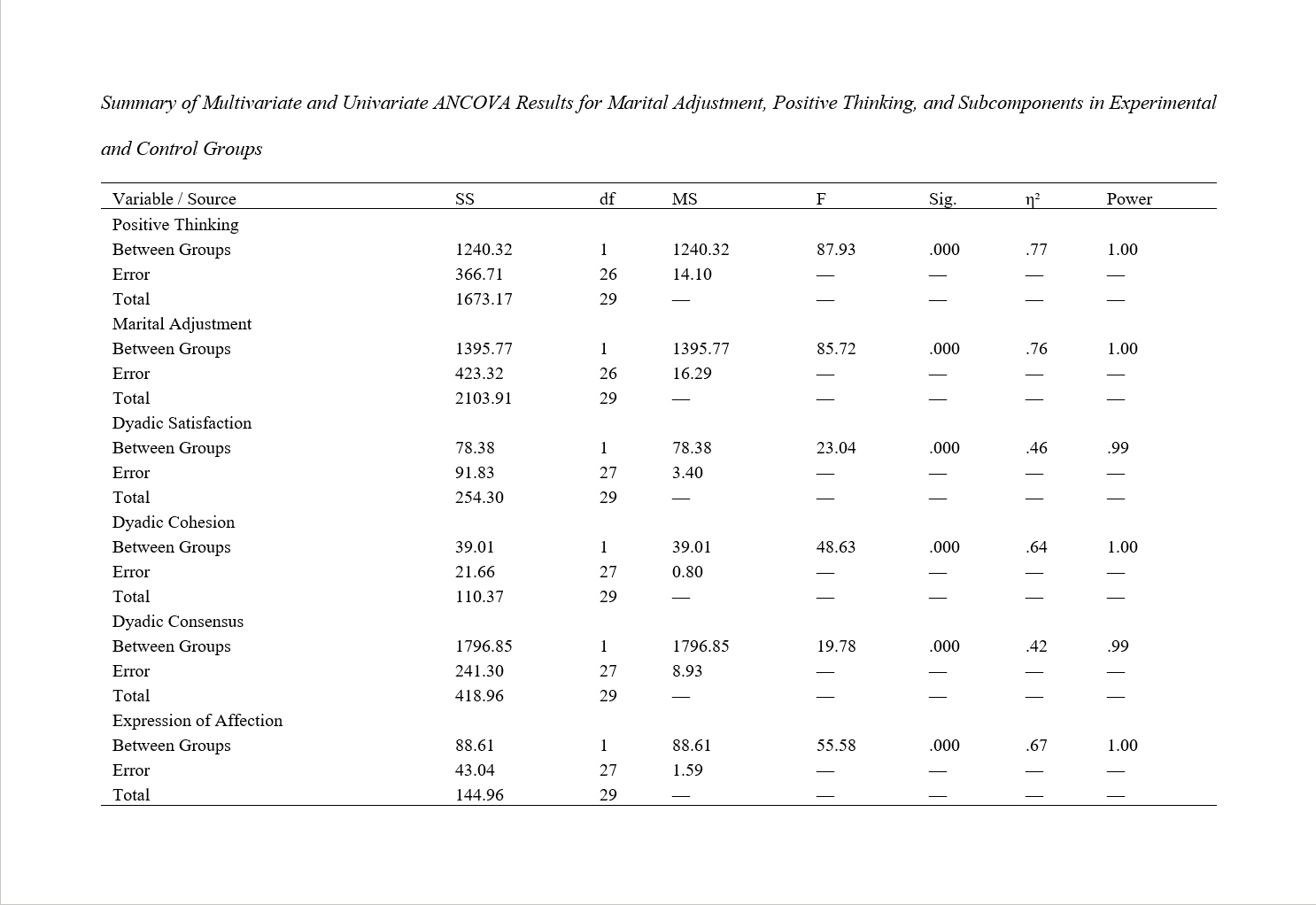
This study aimed to investigate the effectiveness of self-regulation–based couple therapy on marital adjustment and positive thinking among married employees working in healthcare centers in Sari. This quasi-experimental study used a pretest–posttest design with a control group. The statistical population included all married employees of healthcare centers in Sari during the fall of 2021, from which 30 individuals were selected through cluster sampling and assigned to experimental (n = 15) and control (n = 15) groups. Data were collected using the Spanier Marital Adjustment Scale (1976) and the Ingram & Wisnicki Positive Thinking Questionnaire (1998). The experimental group received nine 90-minute sessions of self-regulation–based couple therapy, whereas the control group received no intervention. After the intervention, both groups completed the posttest. Data analysis was conducted using univariate and multivariate analysis of covariance (ANCOVA and MANCOVA) in SPSS-22. Results showed a significant effect of the intervention on marital adjustment (F = 85.72, p < .001, η² = .76) and positive thinking (F = 87.93, p < .001, η² = .77). Significant improvements were also found in marital adjustment subcomponents, including dyadic satisfaction (F = 23.04, p < .001, η² = .46), dyadic cohesion (F = 48.63, p < .001, η² = .64), dyadic consensus (F = 19.78, p < .001, η² = .42), and expression of affection (F = 55.58, p < .001, η² = .67). Statistical power across all analyses ranged from .99 to 1.00, confirming the robustness of the findings. Self-regulation–based couple therapy significantly enhances marital adjustment, positive thinking, and key relational dimensions, demonstrating its effectiveness as a comprehensive therapeutic approach for improving marital functioning.
Downloads
References
Alizadeh, Z., Dokaneifard, F., & Fattahi Andabil, A. (2023). Presenting a Predictive Model of Marital Adjustment Based on Psychological Flexibility and Frustration Discomfort with the Mediation of Marital Self-Regulation and Self-Compassion. Psychology of Woman Journal, 4(4), 109-116. https://doi.org/10.61838/kman.pwj.4.4.13
Alizadeh, Z., Dokaneifard, F., & Fattahi Andabil, A. (2024). Predicting marital adjustment by self-compassion and marital self-regulation. Applied Family Therapy Journal, 5(4), 194-200. https://doi.org/10.61838/kman.aftj.5.4.22
Ataeimehr, N., Babakhani, V., Alijani, F., & Pouyamanesh, J. (2023). Comparing the Effectiveness of Emotionally Focused Couple Therapy and Self-Regulation Couple Therapy in Ego Strength in Couples on the Verge of Divorce. Journal of Family Relations Studies, 3(10), 17-25. https://jhrs.uma.ac.ir/article_2253_abfe8bdc51dab0ff33073294496417c0.pdf
Atkins, D. C., Marín, R. A., Lo, T. T. Y., Klann, N., & Hahlweg, K. (2010). Outcomes of couples with infidelity in a community-based sample of couple therapy. Journal of Family Psychology, 24(2), 212-216. https://doi.org/10.1037/a0018789
Ghazalsaflou, M., Saadati, N., & Rostami, M. (2022). The Effectiveness of Emotional Self-Regulation in Increasing Self-Regulation among Newlywed Couples. Journal of Applied Family Therapy(2). https://doi.org/10.61838/kman.aftj.3.2.35
Halford, W. K., Sanders, M. R., & Behrens, B. C. (2004). Self-regulation in behavioral couple therapy. Behavior therapy, 25, 431-452. https://doi.org/10.1016/S0005-7894(05)80156-X
Kazemi, N., Narimani, M., SadeghiHashjin, G., & Basharpoor, S. (2021). The effectiveness of brief self-regulation couple therapy (srct) on reducing marital covert relational aggression, changing of communication patterns and reduction of alexithymia among conflicting couples. Journal of Psychological Science, 20(108), 2225-2238. https://doi.org/10.52547/JPS.20.108.2225
Kazemi, N., Sadeghi Heshjin, G., Basharpoor, S., & Narimani, M. (2021). Examining the Effectiveness of Short-Term Self-Regulation Couple Therapy (SRCT) in Reducing Marital Covert Relational Aggression, Changing Communication Patterns, and Reducing Emotional Dysregulation in Conflictual Couples. Psychological Sciences Journal(108). https://doi.org/10.52547/JPS.20.108.2225
Navabifar, F., Atashpour, H., & Golparvar, M. (2020). The Effectiveness of Enneagram Typology Training Package on Emotional Self-Regulation of Couples in Premarital Stage. socialwm, 8(4), 43-51. http://socialworkmag.ir/article-1-530-en.html
Pouya, F. H., Gharamaleki, N. S., & Mirzahosseini, H. (2025). The Structural Model for Predicting Marital Burnout Based on Attachment Styles With the Mediating Role of Marital Self-Regulation and Marital Intimacy in Married Individuals. Aftj, 6(1), 29-36. https://doi.org/10.61838/kman.aftj.6.1.4
Sarchuni, S. (2024). Efficacy of the Gottman Method on Family Cohesion and Emotional Self-Regulation Among Couples. Journal of Assessment and Research in Applied Counseling (JARAC), 6(3), 125-132. https://doi.org/10.61838/kman.jarac.6.3.14
Scale, P. M. B. (2022). The Effect of Emotion-Oriented Couple Therapy on Forgiveness, Emotional Self-Regulation and Marital Boredom of Couples Seeking Divorce Referring to Family Social Emergencies. https://www.islamiilife.com/article_185336.html?lang=en
Shamsaei, Z., Karimi, K., & Akbari, M. (2022). Causal modeling of domestic violence based on marital intimacy, self-regulation, and marital conflict. Royesh-e Psychology, 11(8), 59-68. https://frooyesh.ir/browse.php?a_id=4077&sid=1&slc_lang=fa
Shamsai, Z., Karimi, Q., & Akbari, M. (2022). Modeling the causal relationship of domestic violence based on marital intimacy, self-regulation, and marital conflict. Journal of Psychology Development, 11(8), 59-68. https://frooyesh.ir/article-1-4077-en.html
Sharifi, M., Asghari EbrahimAbad, M., & Salayani, F. (2020). Investigating the Role of Self-Differentiation in Predicting Communication Patterns: The Mediating Role of Psychological Capitals. Thoughts and Behavior in Clinical Psychology, 15(56), 57-70. https://jtbcp.roudehen.iau.ir/article_1858_382b5ab7bc22c3465298dc83ed9eb601.pdf
Shiri, M., Goodarzi, M., Moradi, O., & Ahmadian, H. (2020). Comparing the effectiveness of self-regulation-attachment couple therapy and systemic-behavioral couple therapy on family functioning in women with substance-dependent spouses. Addiction Research Quarterly, 14(56), 247-266. https://doi.org/10.29252/etiadpajohi.14.56.247
Shojaei KalateBali, N., Samari, A., & Akbarzadeh, M. (2022). The effectiveness of couple therapy with the compassion therapy method on depression, marital life quality, and optimism in cardiovascular patients. Iranian Journal of Psychiatric Nursing, 9(6), 86-97. https://ijpn.ir/browse.php?a_id=1941&sid=1&slc_lang=en&ftxt=0
Shokri, M., Rahmani, M. A., & Abolghasemi, S. (2022). The effect of Emotionally Focused Couple Therapy (EFCT) on forgiveness, emotional self-regulation, and marital burnout in divorce-seeking couples referred to family social emergency centers. Islamic Lifestyle Centered on Health, 6(1), 145-155. https://www.islamiilife.com/article_185336.html?lang=en
Solt Petloo, A., Vaziri, S., & Lotfi Kashani, F. (2022). The Effect of Couple Therapy with Self-Regulation Approach on Marital Satisfaction: A Semi-Experimental Study. Payesh Journal, 21(4), 407-399. https://doi.org/10.52547/payesh.21.4.399
Downloads
Additional Files
Publication Timeline
- Submitted
- Revised
- Accepted