Comparison of the Effectiveness of Acceptance and Commitment–Based Couple Therapy and Integrative Couple Therapy on Dysfunctional Beliefs in Infertile Couples
DOI:
https://doi.org/10.61838/kman.fct.psynexus.4815Keywords:
Acceptance and Commitment Couple Therapy, Integrative Approach, Dysfunctional Beliefs, Infertile CouplesAbstract
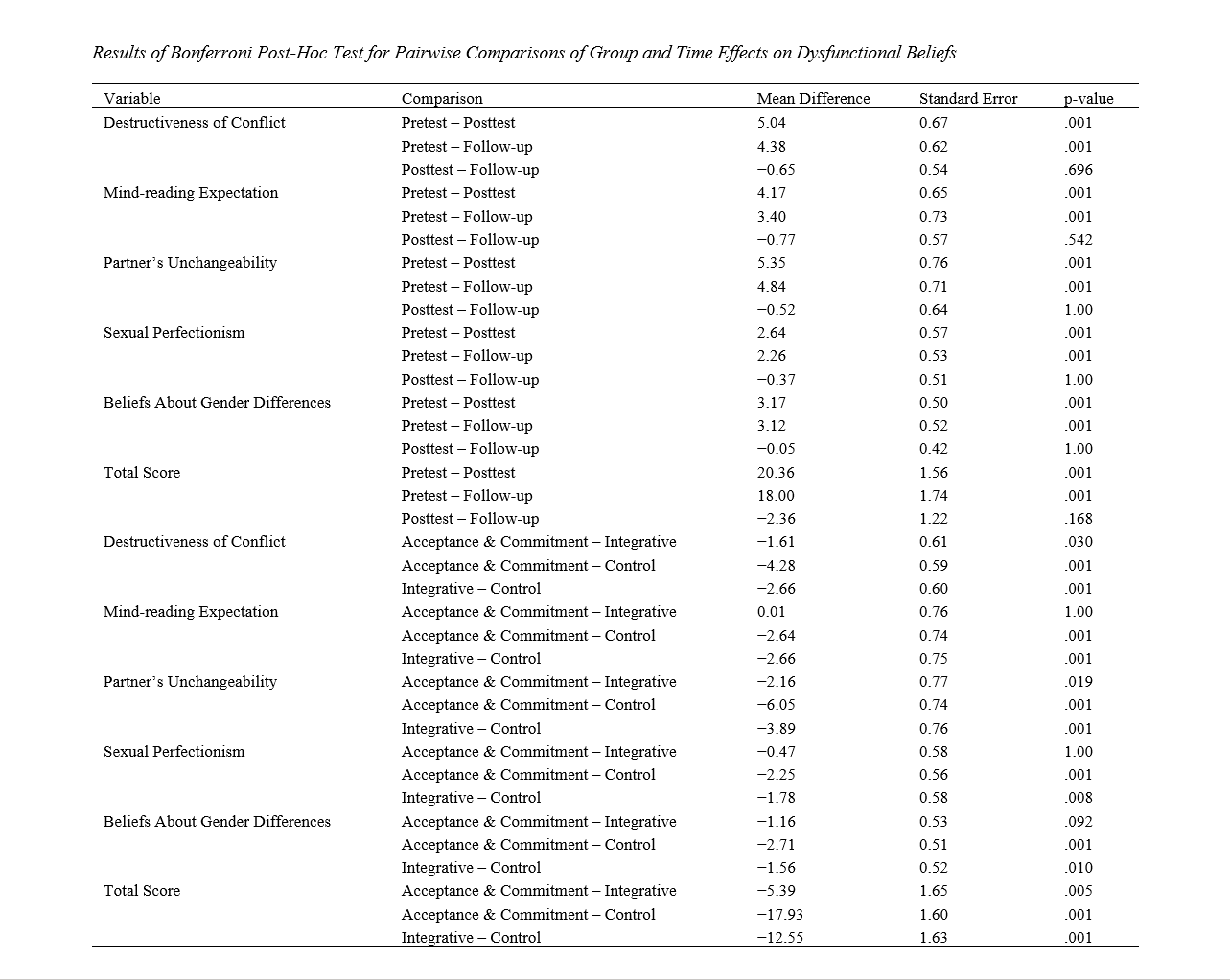
This study aimed to compare the effectiveness of Acceptance and Commitment–based Couple Therapy (ACT-CT) and Integrative Couple Therapy (IBCT) in reducing dysfunctional beliefs among infertile couples. This quasi-experimental study employed a pretest–posttest design with a control group and a three-month follow-up. The statistical population included infertile couples who were referred to the infertility center of Karaj University of Medical Sciences in 2023 and met the diagnostic criteria for infertility. Using purposive sampling, 45 couples were selected based on inclusion and exclusion criteria and were randomly assigned into three groups: ACT-CT (n = 15), IBCT (n = 15), and control (n = 15). The Dysfunctional Beliefs Questionnaire (Eidelson & Epstein, 1981) was administered at pretest, posttest, and follow-up. The ACT-CT and IBCT groups received twelve 90-minute sessions over three months, while the control group received no intervention. Due to attrition, the final sample consisted of 14 ACT-CT couples, 13 IBCT couples, and 15 control couples. Data were analyzed using repeated-measures ANOVA and multivariate tests. Results showed significant time, group, and group × time interaction effects for all components of dysfunctional beliefs (p < .05). Comparative analyses indicated that ACT-CT produced significantly greater reductions than IBCT in beliefs about the destructiveness of conflict (p = .030), partner unchangeability (p = .019), and total dysfunctional belief scores (p = .001). Bonferroni post-hoc tests confirmed significant improvements from pretest to posttest and follow-up in both intervention groups, with no meaningful changes in the control group. Both ACT-CT and IBCT effectively reduced dysfunctional beliefs in infertile couples; however, ACT-CT demonstrated superior effectiveness in modifying key maladaptive cognitive components.
Downloads
References
Ahmadi, Z. (2025). The Effectiveness of Acceptance and Commitment Couple Therapy on Spousal Cognitive Empathy, Attachment-Detachment, and Sexual Satisfaction in Infertile Couples. Emotional and Behavioral Disorders, 2(2), 19-34. https://ebd.shirazu.ac.ir/article_8227.html?lang=en
Ahmadzadeh, L., Sodargar, S., Vaezi, M., Bahrami Hidaji, M., & Golmohammadnezhad Bahrami, G. (2019). The Effectiveness of Adapted Couple-Based Acceptance and Commitment Therapy versus Integrative Couple Therapy on the Psychological Distress of Couples with a Spouse Suffering from Cancer. Modern psychological research, 14(55), 1-22. https://psychologyj.tabrizu.ac.ir/article_9890.html
Barraca, J., Nieto, E., & Polanski, T. (2021). An integrative behavioral couple therapy (IBCT)-based conflict prevention program: A pre-pilot study with non-clinical couples. International journal of environmental research and public health, 18(19), 9981. https://doi.org/10.3390/ijerph18199981
Barraca, J., Polanski, T., Duarte-Díaz, A., & Perestelo-Pérez, L. (2024). Acceptance and Commitment Therapy for Couples: A Systematic Review and Meta-Analysis. Journal of Contextual Behavioral Science, 100867. https://doi.org/10.1016/j.jcbs.2024.100867
Beck, J. S. (1978). Cognitive behavior therapy: Basics and beyond. Guilford Publications. https://books.google.com/books?id=yb_nDwAAQBAJ&source=gbs_navlinks_s
Bowen, M. (2003). Family therapy in clinical practice. Aronson. https://books.google.com/books/about/Family_Therapy_in_Clinical_Practice.html?id=m2Xs2fnEmWwC
Briggs, J. G., Finley, M. A., & Sprenkle, D. H. (2015). A Substantive and methodological review of the integrative behavioral couple therapy research program: Clinical implications for a research informed practice. Journal of Couple & Relationship Therapy, 14(3), 219-253. https://doi.org/10.1080/15332691.2014.959229
Christensen, A., & Jacobson, N. (1998). Integrative behavioral couple therapy. Current opinion in psychology, 13, 111-114. https://doi.org/10.1016/j.copsyc.2016.04.022
Çinar, P. (2025). Infertility and Bowen's systematic family therapy approach. Psikiyatride Güncel Yaklaşımlar, 17(3), 577-588. https://doi.org/10.18863/pgy.1494147
Deyhimi, M., Kariman, N., & Azadfar, Z. (2019). The Effectiveness of Cognitive-Behavioral Therapy on Dysfunctional Attitudes and Irrational Beliefs of Infertile Women. Royesh-e-Ravanshenasi, 8(12), 99-106. https://frooyesh.ir/article-1-1703-en.html
Hosseinpanahi, M., & Mirkhafvand, M. (2020). The Effect of Counseling Based on Acceptance and Commitment Therapy on the Mental Health and Quality of Life of Infertile Couples: A Randomized Controlled Trial. Journal of Health Education and Health Promotion, 9, 136. https://doi.org/10.4103/jehp.jehp_512_20
Keybollahi, T., Kraskian Mujembari, A., Havassi Somar, N., Mansoobifar, M., & TariMoradi, A. (2022). Meta-analysis and comparison of the effectiveness acceptance commitment therapy and integrated behavioral couple therapy on the components of marital quality of couples. Psychological Models and Methods, 13(47), 29-52. https://doi.org/10.52547/rbs.20.1.32
Koser, K. (2020). Fertility counseling with couples: A theoretical approach. The Family Journal, 28(1), 25-32. https://doi.org/10.1177/1066480719887498
Lebow, J. (2015). Integrative approaches to couple and family therapy. In Handbook of family therapy (pp. 205-228). Routledge. https://doi.org/10.4324/9780203123584-11
Lefebvre, T., Fréour, T., Ploteau, S., Le Bizec, B., Antignac, J. P., & Cano-Sancho, G. (2021). Associations between human internal chemical exposure to Persistent Organic Pollutants (POPs) and In Vitro Fertilization (IVF) outcomes: Systematic review and evidence map of human epidemiological evidence. Reproductive toxicology (Elmsford, N.Y.), 105, 184-197. https://doi.org/10.1016/j.reprotox.2021.09.005
Mokhtari Sorkhani, T., Alidousti, K., Ahmadi, A., Mirzaei, M., & Habibzadeh, V. (2021). The Effect of Infertility Counseling on the Quality of Life of Infertile Couples with a Couple Therapy Approach - A Clinical Trial. Journal of Arak University of Medical Sciences, 24(6), 820-833. https://doi.org/10.32598/jams.24.6.6462.1
Mousavi Haghighi, S. E., Rishehri, P., & Mousavi, S. A. (2022). Effectiveness of acceptance and commitment therapy and integrated behavioral couples therapy on intimacy and family functioning in divorce-seeking couples. Journal of Research and Health, 12(3), 167-176. https://doi.org/10.32598/JRH.12.3.1972.1
Obeagu, E. I., Njar, V. E., & Obeagu, G. U. (2023). Infertility: Prevalence and consequences. Int. J. Curr. Res. Chem. Pharm. Sci, 10(7), 43-50. https://doi.org/10.22270/ijmspr.v10i4.123
Pasch, L. A., & Sullivan, K. T. (2017). Stress and coping in couples facing infertility. Current opinion in psychology, 13, 131-135. https://doi.org/10.1016/j.copsyc.2016.07.004
Pásztor, N., Hegyi, B. E., Dombi, E., & Németh, G. L. (2019). Psychological distress and coping mechanisms in infertile couples. Open Psychology Journal, 12(1), 169-173. https://doi.org/10.2174/1874350101912010169
Peterson, B. D., Eifert, G. H., Feingold, T., & Davidson, S. (2009). Using acceptance and commitment therapy to treat distressed couples: A case study with two couples. Cognitive and Behavioral Practice, 16(4), 430-442. https://doi.org/10.1016/j.cbpra.2008.12.009
Rabiei, M., Ebrahimi Moghadam, H., & Hassani, F. (2023). The Effect of Acceptance and Commitment Therapy on Self-Differentiation and Irrational Beliefs of Women with Marital Conflicts. Women and Family Studies, 11(2), 99-123. https://jwfs.alzahra.ac.ir/.%20https:/jwfs.alzahra.ac.ir/article_7240.html?lang=en
Rajabi, G. R., Imani, M., Khojastemehr, R., Beyrami, M., & Beshlideh, K. (2013). The Efficacy of Acceptance and Commitment Therapy and Integrative Behavioral Couple Therapy on Worry and Marital Adjustment in Women with Marital Distress and Generalized Anxiety Disorder. Behavioral Sciences Research, 11(6), 600-619. https://rbs.mui.ac.ir/article-1-351-en.html
Sedghi, M., Ghaffari, O., Kazemi, R., & Narimani, M. (2019). Comparison of the effectiveness of couple therapy methods in the theory of Choice, acceptance and commitment (ACT), and integrative couple therapy in marital commitment of couples. Journal of Psychological Science, 18(81), 1069-1080. https://psychologicalscience.ir/article-1-336-en.html
Snyder, D., Castellani, A., & Washman, M. (2019). Current status and future directions in couple therapy. Journal Annual Review of psychology, 57, 417-344. https://doi.org/10.1146/annurev.psych.56.091103.070154
Snyder, D. K., & Balderrama-durbin, C. (2022). Integrative approaches to couple therapy: Implications for clinical practice and rerearch. Behavior therapy, 43, 13-24. https://doi.org/10.1016/j.beth.2011.03.004
Sorush, S., Zare Bahramabadi, M., & Nasrallahi, B. (2021). Comparing the Effectiveness of Emotion-Focused Couple Therapy and Integrative Behavioral Couple Therapy on Obsessive Symptoms and Marital Burnout in Couples Diagnosed with Obsession. Cultural Psychology, 5(1), 304-327. https://jcp.samt.ac.ir/article_140956_en.html
Taghavi Sureh Bargh, M., & Mahdizadeh, A. (2022). The Effectiveness of Integrative Couple Therapy on Dysfunctional Attitudes in Married Women. Psychology and Educational Sciences in the Third Millennium, 6(2), 103-112. https://www.pejournal.ir/fa/downloadpaper.php?pid=173&rid=19&p=A
Vazirnia, F., Karimi, J., Goodarzi, K., & Sadeghi, M. (2021a). Comparing the Effectiveness of Integrative Behavioral Couple Therapy and Emotion-Focused Therapy on the Health (Infertility Self-Efficacy Component) of Infertile Couples. Islamic Lifestyle, 5(2), 38-49. https://www.islamiilife.com/article_186797_en.html
Vazirnia, F., Karimi, J., Goodarzi, K., & Sadeghi, M. (2021b). Effects of integrative behavioral couple therapy on infertility self-efficacy, dyadic adjustment, and sexual satisfaction in infertile couples. Journal of Client-Centered Nursing Care, 7(1), 43-54. https://doi.org/10.32598/JCCNC.7.1.354.1
Walser, R. D., & O'Connell, M. (2023). Alliance rupture and repair in acceptance and commitment therapy. In C. F. Eubanks, L. W. Samstag, & J. C. Muran (Eds.), Rupture and repair in psychotherapy: A critical process for change (pp. 165-186). American Psychological Association. https://doi.org/10.1037/0000306-008
Wang, Y. X., Farland, L. V., Wang, S., Gaskins, A. J., Wang, L., Rich-Edwards, J. W., Tamimi, R., Missmer, S. A., & Chavarro, J. E. (2022). Association of infertility with premature mortality among US women: Prospective cohort study. The Lancet Regional Health-Americas, 7. https://doi.org/10.1016/j.lana.2021.100122
Yazar, R., & Tolan, Ö. (2021). Cognitive-behavioral approach in marital therapy. Psikiyatride Guncel Yaklasimlar, 13(1), 1-22. https://doi.org/10.18863/pgy.708061
Yoshiko, S., & Hiroya, M. (2022). Trial development of the Cognitive Appraisal Scale for Infertility (CASI) (version 1). Fertility and sterility, 91(6), 2596-2601. https://doi.org/10.1016/j.fertnstert.2008.03.052
Downloads
Additional Files
Publication Timeline
- Submitted
- Revised
- Accepted