Development of a Causal Model of Marital Distress Tolerance Based on Cognitive Flexibility and Family-of-Origin Health with the Mediating Role of Problem-Solving Skills
DOI:
https://doi.org/10.61838/kman.fct.psynexus.4868Keywords:
Marital distress tolerance, cognitive flexibility, family-of-origin health, problem-solving skills, structural equation modelingAbstract
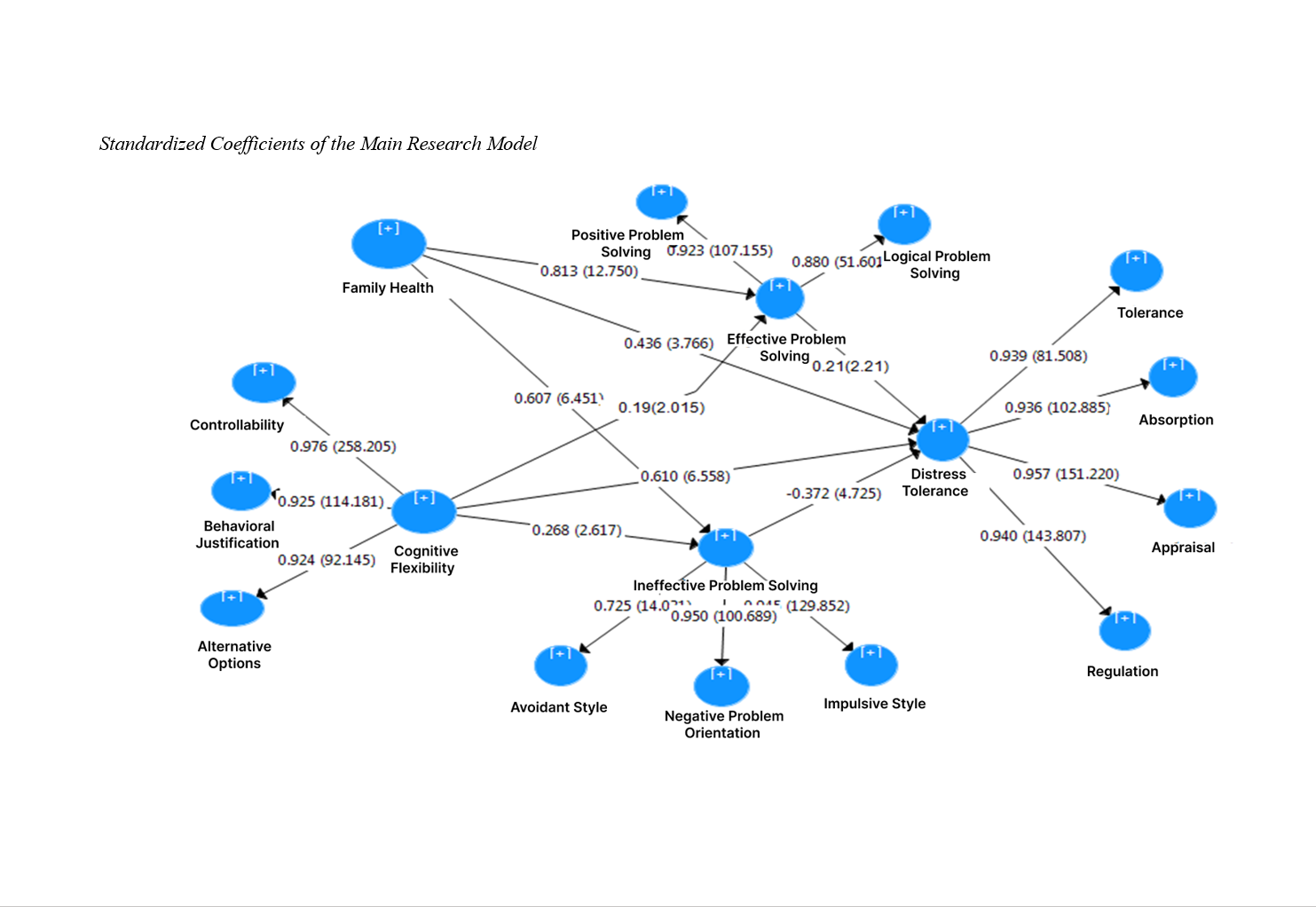
The objective of this study was to develop and test a causal structural model explaining marital distress tolerance based on cognitive flexibility and family-of-origin health, with the mediating role of effective and ineffective problem-solving skills. This applied–developmental study was conducted using a quantitative, descriptive–correlational design based on structural equation modeling. The statistical population consisted of couples experiencing marital conflict who referred to counseling centers in Tehran during the second half of 2021. Using G*Power software and considering effect size and statistical power, a sample of 350 participants was selected through convenience sampling. Data were collected using standardized self-report instruments, including the Emotional Distress Tolerance Scale, the Family-of-Origin Health Scale, the Cognitive Flexibility Inventory, and the Social Problem-Solving Questionnaire. Data analysis was performed using SPSS for descriptive statistics and SmartPLS-3 for evaluating the measurement and structural models. Inferential results showed that cognitive flexibility had a significant positive direct effect on marital distress tolerance and significant effects on both effective and ineffective problem-solving skills. Family-of-origin health also exerted a significant positive direct effect on marital distress tolerance and significantly predicted problem-solving skills. Ineffective problem-solving skills had a significant negative effect on marital distress tolerance, whereas effective problem-solving skills showed a significant positive effect. The structural model demonstrated high explanatory power, with substantial coefficients of determination for marital distress tolerance and both types of problem-solving skills, as well as satisfactory predictive relevance indices, confirming the adequacy and robustness of the proposed model. The findings indicate that marital distress tolerance is a multidimensional construct shaped by cognitive flexibility and family-of-origin health, both directly and indirectly through problem-solving skills, highlighting the importance of integrated cognitive–familial approaches in understanding and improving couples’ emotional resilience
Downloads
Downloads
Additional Files
Publication Timeline
- Submitted
- Revised
- Accepted