Examining the Effectiveness of Couple Therapy Based on Positive Psychology and Religious Spirituality on Marital Satisfaction and Marital Adjustment
DOI:
https://doi.org/10.61838/kman.cp.psynexus.4871Keywords:
Couple therapy based on positive psychology and religious spirituality, marital satisfaction, marital adjustmentAbstract
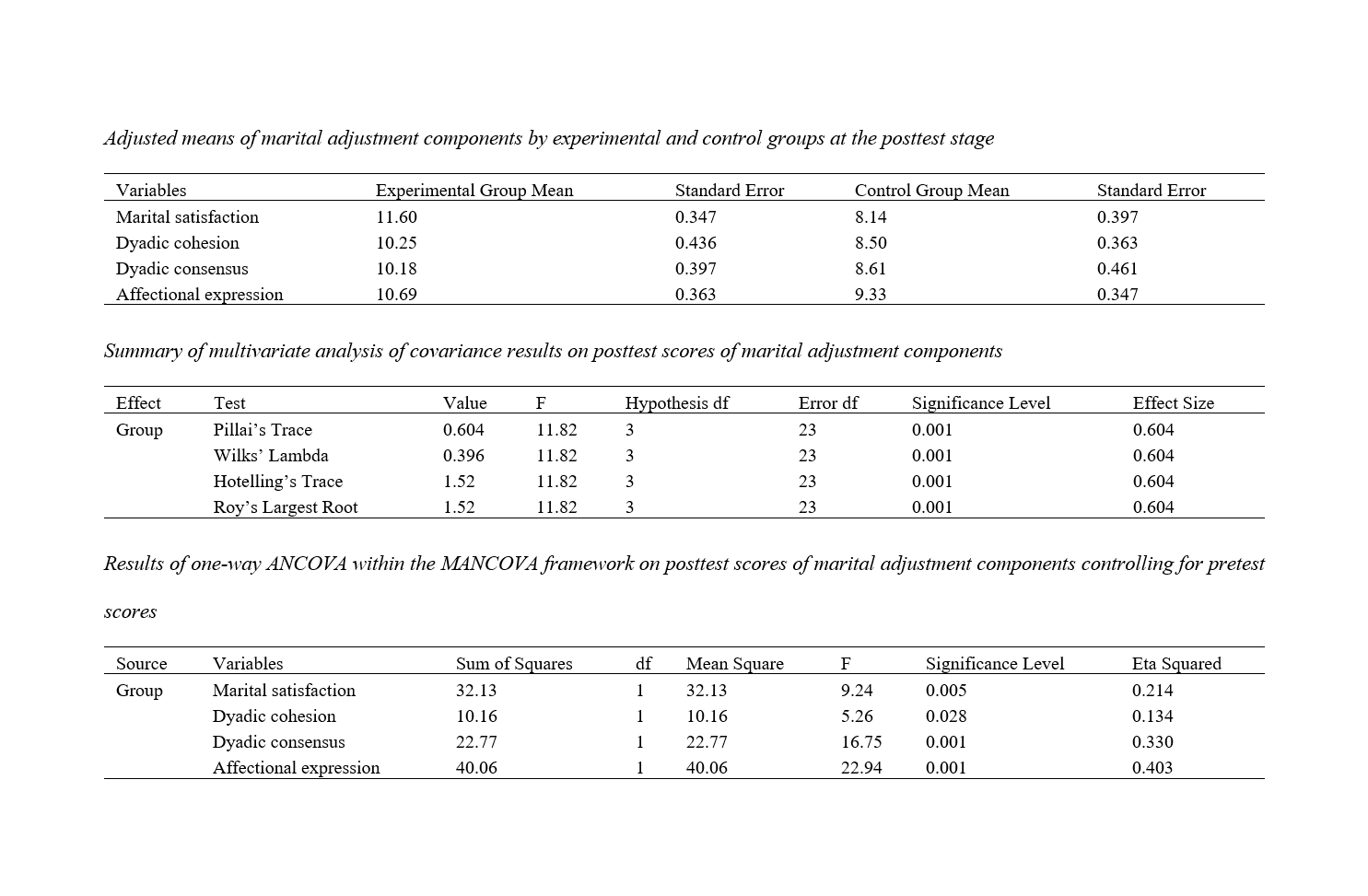
The objective of the present study was to examine and compare the effectiveness of positive psychology–based couple therapy and religious spirituality–based couple therapy on marital satisfaction and marital adjustment among married couples. The study employed a quasi-experimental design with pretest–posttest and a control group. The statistical population consisted of married couples referring to psychology clinics in Bushehr, from whom 45 participants were selected through voluntary sampling and assigned to experimental (n = 30) and control (n = 15) groups. The experimental groups received either positive psychology–based couple therapy or religious spirituality–based couple therapy across six structured sessions, while the control group received no intervention during the study period. Data were collected using the ENRICH Marital Satisfaction Questionnaire and the Spanier Dyadic Adjustment Scale. Data analysis was conducted using IBM SPSS Statistics, applying descriptive statistics, Kolmogorov–Smirnov tests for normality, multivariate analysis of covariance (MANCOVA), and one-way analyses of covariance (ANCOVA) while controlling for pretest scores. Inferential analyses indicated statistically significant differences between the experimental and control groups on posttest scores of all components of marital satisfaction, including personality issues, marital communication, conflict resolution, financial management, leisure activities, sexual relationship, marriage and children, relatives and friends, and religious orientation (p < 0.05). In addition, significant improvements were observed in marital adjustment components—marital satisfaction, dyadic cohesion, dyadic consensus, and affectional expression—in the experimental groups compared with the control group (p < 0.05). Effect sizes ranged from moderate to large, indicating substantial intervention effects. The findings demonstrate that both positive psychology–based and religious spirituality–based couple therapy are effective in enhancing marital satisfaction and marital adjustment, suggesting that strength-based psychological and spiritually integrated interventions can meaningfully improve the quality and functioning of marital relationships.
Downloads
References
Andreotti, E., & Congard, A. (2020). Positive psychology intervention for couples: A pilot study. Stress and Health, 36(2), 179-190. https://doi.org/10.1002/smi.2925
Asadpour, E., Sharei, A., & Salmani, A. (2025). Premarital intervention based on attachment and differentiation improves communication and conflict management in couples. Scientific reports, 15, 29151. https://doi.org/10.1038/s41598-025-15051-3
Bedir Akpınarlı, B., & Eryücel, S. (2024). Marital adjustment, spiritual well being, and locus of control in married couples. Religions, 15(11), 1376. https://doi.org/10.3390/rel15111376
Coyle, S. M. (2024). A Case Study Method for Integrating Spirituality and Narrative Therapy. Religions, 15(3), 361. https://doi.org/10.3390/rel15030361
Evans, A. L., & Nelson, J. K. (2022). Spiritually incorporating couple therapy in practice: Christian-accommodated couple therapy as an illustration. APA PsycInfo Database Record. https://psycnet.apa.org/record/2022-46560-001
Farahmandi, M. H., Bakhshipour, A., & Jajarmi, M. (2025). The Effectiveness of Meaning Therapy on Family Functioning and Marital Satisfaction of Couples with Marital Conflicts. Applied Psychological Research, 16(2), 271-286. https://doi.org/10.22059/japr.2025.349159.644397
Jemima, N. A. A. L. (2025). Factors Affecting Marital Satisfaction and Relationship Quality Among Christians in Ghana. International Journal of Social Science and Human Research, 08(09). https://doi.org/10.47191/ijsshr/v8-i9-25
Lotfi, Z. (2025). Comparison of the Effectiveness of Olson's Marital Enrichment Training, Lazarus's Multimodal Therapy, and Islamic Approach-Based Marital Skills Training on Marital Satisfaction and Conflicts Among Couples. Aftj, 6(1), 89-99. https://doi.org/10.61838/kman.aftj.6.1.10
Mahoney, A., Chinn, J. R., & McGraw, J. S. (2023). Positive psychology and religiousness/spirituality in the context of couples and families. In Handbook of Positive Psychology, Religion, and Spirituality (pp. xxx-xxx). Springer, Cham. https://doi.org/10.1007/978-3-031-10274-5_28
Odebunmi, O., & Сабіна, Н. Ю. (2025). Emotional Regulation as a Mediator of Personality Traits and Marital Satisfaction Among Academic Staff in Colleges of Education in Oyo State. Mejaee. https://doi.org/10.70382/mejaee.v7i8.028
Sajjad, A., & Thakur, S. C. (2025). The Role of Resilience in Predicting Marital Adjustment and Psychological Well-Being Among Married People. Sra, 3(1), 214-223. https://doi.org/10.70670/sra.v3i1.300
Sandage, S. J., Worthington Jr, E. L., & Zhu, G. (2024). Spiritual and Religious Competence in Couple Therapy Training: A Relational Spirituality Perspective. Counseling and Values, 69(3), 362-377. https://doi.org/10.1163/2161007x-bja10026
Williamson, I. (2024). The Associations Between Adverse Childhood Experiences, Shared Religious/Spiritual Practices, and Relationship Satisfaction in Couple Therapy. Pastoral Psychology. https://onlinelibrary.wiley.com/doi/abs/10.1111/jmft.12761
Wondimu, S., & Zeleke, S. (2024). The Effects of Religiosity, Forgiveness, and Emotion on Marital Adjustment. Journal of Family Therapy. https://so06.tci-thaijo.org/index.php/IJBS/article/view/272760
Worthington, E. L., Ripley, J. S., Hook, J. N., & Davis, D. E. (2021). A Christian-integrative couple therapy: Clinician's guide. American Psychological Association (APA). https://doi.org/10.1037/0000247-000
Downloads
Additional Files
Publication Timeline
- Submitted
- Revised
- Accepted