The Mediating Role of Marital Infidelity Justification in the Relationship Between Cognitive Flexibility and Marital burnout
DOI:
https://doi.org/10.61838/kman.fct.psynexus.4948Keywords:
cognitive flexibility, marital infidelity, marital burnoutAbstract
Objective: This study aimed to investigate the mediating role of marital infidelity justification in the relationship between cognitive flexibility and marital burnout.
Methods: A descriptive-correlational research design with a structural equation modeling (SEM) approach was employed. The statistical population consisted of all married individuals who referred to counseling centers in Districts 3 and 11 of Tehran in 2024. A total of 373 participants were selected using purposive sampling. Data were collected using Pines’ (1996) Marital Burnout Questionnaire, Dennis and VanderWal’s (2010) Cognitive Flexibility Inventory, and Yenisari and Kokdemir’s (2006) Marital Infidelity Justification Scale. Data analysis was performed using SEM.
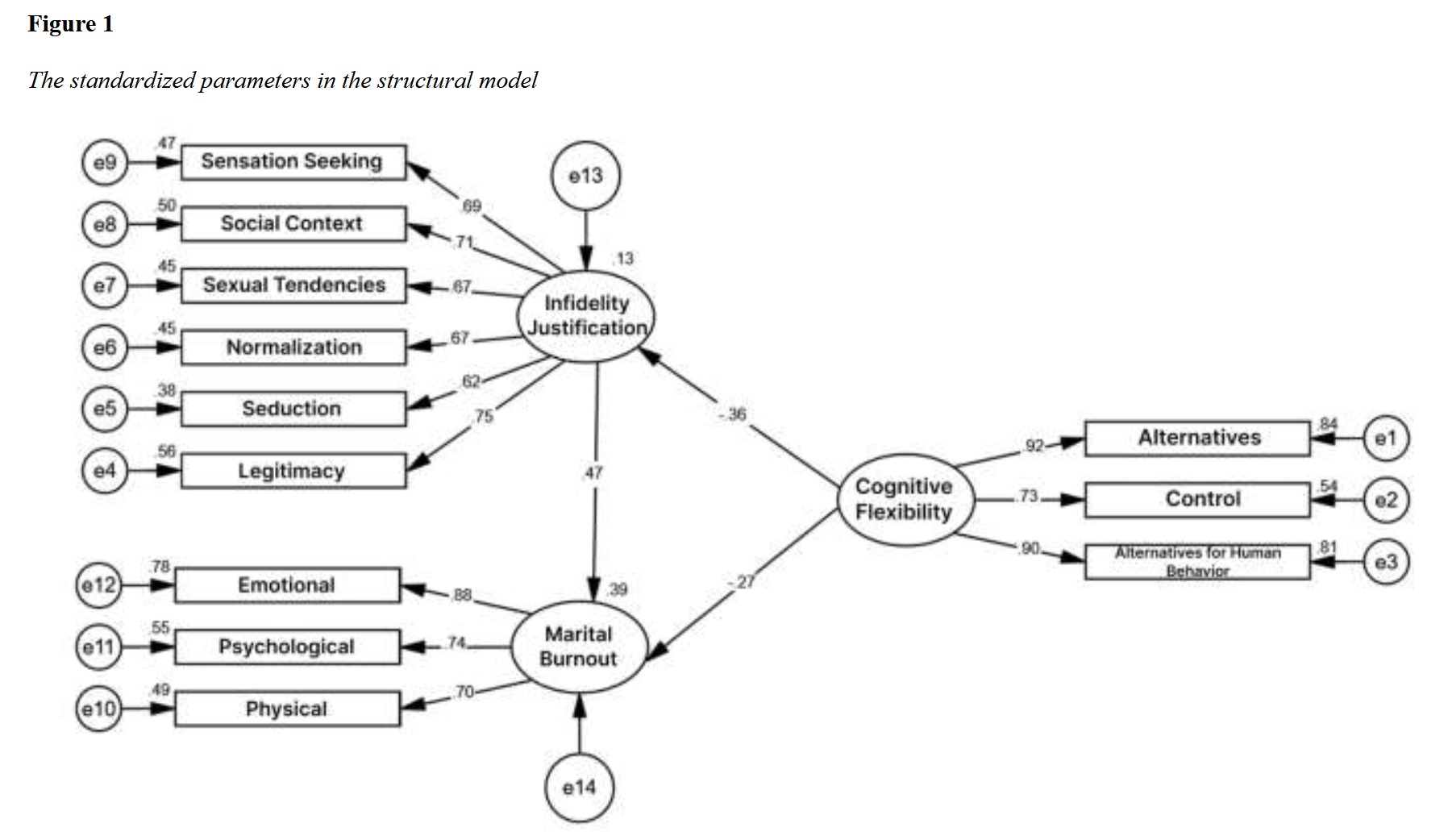
Findings: The results showed that the structural model had a good fit with the collected data. Cognitive flexibility was found to have a significant negative relationship with marital burnout. Additionally, justification of marital infidelity was positively and significantly related to marital burnout. Moreover, justification of infidelity significantly and negatively mediated the relationship between cognitive flexibility and marital burnout.
Conclusion: Based on the findings, practical implications can be proposed to improve couple relationships by focusing on the key psychological variables explored in this study.
Downloads
References
Akbari, M., Seydavi, M., & Zamani, E. (2021). The mediating role of personalized psychological flexibility in the association between distress intolerance and psychological distress: A national survey during the fourth waves of COVID-19 pandemic in Iran. Clinical Psychology and Psychotherapy, 28(6), 1416-1426. https://doi.org/10.1002/cpp.2685
Akbarzadeh, S., & Zehrakar, K. (2022). Predicting marital adjustment based on cognitive flexibility and self-compassion in couples. New Ideas in Psychology Quarterly, 12(16), 1-16.
Alizadeh-Navaei, N., Rostampour, K., Rabie-Nataj Divkolaei, S. R., Mohamadjampour Kalebasti, K., & Shabani, V. (2023). The relationship between couples' communication styles and marital burnout through the mediation of psychological flexibility. The 4th International Conference on Health, Educational Sciences, and Psychology,
Beam, C. R., Marcus, K., Turkheimer, E., & Emery, R. E. (2018). Gender differences in the structure of marital quality. Behavior genetics, 48(3), 209-223. https://doi.org/10.1007/s10519-018-9892-4
Belu, C. F., & O'Sullivan, L. F. (2024). Predictors of infidelity among couples. The Journal of Sexual Medicine, 21(4), 270-272. https://doi.org/10.1093/jsxmed/qdad165
Carbonella, J. Y., & Timpano, K. R. (2016). Examining the link between hoarding symptoms and cognitive flexibility deficits. Behavior therapy, 47(2), 262-273. https://doi.org/10.1016/j.beth.2015.11.003
Dennis, J. P., & Vander Wal, J. S. (2010). The cognitive flexibility inventory: Instrument development and estimates of reliability and validity. Cognitive therapy and research, 34(3), 241-253. https://doi.org/10.1007/s10608-009-9276-4
Dheer, R. J. S., & Lenartowicz, T. (2018). Multiculturalism and entrepreneurial intentions: Understanding the mediating role of cognitions. Entrepreneurship Theory and Practice, 42(3), 426-466. https://doi.org/10.1111/etap.12260
Es-haqi Jardoui, H., Jajarmi, M., & Akbari, H. (2021). Determining the effect size of psychological flexibility and self-control on marital adjustment among married employees of Samen Al-Aemeh Hospital, Mashhad. Journal of Disability Studies, 11, 180-180.
Farhani, S., & Ahmadi, S. (2019). The relationship between marital boredom and marital satisfaction among female students of Karaj Azad University. J Psychol Stud, 15(3), 45-56.
Fine, A. N., Sheets, A. R., & Stopsack, K. C. (2018). Cognitive control and flexibility in the context of stress: Development and psychometric properties of the Cognitive Control and Flexibility Questionnaire (CCFQ). Frontiers in psychology, 9, 2219. https://doi.org/10.3389/fpsyg.2018.02219
Garver, M. S., & Mentzer, J. T. (1999). Logistics research methods: Employing structural equation modeling to test for construct validity. Journal of Business Logistics, 20(1), 33-57.
Ho, R. (2008). Handbook of Univariate and Multivariate Data Analysis with IBM SPSS. CRC Press.
Hoelter, J. W. (1983). The analysis of covariance structures: Goodness-of-fit indices. Sociological Methods & Research, 11(3), 325-344. https://doi.org/10.1177/0049124183011003003
Hosseini, S. Z., Esmaeilpour, K., & Heshmati, R. (2024). Prediction of marital burnout based on marital conflicts and communication beliefs in couples applying for divorce. Razi J(84). https://doi.org/10.47176/rjms.31.84
Kamaljou, A., Narimani, M., Atadkht, A., & Abolghasemi, A. (2016). Causal model of the effects of spiritual and moral intelligence on extramarital relationships with mediators of social networks and marital satisfaction [in Persian]. Social Psychological Research, 6(24).
Karimi, N., Hasani, Y., & Farahani, M. (2019). Examining the validity and reliability of the marital infidelity justification questionnaire in the Iranian population [in Persian]. Family Psychology Quarterly, 6(2), 89-106.
Kline, R. B. (2016). Principles and practice of structural equation modeling (4th ed.). Guilford Press.
Körük, S., Aykaç, B., & Vapurlu, S. (2023). The mediating role of psychological flexibility in the relationship between job satisfaction-job-related emotional exhaustion and dyadic marital adjustment. Marriage & Family Review, 59(7), 480-499. https://doi.org/10.1080/01494929.2023.2234352
Leece, M., & Leece, J. (2001). Burnout and relationship satisfaction in couples: A cross-cultural study. Journal of Comparative Family Studies, 32(4), 509-520.
Lișman, C., & Holman, A. C. (2022). Innocent cheaters: A new scale measuring the moral disengagement of marital infidelity. Current Psychology. https://doi.org/10.31234/osf.io/pbc49
MacQuitty, S. (2004). Statistical power and structural equation models in business research. Journal of Business Research, 57(2), 175-183. https://doi.org/10.1016/S0148-2963(01)00301-0
Mbwirire, J. (2017). Causes of marital conflicts in Christian marriages in Domboshava area Mashonaland east province, Zimbabwe. International Journal of Humanities Arts Social Studies, 1(2), 59-75.
Najafi, M., Esrafilian, F., & Azadfallah, P. (2025). Predicting Marital Burnout Based on Sexual Health Literacy in Married Women: The Mediating Role of Sexual Satisfaction. Clinical Psychology and Personality(1), 47-60.
Navidi, N. (2005). Examining the reliability and validity of the marital burnout scale in occupational samples [Master's thesis, Alzahra University]. Tehran.
Nikmanesh, Z., & Amirimoghadam, D. (2020). Investigating and assessing attitudes toward infidelity and its relationship with marital burnout and discord. https://civilica.com/doc/1352966
O'Brien, R. M. (2007). A caution regarding rules of thumb for variance inflation factors. Quality and Quantity, 41(5), 673-690. https://doi.org/10.1007/s11135-006-9018-6
Perez, A., Xie, J., & Zhou, Z. E. (2023). Decision-making process in marital infidelity: A stage-based model. Journal of Family Psychology, 37(2), 145-158. https://doi.org/10.1037/fam0001056
Pines, A. M. (1996). Couple burnout: Causes and cures. Taylor & Francis/Routledge.
Pines, A. M. (2007). Marital burnout. Ravan Publishing.
Pines, A. M., & Nunes, R. (2003). The relationship between burnout and marital satisfaction. Journal of Social Psychology, 143(5), 601-617.
Pouya, F. H., Gharamaleki, N. S., & Mirzahosseini, H. (2025). The Structural Model for Predicting Marital Burnout Based on Attachment Styles With the Mediating Role of Marital Self-Regulation and Marital Intimacy in Married Individuals. Aftj, 6(1), 29-36. https://doi.org/10.61838/kman.aftj.6.1.4
Rikhye, R. V., Gilra, A., & Halassa, M. M. (2018). Thalamic regulation of switching between cortical representations enables cognitive flexibility. Nature Neuroscience, 21(12), 1753-1763. https://doi.org/10.1038/s41593-018-0269-z
Sabetro, S., Zahrakar, K., & Asadpour, M. (2023). The relationship between psychological flexibility and marital burnout in high school teachers: The mediating role of mindfulness [in Persian]. Andisheh va Raftar (Iran Journal of Psychiatry and Clinical Psychology), 29(2), 158-170.
Salehi, H., Hosseini, S., & Yazdi, M. S. (2022). Modeling the relationship between cognitive flexibility and self-differentiation with successful marriage: The mediating role of cognitive emotion regulation. Journal of Applied Family Therapy, 3(3). https://doi.org/10.61838/kman.aftj.3.3.6
Schreiber, J. B., Nora, A., Stage, F. K., Barlow, E. A., & King, J. (2006). Reporting structural equation modeling and confirmatory factor analysis results: A review. Journal of Educational Research, 99(6), 323-338. https://doi.org/10.3200/JOER.99.6.323-338
Sedaghatkhah, A., & Behzadi-Pour, S. (2017). Predicting marital relationship quality based on communication beliefs, mindfulness, and psychological flexibility. Scientific Research Quarterly of Woman and Society, 8(30), 57-76.
Sharifi, B., Raeisi, F., & Haji Hassani, M. (2024). The relationship between self-compassion and forgiveness with marital burnout: The mediating role of self-criticism in married individuals. Rooyesh-e-Ravanshenasi Journal (Psychology Rising), 13(9), 21-30. https://frooyesh.ir/article-1-5199-en.html
Shirani, F., Shirani, P., Samimi Sahrafiroozani, Z., & Samadi Kaleh Masiha, F. (2022). Investigating the role of family human resources and its relation to the incidence of learning disorders in children [in Persian]. Quarterly Journal of Human Resources and Capital, 2(3), 373-393.
Sivo, S. A., Fan, X., Witta, E. L., & Willse, J. T. (2006). The search for "optimal" cutoff properties: Fit index criteria in structural equation modeling. Journal of Experimental Education, 74(3), 267-288. https://doi.org/10.3200/JEXE.74.3.267-288
Soltani, S., Shareh, N., Bahrinian, M., & Farmani, M. (2013). Effectiveness of acceptance and commitment therapy on increasing psychological flexibility in students with depressive symptoms [in Persian]. Behavioral Sciences Research, 11(2), 192-201.
Teimoori, M., & Ghamari, M. (2022). Predicting marital burnout based on mindfulness, psychological well-being, and cognitive flexibility in couples referring to counseling centers. https://civilica.com/doc/1670689
Vaslehchi, S., Qamari, M., & Barati, H. (2024). Effectiveness of enhanced cognitive-behavioral couple therapy (ECBCT) on emotional regulation and marital burnout in couples on the verge of divorce [in Persian]. Quarterly Journal of Psychological Research, 26(1), 45-60. https://doi.org/10.61838/kman.jarac.6.1.7
Xie, J., Zhou, Z. E., & Gong, Y. (2018). Proactive personality and marital satisfaction. Personality and individual differences, 128, 75-80. https://doi.org/10.1016/j.paid.2018.02.011
Yeniseri, Z., & Kokdemir, D. (2006). Justification of infidelity: The development and validation of a measurement tool. Middle East Technical University.
Zanganeh Parsa, S., & Hobbi, F. (2021). The mediating role of cognitive flexibility in the relationship between psychological capital and tolerance of marital infidelity. Cultural Women and Family Studies, 6(22), 125-148.
Downloads
Additional Files
Publication Timeline
- Submitted
- Revised
- Accepted