Comparison of the Effectiveness of Cognitive-Behavioral Therapy and an Integrated Seven-Domain Competence-Based Approach in Reducing Suicidal Ideation Among Individuals Recovering from Substance Use Disorder
Keywords:
Cognitive-behavioral therapy, seven-domain competence model, suicidal ideation, substance use disorder.Abstract
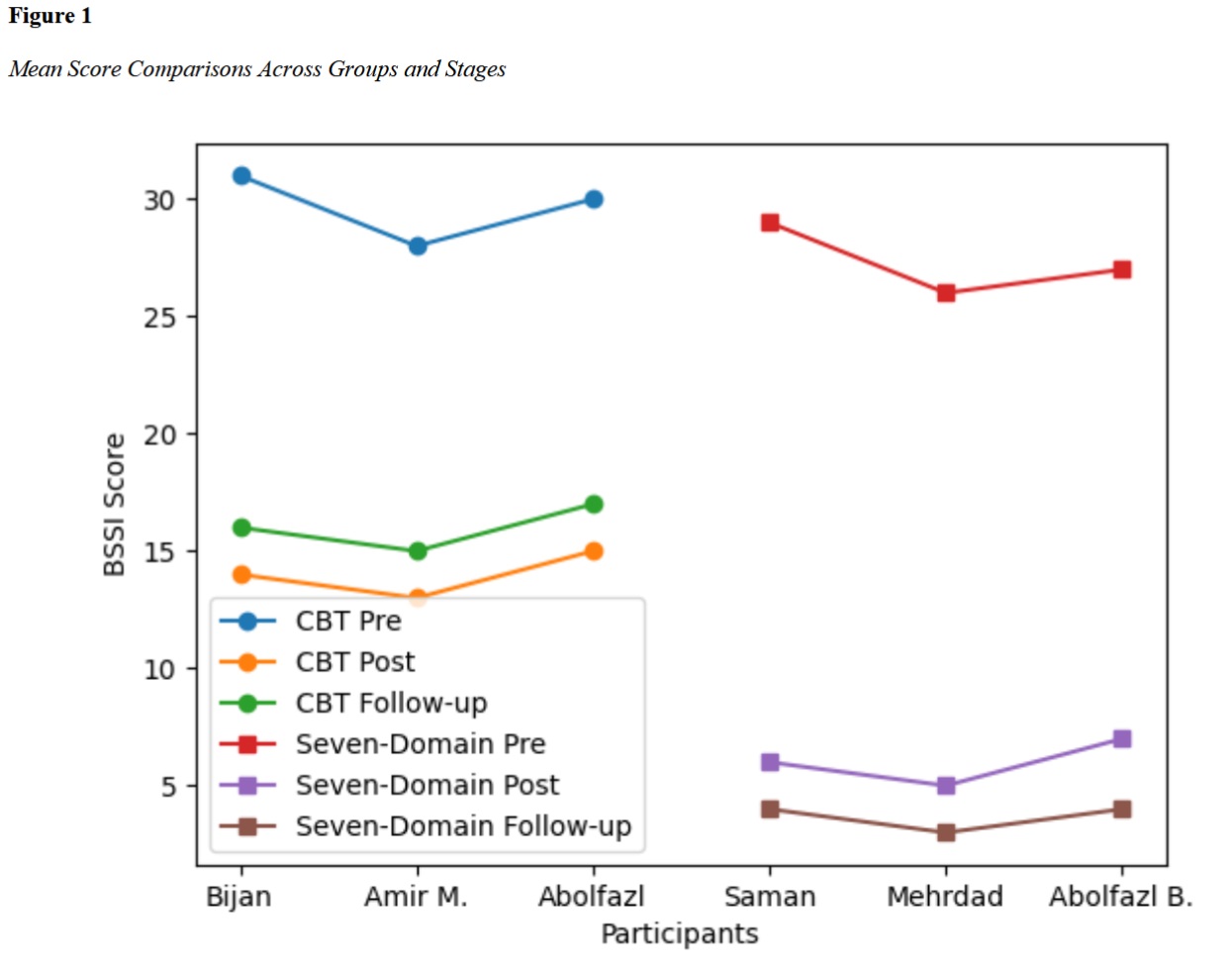
This study aimed to compare the effectiveness of cognitive-behavioral therapy and an integrated seven-domain competence-based counseling approach in reducing suicidal ideation among individuals recovering from substance use disorder. The study employed a single-case experimental design with repeated measures across twelve treatment sessions and an eight-week follow-up period. Six recovered individuals with substance use disorder were purposively selected from an addiction treatment center in Tehran Province and assigned to either a cognitive-behavioral therapy group or a seven-domain competence-based intervention group. Suicidal ideation was assessed at baseline, post-treatment, and follow-up using the Beck Scale for Suicide Ideation Questionnaire. Interventions were delivered weekly in forty-five-minute sessions. Data were analyzed through visual analysis and change-score comparisons to evaluate treatment effects and maintenance of gains. Both treatment approaches produced significant and clinically meaningful reductions in suicidal ideation. However, the seven-domain competence-based intervention resulted in significantly greater magnitude of improvement and superior maintenance of therapeutic gains at follow-up. Participants in this group demonstrated near-complete remission of suicidal ideation with minimal post-treatment relapse, whereas the cognitive-behavioral therapy group exhibited moderate symptom fluctuation and less stable long-term outcomes. The findings indicate that although cognitive-behavioral therapy is an effective intervention for reducing suicidal ideation among individuals in recovery from substance use disorder, an integrated seven-domain competence-based counseling approach may yield deeper and more durable psychological change.
Downloads
References
Abdolmohamamadi, K., Mohammadzadeh, A., & Ghadiri Sourman Abadi, F. (2023). The Effectiveness of Computerized Cognitive Rehabilitation in Improving Response Inhibition and Working Memory in Adolescents with Tendency to Substance Use [Research]. Research on Addiction, 16(66), 71-90. https://doi.org/10.52547/etiadpajohi.16.66.71
Badiee, S., Tizdast, T., & Ahadi, H. (2025). Comparison of the Effectiveness of Cognitive-Behavioral Therapy and Mindfulness Therapy on Craving in Methamphetamine-Addicted Patients. Health, 3(2), 54-62. https://doi.org/10.61838/kman.hn.3.2.7
Baqer Nejad, U., & Mousavi, N. (2015). The impact of mindfulness-based stress reduction training on resilience and marital adjustment in women with addicted spouses. World Conference on New Horizons in Humanities, Foresight, and Empowerment,
Fitzsimmons-Craft, E. E., Laboe, A. A., McGinnis, C., Firebaugh, M.-L., Shah, J., Wallendorf, M., Jacobi, C., Bardone-Cone, A. M., Pike, K. M., Taylor, C. B., & Wilfley, D. E. (2023). A pilot randomized controlled trial of a cognitive-behavioral therapy guided self-help mobile app for the post-acute treatment of anorexia nervosa: A registered report. International Journal of Eating Disorders, 56(3), 654-661. https://doi.org/10.1002/eat.23891
Jiao, Y., & Zhang, W. (2025). The efficacy of cognitive behavioral therapy on reducing suicidal ideation and deliberate self-harm: A systematic review. Frontiers in psychology, 16, 1672957. https://doi.org/10.3389/fpsyg.2025.1672957
McEvoy, P. M., Hyett, M. P., Bank, S. R., Erceg-Hurn, D. M., Johnson, A. R., Kyron, M. J., Saulsman, L. M., Moulds, M. L., Grisham, J. R., Holmes, E. A., Moscovitch, D. A., Lipp, O. V., Campbell, B. N. C., & Rapee, R. M. (2022). Imagery-enhanced v. verbally-based group cognitive behavior therapy for social anxiety disorder: a randomized clinical trial. Psychological medicine, 52(7), 1277-1286. https://doi.org/10.1017/S0033291720003001
Moayedimehr, M., Peymani, J., Ahadi, H., & Tizdast, T. (2023). Investigating the Impact of Psychological Empowerment Program Training on Marital Responsibility and Mental Well-being in Spouse of Addicted Husband. IJPN VL - 11 IS - 3 SP - 81 EP - 94. https://ijpn.ir/browse.php?a_id=2124&sid=1&slc_lang=en
Nateghi, M., & Sohrabi, F. (2017). The Effectiveness of Cognitive-Behavioral Therapy in Suicidal Thoughts and Impulsivity among Adolescents with Addiction. etiadpajohi, 11(42), 213-228. http://etiadpajohi.ir/article-1-1389-en.html
Olivari, C., Mansueto, G., Marino, C., Candellari, G., Cericola, J., Binnie, J., & Caselli, G. (2025). Metacognitive beliefs and desire thinking as potential maintenance factors of compulsive sexual behavior. Addictive behaviors, 161, 108214. https://doi.org/10.1016/j.addbeh.2024.108214
Ottonello, M., Fiabane, E., Pistarini, C., Spigno, P., & Torselli, E. (2019). Difficulties In Emotion Regulation During Rehabilitation For Alcohol Addiction: Correlations With Metacognitive Beliefs About Alcohol Use And Relapse Risk. Neuropsychiatric Disease and Treatment, 15, 2917-2925. https://doi.org/10.2147/NDT.S214268
Pirkashani, N. G., Shahidi, S., Heidari, M., & Nejati, V. (2021). Effectiveness of Interpersonal and Social Rhythm Therapy with and Without Computer-based Cognitive Rehabilitation Therapy on Emotion Regulation and Response Inhibition in Methamphetamine Abusers. International Journal of High Risk Behaviors and Addiction, 10(4).
Pourjaberi, B., Shirkavand, N., & Ashoori, J. (2023). The Effectiveness of Cognitive Rehabilitation Training on Prospective Memory and Cognitive Flexibility in Individuals with Depression. International Journal of Education and Cognitive Sciences, 4(3), 45-53. https://doi.org/10.61838/kman.ijecs.4.3.5
Rahimi, C., Jamalabadi, P., & Sedaghat Pour Haghighi, M. M. (2022). Cognitive Behavioral Treatment on Self-Esteem and Emotional Self-Efficacy of Female Students with Failure in Love [Original Research Article]. Middle Eastern Journal of Disability Studies, 12(0), 19-19. https://doi.org/10.29252/mejds.0.0.78
Reangsing, C., Wongchan, W., Trakooltorwong, P., Thaibandit, J., & Oerther, S. (2025). Effects of cognitive behavioral therapy (CBT) on addictive symptoms in individuals with internet gaming disorders: A systematic review and meta-analysis. Psychiatry research, 348, 116425. https://doi.org/10.1016/j.psychres.2025.116425
Rojas, S. M., Gold, S. D., Bryan, C. J., Pruitt, L. D., Felker, B. L., & Reger, M. A. (2022). Brief cognitive-behavioral therapy for suicide prevention (BCBT-SP) via video telehealth: a case example during the COVID-19 outbreak. Cognitive and Behavioral Practice, 29(2), 446-453. https://doi.org/10.1016/j.cbpra.2020.12.001
Sadeghifar, J., & Mehrabian, T. (2022). Predicting Spiritual Intelligence Based on Personality Traits in Male Addicts Undergoing Rehabilitation in Ilam Province. Military Caring Sciences, 5(17), 192-200. https://doi.org/10.29252/mcs.5.3.192
Sheikhul-Islami, A., & Nowrozi Firouz, A. (2023). The effect of psycho-social empowerment on the tolerance of students with readiness for addiction. Scientific Quarterly of Addiction Research, 17(67), 7-24. https://doi.org/10.52547/etiadpajohi.17.67.7
Downloads
Additional Files
Publication Timeline
- Submitted
- Revised
- Accepted