Comparing the Effectiveness of Art Therapy and Cognitive Behavioral Play Therapy on Anxiety and Assertiveness in Preschool Children
Keywords:
Anxiety, Art Therapy, Assertiveness, Play Therapy, Preschool ChildrenAbstract
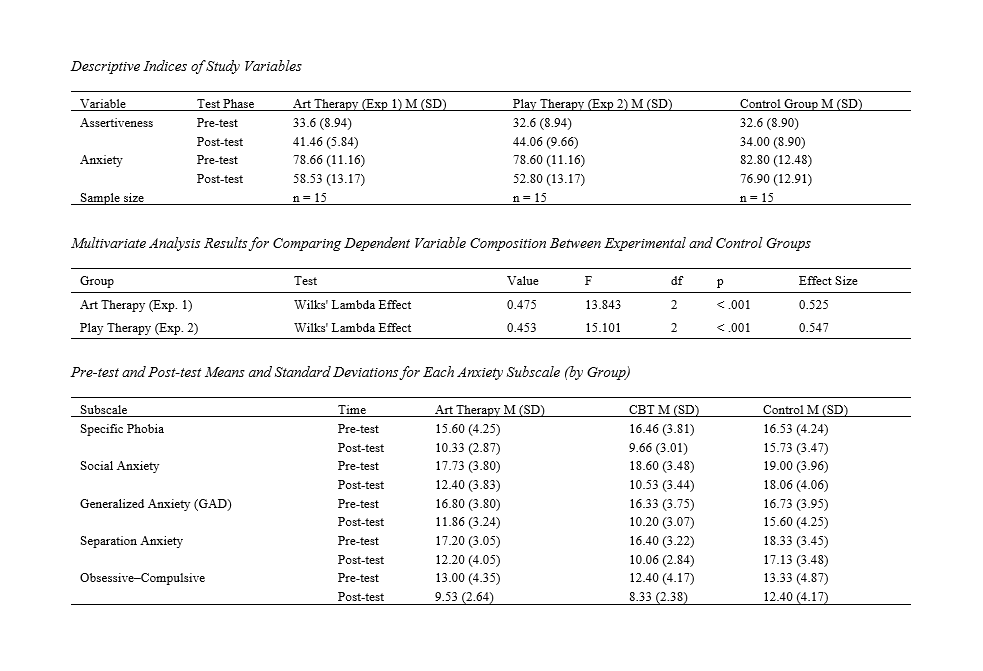
Anxiety and assertiveness issues are among the most important challenges among preschool children. This study examines the effectiveness of art therapy and cognitive-behavioral play therapy in reducing anxiety and improving assertiveness in preschool children. The study employed a quasi-experimental pretest-posttest design with a control group. The statistical population included all 5–6-year-old children referred to the Nedaye Aramesh Ravan Counseling Clinic in Tehran. Using Cochran’s formula, 45 eligible children were selected and randomly assigned to two experimental groups and one control group (n = 15 per group). The first experimental group received 10 weekly sessions of art therapy, and the second received 12 weekly sessions of cognitive-behavioral play therapy. The control group did not receive any intervention during the study period. Data were collected using the Preschool Anxiety Scale (PAS) and the Social Skills Rating System (SSRS). Data analysis was performed using multivariate analysis of covariance (MANCOVA) in SPSS-23. Both art therapy and cognitive-behavioral play therapy led to significant reductions in anxiety and increases in assertiveness compared with the control group after the intervention (P < 0.001). However, the difference in effectiveness between the two therapeutic approaches was not statistically significant (P > 0.05). Both art therapy and cognitive-behavioral play therapy were effective in reducing anxiety and enhancing assertiveness in preschool children. Although each approach relies on different therapeutic mechanisms, their outcomes were comparable, indicating similar therapeutic value. These findings suggest that either intervention can be appropriately selected based on the child’s needs and treatment context.
Downloads
References
Alacha, H., Isaac, A., Gemmell, N., Dougherty, L., Olino, T., & Bufferd, S. (2024). Comparison of Global and Daily Ratings of Associations Between Anxiety and Depressive Behaviors and Impairment in Preschool-Aged Children. Child Psychiatry & Human Development, 1-12. https://doi.org/10.1007/s10578-024-01697-z
Alemdar, H., & Karaca, A. (2025). The Effect of Cognitive Behavioral Interventions Applied to Children with Anxiety Disorders on Their Anxiety Level: A Meta-Analysis Study. Journal of Pediatric Nursing, 80, e246-e254. https://doi.org/10.1016/j.pedn.2024.12.020
Alemdar, H., Karaca, A., Şener, D., & Halmatov, S. (2024). The Impact of Cognitive-Behavioral Play Therapy on Children's Anxiety Levels: A Systematic Review. Balikesir Health Sciences Journal, 13(1), 184-191. https://doi.org/10.53424/balikesirsbd.1349116
Alisherovna, A. G. (2024). Psychocorrection of Psychological Traumas in Children Through Art Therapy. American Journal of Advanced Scientific Research, 1(1), 41-44.
An, Q. (2025). The Impact of Art-Based Interventions on Emotional Regulation in Chinese Children with Autism: A Drawing Therapy Approach. Journal of Autism and Developmental Disorders, 1-8. https://doi.org/10.1007/s10803-025-06727-w
Andersen, M., & Kiverstein, J. (2024). Play in Cognitive Development: From Rational Constructivism to Predictive Processing. Topics in Cognitive Science. https://doi.org/10.1111/tops.12752
Barnett, K., & Vasiu, F. (2024). How the Arts Heal: A Review of the Neural Mechanisms Behind the Therapeutic Effects of Creative Arts on Mental and Physical Health. Frontiers in Behavioral Neuroscience, 18, 1422361. https://doi.org/10.3389/fnbeh.2024.1422361
Behzadpoor, S., Pouretemad, H., & zardkhaneh, S. A. (2020). Predictors of Anxiety in a Sample of Preschoolers with ASD. medRxiv, 2020.2010. 2022.20217711.
Bellaiche, L., Lihardo, K., Williams, C., Chaffee, J., LaBar, K., & Seli, P. (2025). Selective Emotion Regulation in Creative Art Production: Psychophysiological Reactivity During Painting Reduces Anxiety. Iscience, 28(6). https://doi.org/10.1016/j.isci.2025.112543
Dastjerdi, S., Ali, A., Azmoudeh, M., & Molavi, E. (2024). Comparing the Effectiveness of Cognitive-Behavioral Play Therapy and Resilience-Based Play Therapy on Anxiety, Executive Functioning Behaviors, and Emotional Expression in Children Undergoing Dental Treatment. Applied Family Therapy Journal, 5(3), 1-13. https://doi.org/10.61838/kman.aftj.5.3.1
E, T. (2025). Early Diagnosis of Anxiety in Children of Primary School Age. International Journal of Clinical Case Reports and Reviews.
Eslami, A. A., Mazaheri, M. A., Mostafavi, F., Abbasi, M. H., & Noroozi, E. (2014). Farsi version of social skills rating system-secondary student form: Cultural adaptation, reliability and construct validity. Iranian journal of psychiatry and behavioral sciences, 8(2), 97.
Etokabeka, E. (2024). Supporting the Development of Executive Function Skills Through Structured Play: A Qualitative Study of South African Preschool Teachers. Early Childhood Education Journal, 1-10. https://doi.org/10.1007/s10643-024-01827-1
Fernando, F., T, T., & Safitri, I. (2025). Art Therapy for Early Childhood: Enhancing Emotional Well-Being Through Creativity Proceedings of the Al-Ghazali International Conference, https://doi.org/10.52802/aicp.v1i1.1220
Fletcher, K., Wright, C., Pesch, A., Abdurokhmonova, G., & Hirsh-Pasek, K. (2024). Active Playful Learning as a Robust, Adaptable, Culturally Relevant Pedagogy to Foster Children's 21st Century Skills. Journal of Children and Media, 18, 309-321. https://doi.org/10.1080/17482798.2024.2356956
Gresham, F. M., & Elliot, S. N. (1990). Social skills rating system. PsycTESTS Dataset.
Hosokawa, R., Tomozawa, R., & Fujimoto, M. (2025). Effectiveness of Second Step Program in Fostering Social-Emotional Skills in Young Children: A Study in Japan. BMC pediatrics, 25(1), 276. https://doi.org/10.1186/s12887-025-05624-6
Jaggy, A., Kalkusch, I., Bossi, C., Weiss, B., Sticca, F., & Perren, S. (2023). The Impact of Social Pretend Play on Preschoolers' Social Development: Results of an Experimental Study. Early Childhood Research Quarterly, 64, 13-25. https://doi.org/10.1016/j.ecresq.2023.01.012
Liu, X., Sun, L., Du, X., Zhang, C., Zhang, Y., & Xu, X. (2023). Reducing Anxiety and Improving Self-Acceptance in Children and Adolescents with Osteosarcoma Through Group Drawing Art Therapy. Frontiers in psychology, 14, 1166419. https://doi.org/10.3389/fpsyg.2023.1166419
Moses, J., Lehrfield, A., Lupo, A., Fraczek, N., & Wagner, J. (2025). Attention to Threat-Related Faces in Preschool-Aged Children and Associations with Fearful Temperament. Social Development, 34(3), e12810. https://doi.org/10.1111/sode.12810
Nat, M., Van Der Wilt, F., Meeter, M., & Van Der Veen, C. (2024). The Value of Pretend Play for Social Competence in Early Childhood: A Meta-Analysis. Educational psychology review, 36(2), 46. https://doi.org/10.1007/s10648-024-09884-z
Navarro, E., Davis, M., Martin, S., Butler, L., Egger, H., & Carpenter, K. (2024). Pathways to Health: A Longitudinal Examination of Protective Factors in Children with and without Preschool Anxiety. Development and Psychopathology, 37(3), 1584-1592. https://doi.org/10.1017/S0954579424001652
Nazerieh, N., & Niknam, M. (2024). The Effectiveness of Computer Games Rehabilitation and Cognitive Play Therapy Rehabilitation on the Risk-Taking of Children with Attention Deficit Hyperactivity Disorder. International Journal of Applied Behavioral Sciences, 11(2), 1-7. https://doi.org/10.61838/kman.jarac.7.1.17
Ogelman, H., & Kahveci, D. (2024). Coping with Peer Pressure and Social Emotional Well-Being in Preschool Children. International Journal of Educational Spectrum, 6(2), 191-203. https://doi.org/10.47806/ijesacademic.1409535
Rapee, R., Creswell, C., Kendall, P., Pine, D., & Waters, A. (2023). Anxiety Disorders in Children and Adolescents: A Summary and Overview of the Literature. Behaviour Research and Therapy, 168, 104376. https://doi.org/10.1016/j.brat.2023.104376
Raudenská, J., Gumančík, J., Raudenský, M., Pasqualucci, A., Moka, E., & Varrassi, G. (2023). Cognitive-Behavioral Play Therapy and COVID-19 Pandemic Trauma in Preschool Children. Cureus, 15(8). https://doi.org/10.7759/cureus.44249
Saskia, B., Jannati, Z., Putra, B., & Pietrzyk, I. (2025). The Effectiveness of Group Counseling with Art Therapy Methods in Reducing Social Anxiety in Children with Tunagrahita. Al-Ihath Journal Bimbingan Konseling Islam, 5(2), 81-90. https://doi.org/10.53915/jbki.v5i2.632
Shayganfard, M., Kaboudi, B., Arabsheibani, K., Shakiba, E., & Cheshmekaboudi, S. (2024). Effectiveness of Cognitive-Behavioral Group Play Therapy on Anxiety-Based School Refusal and Behavioral Problems in Elementary School Boys: A Preliminary Randomized Controlled Trial. Archives of Psychiatric Nursing, 50, 108-114. https://doi.org/10.1016/j.apnu.2024.03.019
Smith, S., & Monga, S. (2024). Approaching Big Fears in Little Kids: Understanding and Managing Anxiety Disorders in Preschoolers. Child and Adolescent Psychiatric Clinics of North America, 34(2), 279-289. https://doi.org/10.1016/j.chc.2024.08.004
Spence, S. H., Rapee, R., McDonald, C., & Ingram, M. (2001). The structure of anxiety symptoms among preschoolers. Behaviour research and therapy, 39(11), 1293-1316.
Stoyanova, D. (2024). Art as Self-Expression Therapy and a Method for Developing Emotional Intelligence in Preschool Children. Educational Technology Journal.
Varalakshmi, V., & Varun, P. (2025). The Contribution of Social and Emotional Skills to Children's Mental Health Development. Shanlax International Journal of Arts, Science and Humanities, 12(2), 145-151. https://doi.org/10.34293/sijash.v12iS2-Jan.8901
Warne, N., Heron, J., von Gontard, A., & Joinson, C. (2024). Mental Health Problems, Stressful Life Events and New-Onset Urinary Incontinence in Primary School-Age Children: A Prospective Cohort Study. European Child & Adolescent Psychiatry, 33(3), 871-879. https://doi.org/10.1007/s00787-023-02211-x
Xu, J., Akhter, S., & Apuke, O. (2025). The Effectiveness of Combining Interactive Media-Based Cognitive Behaviour Therapy with Art and Music Therapies for Ameliorating Generalized Anxiety Disorder of Children Exposed to Abduction. Psychiatry research, 349, 116498. https://doi.org/10.1016/j.psychres.2025.116498
Yang, X., Yang, P., Li, D., Zhou, J., Liu, M., & Han, X. (2025). Joint Developmental Trajectories of Social Assertiveness and Prosociality: A Parallel Process Latent Class Growth Analysis. Journal of youth and adolescence, 1-16.
Yohannan, S., Pathrose, S., & Devassy, S. (2025). The Effectiveness of Art Therapy in Addressing Emotional and Behavioral Issues and Enhancing Self-Esteem of Children Living in Residential Childcare Institutions: A Feasibility Study in Kerala, India. Arts & Health, 1-17. https://doi.org/10.1080/17533015.2025.2527185
Zeighami, R., Sarichloo, M. E., Hosseinkhani, Z., & Zeynalzad, S. (2021). Anxiety disorder of 3-6 year-old children. Journal of Nursing and Midwifery Sciences, 8(2), 79-79.
Zhang, B., Wang, J., & Abdullah, A. (2024). The Effects of Art Therapy Interventions on Anxiety in Children and Adolescents: A Meta-Analysis. Clinics, 79, 100404. https://doi.org/10.1016/j.clinsp.2024.100404
Zhou, M. (2024). Application and Influence of Children's Painting Psychotherapy on Early Childhood Education. Transactions on Economics, Business and Management Research. https://doi.org/10.62051/2rz4ga11
Zhou, S., Creswell, C., Spence, S. H., & Reardon, T. (2024). Measurement Invariance of the Higher-Order Model of Preschool Anxiety Scale Across Child Age, Gender, Parental Anxiety, and Pandemic Period in England. Psychological assessment, 36(9), 526-537. https://doi.org/10.1037/pas0001325
Zhou, S., Li, H., Yang, Y., Qi, Y., Liu, W., & Mo, L. (2025). Effects of Art Therapy on Psychological Outcomes Among Children and Adolescents with Cancer: A Systematic Review and Meta-Analysis. BMC Complementary Medicine and Therapies, 25(1), 149. https://doi.org/10.1186/s12906-025-04866-2
Downloads
Publication Timeline
- Submitted
- Revised
- Accepted