A Dyadic Machine Learning Model of Relationship Stability: Integrating Trust, Sexual Satisfaction, Emotional Intelligence, and Conflict Avoidance
Keywords:
Relationship stability, trust, sexual satisfaction, emotional intelligence, conflict avoidance, dyadic analysis, machine learning, romantic relationshipsAbstract
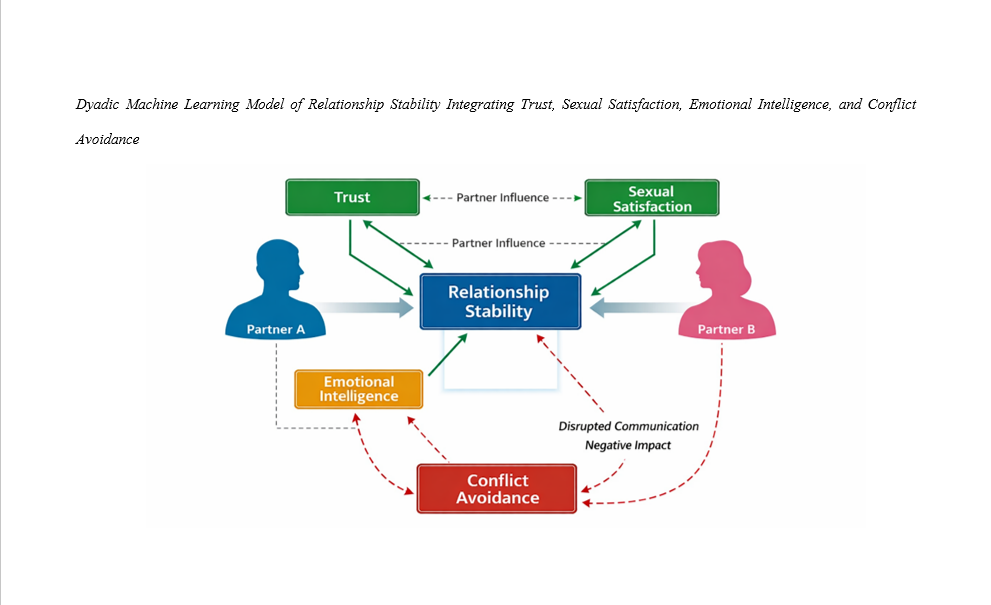
The present study aimed to develop and test a dyadic machine learning model of relationship stability by examining the interdependent effects of trust, sexual satisfaction, emotional intelligence, and conflict avoidance among romantic couples. This cross-sectional, correlational study employed a dyadic analytical framework and was conducted on 286 couples (572 individuals) residing in Tehran. Participants were recruited using stratified convenience sampling and were required to be in committed relationships of at least one year. Data were collected using validated self-report instruments measuring trust, sexual satisfaction, emotional intelligence, conflict avoidance, and relationship stability. The Actor–Partner Interdependence Model (APIM) was used to estimate actor and partner effects, while machine learning techniques, including gradient boosting and random forest algorithms, were applied to model nonlinear relationships and enhance predictive accuracy. Model performance was evaluated using k-fold cross-validation, and feature importance was examined using Shapley value analysis. The results indicated that trust (β = 0.41, p < .001) and sexual satisfaction (β = 0.36, p < .001) had the strongest positive actor effects on relationship stability, while emotional intelligence showed a moderate positive effect (β = 0.27, p < .001), and conflict avoidance demonstrated a significant negative effect (β = -0.33, p < .001). Partner effects were also significant across all variables, confirming dyadic interdependence. The machine learning model achieved a high predictive accuracy (R² = 0.71), with trust (feature importance = 0.34) and sexual satisfaction (0.28) emerging as the most influential predictors, followed by conflict avoidance (0.22) and emotional intelligence (0.16). The findings support a multidimensional and interdependent model of relationship stability, highlighting the central roles of trust and sexual satisfaction alongside the regulatory function of emotional intelligence and the detrimental impact of conflict avoidance.
Downloads
References
Alam, M. A. (2024). HR Analytics for Strategic Decisions: Resolving Conflicts From a Psychological Perspective. https://doi.org/10.21203/rs.3.rs-5344306/v1
Castillo‐López, Á. G. d., Berenguer-Soler, M., & Pineda, D. (2025). Relationship Love Styles’ Effects on Conflict, Emotional Intelligence, and Sexual Satisfaction: A Latent Profile Analysis. Sage Open, 15(3). https://doi.org/10.1177/21582440251358988
Cole, T., & Stonebrook, K. (2025). Deceptive Hearts: Insecure Attachment and Motives Underlying Deception in Romantic Relationships. Personal Relationships, 32(3). https://doi.org/10.1111/pere.70020
Dacka, M., Kulik, A., & Nowak, K. (2023). Determinants of Forgiveness After Experiencing Infidelity in a Marital Relationship. Kwartalnik Naukowy Fides et Ratio, 54(2), 44-57. https://doi.org/10.34766/fetr.v54i2.1185
Dew, J., Trujillo, S., & Saxey, M. T. (2022). Predicting Marital Financial Deception in a National Sample: A Person‐centered Approach. Family Relations, 71(4), 1497-1514. https://doi.org/10.1111/fare.12654
Durasa, H., Fitriani, S. N., Erlin, E., Kusuma, K. C. A., & Sriartha, I. P. (2024). Emile Durkheim S Moral Perspective on Reducing Bullying and Violence in Schools: A Phenomenological Study. International Journal of Didactical Studies. https://doi.org/10.33902/ijods.202427615
Eastwick, P. W., Finkel, E. J., & Joel, S. (2023). Mate Evaluation Theory. Psychological review, 130(1), 211-241. https://doi.org/10.1037/rev0000360
Fernandes, M. I. A., Sousa, C., Conde, A. R., Silva, F. F. d., & Ferreira, M. J. (2023). Exploring the Relationship Between Capacity to Love and Well-Being: A Comparative Study of Emerging Adults and Middle-Aged Adults. Sexuality & Culture, 28(4), 1424-1445. https://doi.org/10.1007/s12119-023-10184-x
Fonte, C., Pires, S., & Ferreira, M. J. (2025). The Role of Personality in the Capacity to Love. International Journal of Psychological Research, 18(1), 69-81. https://doi.org/10.21500/20112084.6843
Ghasemi, Y. (2023). The Relationship Between Attachment Symbols, Attachment Styles and Self-Differentiation With Marital Intimacy. Obstetrics Gynecology and Reproductive Sciences, 7(4), 01-08. https://doi.org/10.31579/2578-8965/168
Giulio, P. (2024). “Perrotta Love Stability Questionnaire” (PLS-Q1): Development and Regulation of a Psychometric Instrument to Investigate Couple Relationship Stability in Healthy and Psychopathologically Affected Individuals. https://doi.org/10.20944/preprints202402.0460.v1
Griffes, S. E., Hardy, N. R., Gregson, T. J., Brosi, M. W., & Gardner, B. C. (2024). Couple Relationship Education Content: What We Have and What We Are Missing. Family Process, 63(4), 1790-1806. https://doi.org/10.1111/famp.13043
Manvelian, A., Fivecoat, H. C., Milek, A., & Lawrence, E. (2021). Ending the Silo Effect: A Test of the Relational Domain Spillover Model. Family Process, 61(3), 1229-1247. https://doi.org/10.1111/famp.12728
Mariano, L. I., Nicosia, L., Sorce, A., Pesapane, F., Coppini, V., Grasso, R., Monzani, D., Pravettoni, G., Mauri, G., Venturini, M., Pizzamiglio, M., & Cassano, E. (2024). Radiologists’ Communicative Role in Breast Cancer Patient Management: Beyond Diagnosis. Healthcare, 12(11), 1145. https://doi.org/10.3390/healthcare12111145
Mogilski, J. K., Rodrigues, D. L., Lehmiller, J. J., & Balzarini, R. N. (2021). Maintaining Multi-Partner Relationships: Evolution, Sexual Ethics, and Consensual Non-Monogamy. https://doi.org/10.31234/osf.io/k4r9e
Mogilski, J. K., Rodrigues, D. L., Lehmiller, J. J., & Balzarini, R. N. (2023). Maintaining Multipartner Relationships. 461-486. https://doi.org/10.1093/oxfordhb/9780197524718.013.17
Mónaco, E., Barrera, U. d. l., & Montoya‐Castilla, I. (2021). The Effectiveness of EMOVERE: An Emotional Education Program for Young Couples. International journal of environmental research and public health, 18(4), 1677. https://doi.org/10.3390/ijerph18041677
Musthofa, M. A., & Lutfiah, S. Q. (2024). Early Marriage and Its Influence on Family Harmony in an Islamic Perspective. Al-Risalah, 15(1), 197-214. https://doi.org/10.34005/alrisalah.v15i1.3351
Ogwuche, C. H., Tyav-Tersoo, K. I., Onah, C., & Orafa, D. T. (2024). Marital Infidelity Among Married Couples: Roles of Emotional Intelligence and Narcissistic Personality Traits in Makurdi, Benue State. Jiped, 28(1), 27-26. https://doi.org/10.29081/jiped.2024.28.1.03
Özbay, A., & Balaban, Ö. (2024). Investigating the Relationship Between Emotional Intelligence and Sexual Satisfaction in Late Adolescent University Students. Sexuality Gender & Policy, 7(4), 382-403. https://doi.org/10.1002/sgp2.12117
Pacheco, J. A. B. (2024). Psychological Consequences in Child Sexual Abuse. Forensic Research & Criminology International Journal, 12(1), 57-66. https://doi.org/10.15406/frcij.2024.12.00398
Phillips, E. M., Ramsdell, E. L., & Brock, R. L. (2025). Core Dimensions of Intimate Relationship Quality: Network Analyses From the Prenatal to Postnatal Period. Journal of Family Psychology, 39(5), 614-626. https://doi.org/10.1037/fam0001338
Ricafrente, G. R., Sumicad, R., Lirazan, M. E., & Gerzon, K. J. (2024). Correlations of Personality Traits and Romantic Relationship Satisfaction. Journal of Psychology and Behavior Studies, 4(1), 38-50. https://doi.org/10.32996/jpbs.2024.1.5
Schulz, O., Gubler, D. A., Raemy, U. E., & Troche, S. J. (2025). Mapping Love: A Personality-Centered Network Analysis of Relationship Satisfaction. Frontiers in psychology, 16. https://doi.org/10.3389/fpsyg.2025.1587405
Tang, L., Yu, X., Liu, Y., Zhou, J., Zhang, D., Wang, J., & Liu, Q. (2024). Current Status and Factors Associated With Sexual Harassment Among Operating Room Nurses: A Multi-Center Cross-Sectional Study. BMC Nursing, 23(1). https://doi.org/10.1186/s12912-024-02606-4
Yordanova, S. D., & Dineva, S. Y. (2022). Emotion Regulation at Work Employees and Leaders’ Perspectives. International Journal of Innovation and Economic Development, 8(1), 50-71. https://doi.org/10.18775/ijied.1849-7551-7020.2015.81.2004
Downloads
Additional Files
Publication Timeline
- Submitted
- Revised
- Accepted