The Mediating Role of Marital Burnout in the Relationship Between Attachment Needs and Couples’ Tendency Toward Divorce
Keywords:
Couple Burnout, Attachment Needs, Tendency to Divorce, Couples, Structural Equation ModelingAbstract
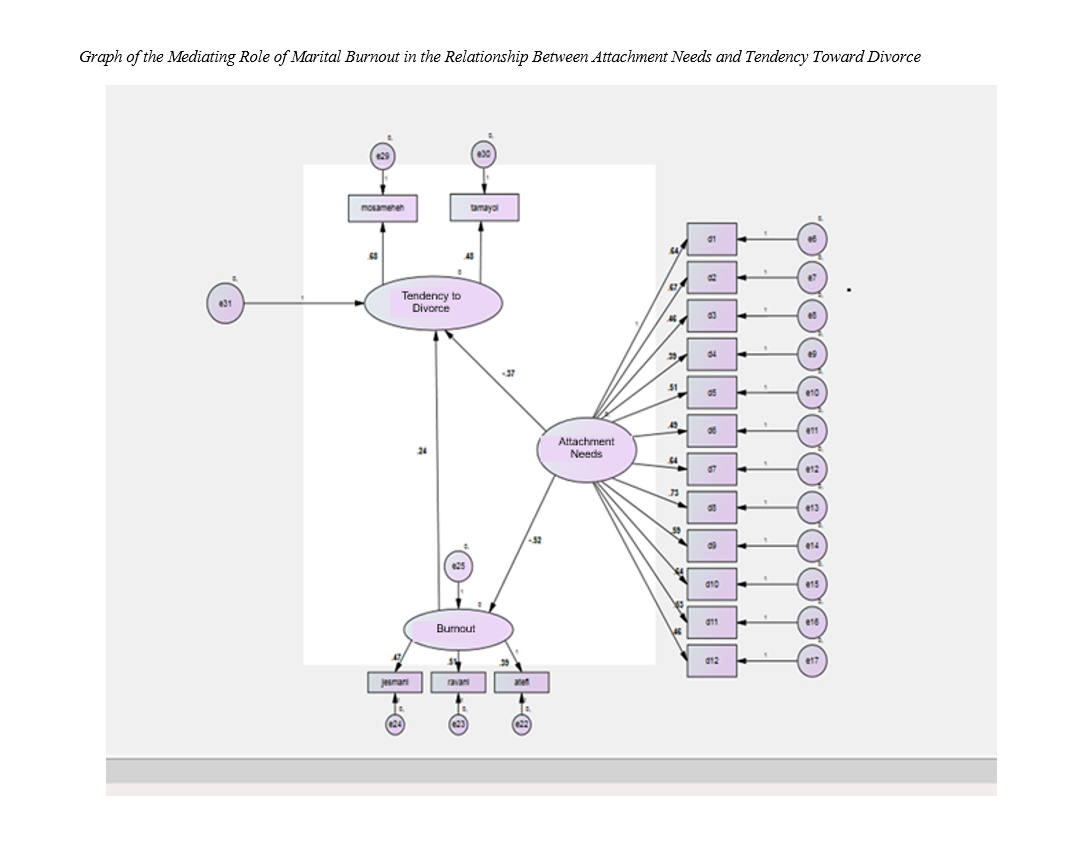
The present study aimed to investigate the mediating role of marital burnout in the relationship between attachment needs and couples’ tendency toward divorce in the city of Shiraz. This applied study was conducted using a correlational design based on structural equation modeling. The statistical population included all married couples in Shiraz in 2025, from whom 200 participants were selected through convenience sampling. The research instruments included the Divorce Tendency Questionnaire developed by Rosebelt, Johnson, and Morrow, the Marital Burnout Questionnaire by Pines, and the Attachment Needs Questionnaire developed by Samani et al. Data were analyzed using SPSS version 21 and AMOS software. In the descriptive section, mean and standard deviation were used, while Pearson correlation coefficient and structural equation modeling were employed in the inferential section. The results indicated that attachment needs had a significant negative relationship with marital burnout (r = -0.524, p < 0.001) and tendency toward divorce (r = -0.474, p < 0.001). In addition, marital burnout showed a significant positive relationship with tendency toward divorce (r = 0.417, p < 0.001). The findings of the structural equation model demonstrated that the path from attachment needs to marital burnout (β = -0.748), the path from attachment needs to tendency toward divorce (β = -0.415), and the path from marital burnout to tendency toward divorce (β = 0.162) were all significant (p < 0.001). Furthermore, the indirect effect of attachment needs on tendency toward divorce through marital burnout was equal to 0.132, confirming the significant mediating role of marital burnout. The findings of the study indicated that unmet attachment needs can increase couples’ tendency toward divorce through heightened marital burnout. Therefore, paying attention to couples’ emotional and affective needs and designing interventions based on attachment-oriented and emotion-focused approaches may play an effective role in reducing marital burnout and preventing divorce.
Downloads
References
Davarnia, R., Zahrakar, K., Moayeri, N., & Shakermi, M. (2015). The Efficacy of Group Emotionally Focused Couple Therapy in Reducing Marital Burnout among Women. Medical Sciences Journal of Islamic Azad University, Tehran Medical Branch, 25(2), 132-140. http://tmuj.iautmu.ac.ir/article-942-1-fa.html
Dehghani, M. (2011). Convergent Validity of the Pines Marital Burnout Questionnaire Using the ENRICH Questionnaire. Journal of Psychology and Educational Sciences, 42(2), 234-245.
Filosa, M., Sharp, C., Gori, A., & Musetti, A. (2024). A comprehensive scoping review of empirical studies on earned secure attachment. Psychological Reports. https://doi.org/10.1177/00332941241277495
Ghaderpour, M. (2014). The Effectiveness of Group Counseling Based on Satir's Communication Approach on Marital Burnout and Desire for Divorce among Couples Referred to Counseling Centers University of Kurdistan].
Gottman, J. M., & Levenson, R. W. (2000). The predictive power of marital dissatisfaction for divorce. Journal of marriage and family, 62(2), 431-449.
Johnson, S. M. (2003). The Practice of Emotionally Focused Couple Therapy: Creating Connection. Brunner-Routledge.
Johnson, S. M., & Greenman, P. S. (2006). The path to a secure bond: Emotionally focused couple therapy. Journal of Clinical Psychology, 62(5), 671-685.
Liu, Q., & Wang, Z. (2020). Associations between parental emotional warmth, parental attachment, peer attachment, and adolescents' character strengths. Children and Youth Services Review. https://doi.org/10.1016/j.childyouth.2020.105437
Mahmoudpour, A., Shiri, T., Farahbakhsh, K., & Zolfaghari, S. (2020). Predicting Divorce Tendency Based on Marital Burnout and Distress Tolerance with the Mediation of Loneliness among Women Applying for Divorce. Culture of Counseling and Psychotherapy, 11(42), 121-141.
Minousepehr, S., Nikogoftar, M., & Lavasani, M. (2022). Predicting Marital Burnout Based on Sexual Intimacy with the Mediation of Sexual Self-Concept. Applied Family Therapy, 3(2), 340-360.
Mousavi Mirkalaei, R. (2023). The Role of Emotion Regulation Difficulty and Social Anxiety in Predicting Marital Burnout among Married Women. Journal of Studies and Research in Behavioral Sciences, 15(2), 152-163.
Naderi, F., Eftekhari, Z., & Amlazadeh, S. (2009). The Relationship of Personality Traits and Intimate Spousal Relations with Marital Burnout among Wives of Male Addicts. New Findings in Psychology (Social Psychology), 4(11), 61-78.
National Organization for Civil, R. (2024). Report on Marriage and Divorce Statistics in Iran during the First Seven Months of 2024. https://www.sabteahval.ir
Pines, A. M., & Nunes, R. (2003). The relationship between career and couple burnout: Implications for career and couple counseling. Journal of employment counseling, 40(2), 50-64.
Power, A. (2023). Making sense of contented couples: Insights from attachment theory and emotionally focused couple therapy (EFT). Attachment, 17(1), 10-26.
Ramezanifar, H., Kaldi, A., & Ghadimi, B. (2021). Analysis of Factors Affecting Emotional Divorce among Married Women in Tonekabon County. Women in Development and Politics (Women's Research), 19(2), 167-191.
Salvatore, J. E., Aggen, S. H., & Kendler, K. S. (2022). Role of parental divorce and discord in the intergenerational transmission of alcohol use disorder. Drug and Alcohol Dependence, 18(1), 226-240. https://doi.org/10.1016/j.drugalcdep.2022.109355
Samani, S., Alicheshmeh-Alai, M., Sohrabi, N., & Baghouli, H. (2023). A Causal Model of Marital Burnout Based on Emotional Maturity and Social Maturity. Quarterly Journal of Psychology and Educational Sciences, 31(1), 81-94.
Samani, S., & Reisi, F. (2025). Predicting Marital Instability Based on Emotional Maturity and Attachment Needs among Married Students. Rooyesh-e-Ravanshenasi, 14(3), 108-108.
Samani, S., & Sohrabi, N. (2023). Lifestyle and attachment needs: Emotional-focused therapy perspective. Middle East Journal of Islamic Studies and Culture, 3(1), 1-4.
Samani, S., Sohrabi, N., Moslehi, M., & Shirazi, M. (2023). Developing a marital attachment needs scale. Iranian Evolutionary and Educational Psychology Journal, 1, 1-4.
Downloads
Additional Files
Publication Timeline
- Submitted
- Revised
- Accepted