The Effectiveness of Islamic Spirituality Training on Academic Well-Being, Achievement Motivation, and Academic Affect
Keywords:
Islamic spirituality training, academic well-being, achievement motivation, academic affect, adolescents, educational psychologyAbstract
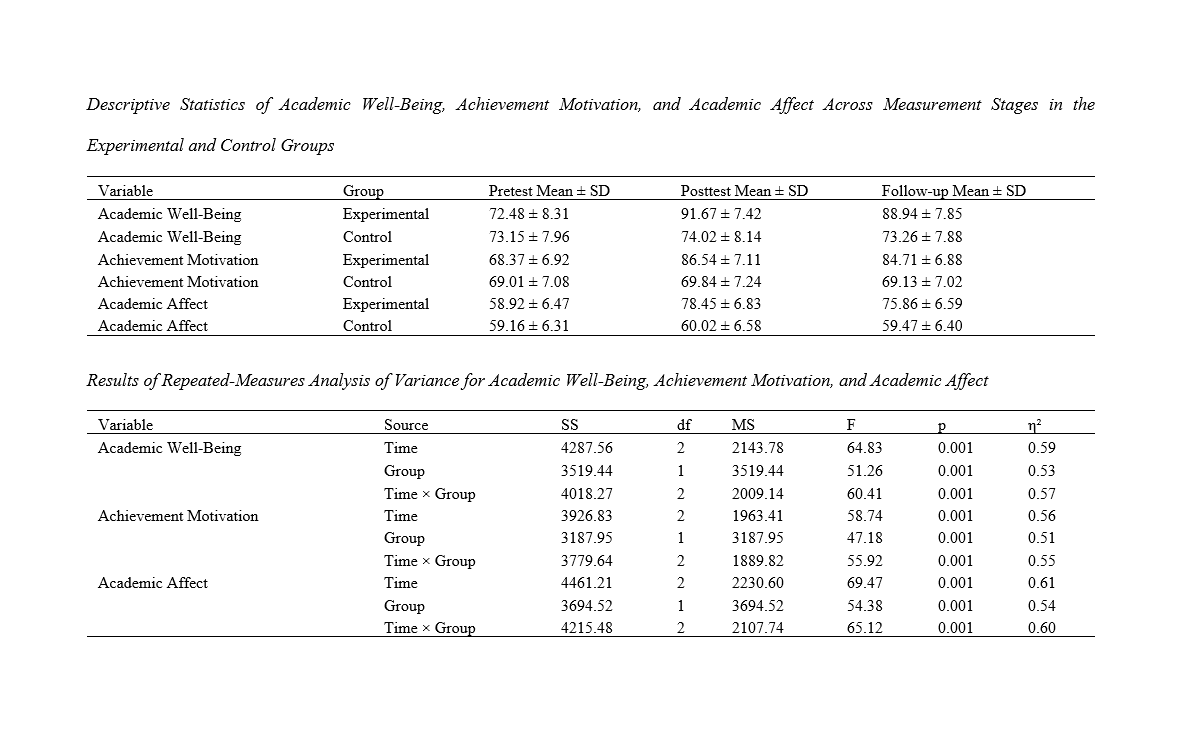
The present study aimed to investigate the effectiveness of Islamic spirituality training on academic well-being, achievement motivation, and academic affect among high school students in Tehran. This study employed a quasi-experimental design with pretest, posttest, and follow-up stages using a control group. The statistical population consisted of high school students in Tehran during the 2025–2026 academic year. A total of 48 students were selected through purposive sampling and randomly assigned into an experimental group (n = 24) and a control group (n = 24). The experimental group participated in eight weekly sessions of Islamic spirituality training, each lasting 90 minutes, while the control group received no intervention. Data collection instruments included the Academic Well-Being Questionnaire, the Hermans Achievement Motivation Questionnaire, and the Academic Affect Scale. Data were analyzed using repeated-measures analysis of variance and Bonferroni post-hoc tests in SPSS-27 software. The results of repeated-measures analysis of variance indicated that Islamic spirituality training had a significant effect on academic well-being (F = 60.41, p = 0.001, η² = 0.57), achievement motivation (F = 55.92, p = 0.001, η² = 0.55), and academic affect (F = 65.12, p = 0.001, η² = 0.60). Bonferroni post-hoc comparisons demonstrated significant differences between pretest and posttest scores as well as between pretest and follow-up scores in the experimental group across all variables (p = 0.001). The findings showed that students who participated in the Islamic spirituality training program experienced increased academic well-being, stronger achievement motivation, and more positive academic affect compared to the control group, and these improvements remained relatively stable during the follow-up stage. The findings suggest that Islamic spirituality training is an effective educational and psychological intervention for improving students’ academic well-being, achievement motivation, and academic affect.
Downloads
References
Abdillah, H. Z., & Madjid, A. (2024). Islamic Education and School Well-Being for Adolescents During the Covid-19 Pandemic. Jurnal Riset Pendidikan Dan Pengajaran, 3(1), 45-55. https://doi.org/10.55047/jrpp.v3i1.614
Aggarwal, S., Wright, J., Morgan, A. J., Patton, G., & Reavley, N. (2023). Religiosity and Spirituality in the Prevention and Management of Depression and Anxiety in Young People: A Systematic Review and Meta-Analysis. BMC psychiatry, 23(1). https://doi.org/10.1186/s12888-023-05091-2
Al‐Thani, H. (2024). Exploring the Challenges and Prospects for Sustainable Wellbeing in Qatar: Stakeholder Perspectives. https://doi.org/10.20944/preprints202405.1273.v1
Badi, J. A., & Surajudeen, A. T. (2022). The Roles of Masjid in Enhancing Networking Opportunities Among the Muslims in the Era of Globalization. Al Hikmah International Journal of Islamic Studies and Human Sciences, 5(4), 71-88. https://doi.org/10.46722/hikmah.v5i4.291
Erwahyudin, D. D. (2024). Adapting Technology in Islamic Psychology: Exploring Digital Pathways to Spiritual and Psychological Wellbeing. 745-754. https://doi.org/10.2991/978-2-38476-273-6_78
Ghezloo, S., Bayatiani, M. R., & Karimi, M. (2024). Ishāq Bin Ali Al-Ruhawi, a Pioneer in Medical Professionalism in the 9th Century AD. Journal of Medical Biography, 33(4), 310-316. https://doi.org/10.1177/09677720241286589
Hasanah, U., Khoiruttobib, S., Hasanah, I. F., Alhafiz, F., Apriyani, H., & Hakim, I. U. (2024). Promoting Sustainable Development Goals in Islamic University of Raden Intan Lampung. E3s Web of Conferences, 482, 04018. https://doi.org/10.1051/e3sconf/202448204018
Hatami, S., & Shekarchizadeh, H. (2022). Relationship Between Spiritual Health, Resilience, and Happiness Among a Group of Dental Students: A Cross-Sectional Study With Structural Equation Modeling Method. BMC Medical Education, 22(1). https://doi.org/10.1186/s12909-022-03243-8
Javeed, N. M., & Othman, A. (2023). In-Service Training and Character Development in Relation to Islamization Initiatives in Selected Islamic Integrated Schools in Selangor. IIUM Journal of Educational Studies, 11(2), 85-114. https://doi.org/10.31436/ijes.v11i2.480
Khaiyom, J. H. A., Ariffin, A. H. T., & Rosli, A. N. (2022). Islam, Iman, and Ihsan: The Role of Religiosity on Quality of Life and Mental Health of Muslim Undergraduate Students in Islamic University. Iium Medical Journal Malaysia, 21(3). https://doi.org/10.31436/imjm.v21i3.2047
Moslimany, R., Otaibi, A., & Shaikh, F. (2024). Designing a Holistic Curriculum: Challenges and Opportunities in Islamic Education. Jois, 1(1), 52-73. https://doi.org/10.35335/beztg009
Nordin, M. S., Hussien, S., Hamid, H. A., & Hashim, K. S. H. (2022). Prevalence and Underlying Structure of Students’ Sejahtera Living Vis-À-Vis Maqāṣid Al-Sharī’ah. IIUM Journal of Educational Studies, 10(2), 150-173. https://doi.org/10.31436/ijes.v10i2.458
Nuzula, F. F. (2024). Psychology of Religion: The Relationship Between Islamic Spirituality and Psychological Well-Being. G-Couns Jurnal Bimbingan Dan Konseling, 8(2), 1157-1167. https://doi.org/10.31316/gcouns.v8i2.5898
Prasetya, R. L., Dwidiyanti, M., & Dewi, N. S. (2022). The Kind of Mindfulness Intervention for Anxiety in Undergraduate Nursing Students: A Literature Review. Nurse and Health Jurnal Keperawatan, 11(1), 111-123. https://doi.org/10.36720/nhjk.v11i1.352
Robiah, S., Elfis, E., Hamzah, H. A., & Triyeni, A. (2023). Workshop on Integrating Biology Instructional Strategies With Al-Quran and as-Sunnah Value for Prospective Biology Teachers. Journal of Community Service and Empowerment, 4(3), 436-441. https://doi.org/10.22219/jcse.v4i3.24841
Rozikan, M., Wibowo, M. E., Purwanto, E., Mulawarman, M., & Saputra, N. (2024). Students' Spiritual Well-Being Landscape: Insights From Indonesian Islamic Universities. International Journal of Religion, 5(10), 1752-1769. https://doi.org/10.61707/jvs37m46
Said, S. M., Sharif, S., & Abdullah, M. K. J. (2023). Unveiling the Excellent Leadership Qualities and Practices of Principals in Islamic Schools: A Systematic Literature Review. International Journal of Learning Teaching and Educational Research, 22(9), 43-61. https://doi.org/10.26803/ijlter.22.9.3
Saidon, R., Manan, S. K. A., Sueb, R., & Rahman, F. N. A. (2021). Islamic Psycho-Spiritual Support Model for Disaster Victims. Environment-Behaviour Proceedings Journal, 6(SI5), 71-76. https://doi.org/10.21834/ebpj.v6isi5.2932
Saritoprak, S. N., & Abu‐Raiya, H. (2022). Living the Good Life: An Islamic Perspective on Positive Psychology. 179-193. https://doi.org/10.1007/978-3-031-10274-5_12
Seydooğulları, S. Ü. (2023). University Students’ Wellbeing and Mental Health During COVID-19: An Online Photovoice Approach. Journal of Happiness and Health, 3(2), 139-156. https://doi.org/10.47602/johah.v3i2.60
Shariff, N. M., Azhar, N. A., Bakar, S. N. A., Ahmad, A., Kaderi, M. A., & Saidi, S. (2022). Islamic Music Listening, Spiritual Well-Being and Burnout of Employees in Islamic University. Al-Irsyad Journal of Islamic and Contemporary Issues, 7(2), 915-923. https://doi.org/10.53840/alirsyad.v7i2.320
Sholihah, H., Syukur, F., Ismail, I., Rosyid, A., & Amantai, K. (2024). The Roles, Opportunities, and Challenges of PAI Teacher's Leadership in Senior High Schools. Cendekia Jurnal Kependidikan Dan Kemasyarakatan, 22(1). https://doi.org/10.21154/cendekia.v22i1.8185
Sholihah, N. m., Kusaeri, K., Kholis, N., Muntafi’ah, U., & Huriyah, L. (2024). Istighātha Dhikr Practices Toward Human Well-Being: An Implication for Islamic Education. Munaddhomah Jurnal Manajemen Pendidikan Islam, 5(3), 338-352. https://doi.org/10.31538/munaddhomah.v5i3.1402
Tabroni, I., Mubarok, Z., & Sari, R. P. (2021). Teacher's Strategy in Educating Student Character in the Coronavirus Disease (COVID-19). Jurnal Ilmu Pendidikan Muhammadiyah Kramat Jati, 2(1), 1-7. https://doi.org/10.55943/jipmukjt.v2i1.13
Wahyuni, S. (2023). Stress Management Islamic Perspective: Systematic Literature Review. 341-350. https://doi.org/10.2991/978-2-38476-032-9_35
Yakubu, A. (2021). Pondok, Tsangaya, and Old Age Spiritual Wellbeing. Tafkir Interdisciplinary Journal of Islamic Education, 2(2), 122-138. https://doi.org/10.31538/tijie.v2i2.44
Zahoor, I., & Khan, S. (2023). Contemplative Practices of Higher Education Faculty of Pakistan: Applications and Propositions. International Journal of Innovation in Teaching and Learning (Ijitl), 8(2), 20-38. https://doi.org/10.35993/ijitl.v8i2.2461
Zuhdi, M., & Syarief, K. (2023). Constructing the Concept of Student Well-Being Within Indonesian Islamic Higher Education. Religions, 14(9), 1140. https://doi.org/10.3390/rel14091140
Downloads
Additional Files
Publication Timeline
- Submitted
- Revised
- Accepted