Comparison of the Effectiveness of Relational Imagery Therapy and Acceptance and Commitment Therapy on We-Ness Experience in Women Exposed to Marital Infidelity
Keywords:
relational imagery therapy, acceptance and commitment therapy, we-ness experienceAbstract
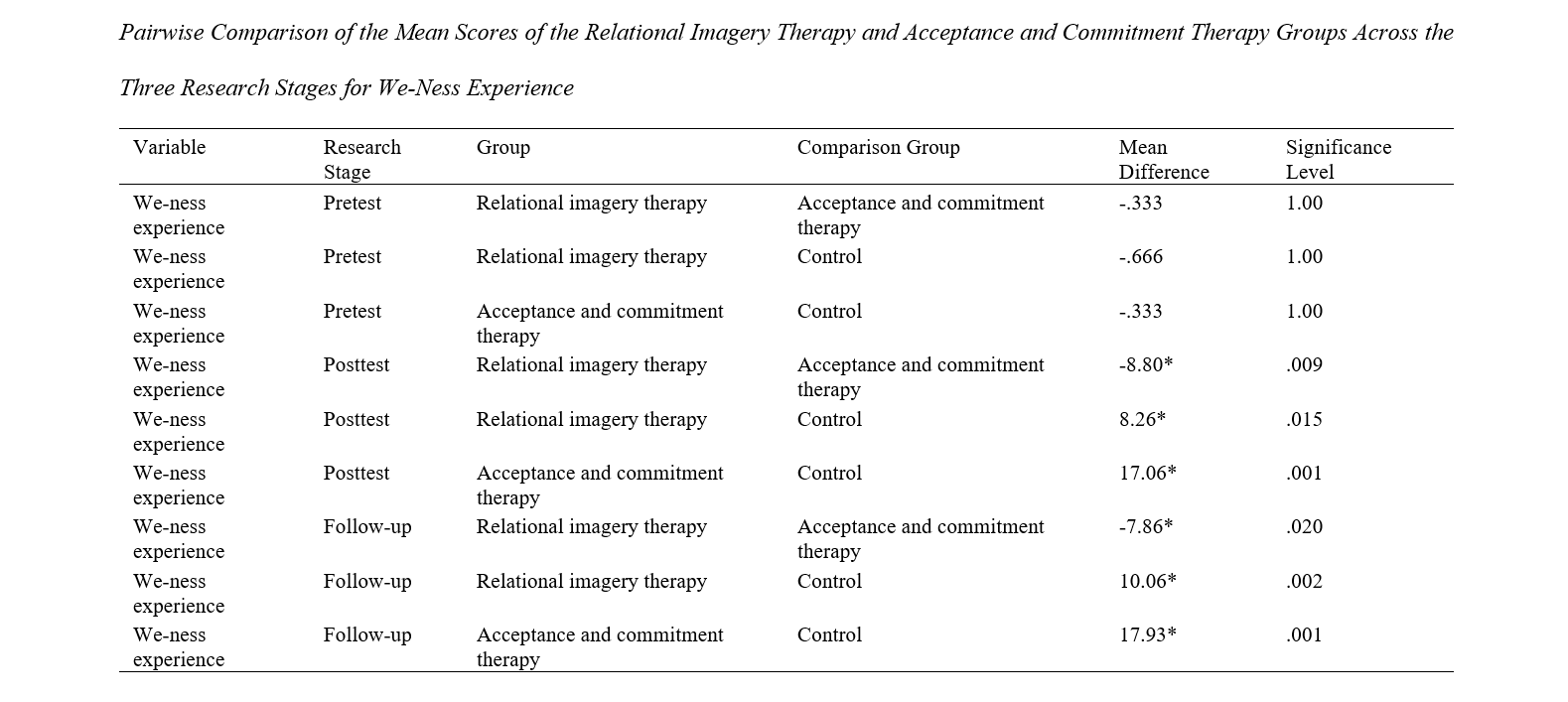
The aim of the present study was to examine the effectiveness of relational imagery therapy and acceptance and commitment therapy on we-ness experience in women exposed to marital infidelity. This study was conducted using a quasi-experimental method with a three-stage pretest, posttest, and three-month follow-up design, including a control group. The statistical population included all women aged 25 to 45 years who referred to Sina Counseling Center in Nowshahr and had experienced marital infidelity. Among them, 45 participants were selected purposively based on the inclusion criteria and were then randomly assigned to three groups of 15 participants each: relational imagery therapy, acceptance and commitment therapy, and control group. The data collection instrument was the We-Ness in Couple Relationships Questionnaire (Cruz et al., 2023). Each experimental group received its respective intervention in eight 90-minute sessions, held twice a week. The posttest was administered immediately after the intervention, and the follow-up phase was conducted three months later. The data were analyzed using multivariate mixed analysis of variance. The results showed that relational imagery therapy was more effective than acceptance and commitment therapy in enhancing we-ness experience (p < .05). These findings, while explaining the importance of relational imagery-based therapeutic interventions in improving the emotional and functional indicators of women harmed by marital infidelity, emphasize the necessity of applying this approach in couple counseling services.
Downloads
References
Ashouri, H. (2022). The effectiveness of reality-oriented acceptance and commitment therapy on emotion regulation and happiness of couples. Psychological Dynamics in Mood Disorders, 1(1), 12-23.
Azandariani, M., Khoei Nejad, G., & Akbari Amraghan, H. (2022). Comparing the effectiveness of emotion-focused therapy and acceptance and commitment therapy on emotional self-regulation and psychological well-being of couples. Applied Family Therapy, 3(1), 223-242.
Barimani, P. (2024). Effectiveness of transdiagnostic child therapy combined with maternal acceptance and commitment intervention on anxiety and depression in anxious children and obsessive thoughts related to COVID-19 in mothers with corona anxiety. Jarac, 6(2), 44-55.
Beheshtinejad, S., Khayatan, F., & Manshaei, G. R. (2022). A comparison between the effectiveness of mindfulness and Imagotherapy on intimacy and commitment among couples having spouses with attention deficit hyperactivity disorder.
Ben-Ari, K. (2022). Healing through the screen: Using Imago relationship therapy online. In Advances in Online Therapy (pp. 240-248). Routledge.
Cao, J., Sun, P., Zhang, L., Chen, X., Gui, W., Ou, A., & Ma, L. (2022). Effects of acceptance and commitment therapy on self-management skills and psychological resilience of young and middle-aged patients underwent percutaneous transluminal coronary intervention for primary myocardial infarction: A pilot study. Trials, 23(1).
Darbani, F., & Lotfi Kashani, F. (2020). The effectiveness of short-term strategic family therapy on marital conflicts. Applied Family Therapy, 1(1), 54-68.
Ehsanifard, G., Sadeghi, M., & Panaghi, L. (2021). The role of parental bonding perception in predicting communication patterns of couples. Journal of Research and Health, 11(1), 21-28.
El-Ashry, A. (2024). Resilience in the face of pandemic: Exploring the influence of psychological flexibility on turnover intentions and burnout among critical care nurses in COVID-19 hospitals. BMC Nursing, 23(1).
Ghaffari, A., Zomorodi, S., & Ghodrati, S. (2025). The Effectiveness of Imago Therapy on Love Styles and Communication Problems in Married Women. Preventive Counseling, 6(1).
Gloster, A. T., Walder, N., Levin, M. E., Twohig, M. P., & Karekla, M. (2020). The empirical status of acceptance and commitment therapy: A review of meta-analyses. Journal of Contextual Behavioral Science, 18, 181-192.
Guven, N., & Iskender, M. (2023). An application of the Imago relationship approach and group counselling for developing the marriage relationship. Bayburt Eğitim Fakültesi Dergisi, 18(39), 1047-1069.
Han, A., & Kim, T. H. (2022). Efficacy of internet-based acceptance and commitment therapy for depressive symptoms, anxiety, stress, psychological distress, and quality of life: Systematic review and meta-analysis. Journal of medical Internet research, 24(12), e39727.
Hazratzadeh, M., Alizadeh Mousavi, E., & Mirzaei, S. H. (2023). Comparing the effectiveness of relationship imagery therapy and object relations therapy on sense of coherence and self-regulation in women with repeated divorces in Tehran. Quarterly Journal of Health Promotion Management.
Heinonen, P., & Tainio, L. (2022). Intercorporeal construction of we-ness in classroom interaction. Human Studies, 46(4), 655-678.
Jafari Nasab, R., Saffarian Toosi, M., Naseri, N. S., & Akbari Amraghan, H. (2021). The effectiveness of Imago-based couple therapy on improving marital distress and quality of life among women affected by marital infidelity. Applied Family Therapy, 2(4), 519-533.
Jalili, M., Saadi, Z. E., Pasha, R., Asgari, P., & Hafezi, F. (2022). Comparing the effectiveness of Imago therapy and transactional analysis in improving communication skills, conflict resolution, and rejection sensitivity of couples referred to Masjed Soleiman counseling centers. Journal of counseling research.
Jangi Roudi, S., Heidarnia, A., & Abbasi, H. (2024). The effectiveness of acceptance and commitment therapy matrix training on communication patterns of married women with avoidant and anxious attachment styles. Quarterly Journal of Applied Psychological Research, 15(2), 77-94.
Karami, M., Karami, J., & Akbari, M. (2025). The Effectiveness of Imago Therapy-Based Couples Therapy on Increasing Marital Forgiveness and Quality of Marital Relationship Among Discordant Couples Visiting Counseling Centers. First National Conference on Developments and New Challenges in Regarding Family, Married Life, and Education, Bandar Abbas.
Keyhan, F., Ghanifar, M. H., & Ahi, G. (2022). Comparing the effectiveness of emotionally focused couple therapy and acceptance and commitment couple therapy on spiritual indicators (patience and forgiveness) in couples affected by extramarital relationships. Applied Family Therapy, 3(3), 20-34.
Khalaj Asadi, S., Fattahi Andabil, A., & Rezakhani, S. (2024). Comparing the effectiveness of meta-emotion-based therapy, narrative therapy, and Imago therapy on marital boredom among conflicted married women. Rooyesh-e-Ravanshenasi, 13(2), 89-100.
Khansari, Z., Toozandehjani, H., & Zendedel, A. (2022). The effectiveness of skills training based on the attachment model on hostile attribution and meta-anger in women seeking divorce. Rooyesh-e-Ravanshenasi, 11(12), 119-130.
Lonergan, M., Brunet, A., Rivest-Beauregard, M., & Groleau, D. (2021). Is romantic partner betrayal a form of traumatic experience? A qualitative study. Stress and Health, 37(1), 19-31.
Luquet, W., & Muro, L. (2018). Imago relationship therapy alignment with marriage and family common factors. The Family Journal, 26(4), 405-410.
Mahmoudi, Z. (2024). Examining the moderating role of marital commitment in the relationship between perceived self-sacrifice and marital satisfaction among married individuals in Ahvaz Shahid Chamran University of Ahvaz, Faculty of Education and Psychology].
Mam Salehi, H., Moradi, O., Arefi, M., & Yarahmadi, Y. (2020). The mediating role of communication patterns in the relationship between differentiation of self and sexual satisfaction of couples. Iranian Journal of Psychiatry and Clinical Psychology, 26(2), 154-169.
Mansourian, J., Khalatbari, J., Tarkhan, M., Ghorban Shiroudi, S., & Zarbakhsh, M. (2018). Comparing the effectiveness of Imago therapy and emotionally focused couple therapy on psychological well-being of incompatible couples involved in infidelity. Journal of Mashhad University of Medical Sciences, 61(6.1), 182-192.
Nadaf, H., Toozandehjani, H., & Bagherzadeh Golmakan, Z. (2021). The effectiveness of Imago therapy-based training on anxiety sensitivity, intolerance of uncertainty, mental health, and physical health indicators in couples on the verge of divorce. Disability Studies, 11(1).
Najjar Asl, S., Asgari, P., Naderi, F., & Esmailkhani, F. (2020). Comparing the effectiveness of positivity training and relationship imagery therapy on relationship attributions, attitudes toward extramarital relationships, and differentiation of self among clients of psychological centers. Positive Psychology Research, 6(4), 63-80.
Najjar Khodabakhsh, S. H., Torkan, S., & Golparvar, M. (2025). Comparing the effectiveness of imago relationship therapy (IR) and narrative therapy on spouse selection regret, marital disenchantment, and resilience in women affected by domestic violence. Psychological Dynamics in Mood Disorders, 3(4), 82-96. https://doi.org/10.61838/kman.pdmd.3.4.6
Pule, N., & Gibney, J. (2023). South African student leaders' role experience through social dream drawing: A driver of compassion. Frontiers in psychology, 14.
Rahimi Kelishadi, H. (2024). The effectiveness of Imago therapy-based couple therapy on positive emotion toward spouse, alexithymia, and marital burnout in couples with experience of marital infidelity in Isfahan Islamic Azad University, Khomeini Shahr Branch].
Rahimipour, A. (2024). The effectiveness of couple relationship enrichment training on marital commitment and marital attachment among married teachers in Pakdasht County Adiban Institute of Higher Education].
Rauwenhoff, J. C., Bol, Y., van Heugten, C. M., Batink, T., Geusgens, C. A., van den Hout, A. J., & Peeters, F. (2023). Acceptance and commitment therapy for people with acquired brain injury: Rationale and description of the BrainACT treatment. Clinical Rehabilitation, 37(8), 1011-1025.
Reardon, K. W., Lawrence, E., & Mazurek, C. (2020). Adapting acceptance and commitment therapy to target intimate partner violence. Partner Abuse, 11(4).
Salarifar, M., Dasht Bozorgi, Z., & Jadidi, M. (2022). Comparing the effectiveness of Imago therapy psychoeducation and acceptance and commitment therapy on improving communication patterns of couples seeking divorce. Rooyesh-e-Ravanshenasi, 11(8), 79-90.
Spidel, A., Lecomte, T., Kealy, D., & Daigneault, I. (2018). Acceptance and commitment therapy for psychosis and trauma: Improvement in psychiatric symptoms, emotion regulation, and treatment compliance following a brief group intervention. Psychology and Psychotherapy: Theory, Research and Practice, 91(2), 248-261.
Vlaicu, C. (2018). Imago therapy and Orthodox therapy on couples and marriage. International Multidisciplinary Scientific Conference on the Dialogue between Sciences & Arts, Religion & Education,
Walser, R. D., & O'Connell, M. (2021). Acceptance and commitment therapy and the therapeutic relationship: Rupture and repair. Journal of Clinical Psychology, 77(2), 429-440.
Downloads
Additional Files
Publication Timeline
- Submitted
- Revised
- Accepted