Comparing the Effectiveness of Emotion-Focused Cognitive Therapy and Acceptance and Commitment Therapy on Interpersonal Forgiveness in Women Affected by Marital Infidelity
Keywords:
Emotion-Focused Cognitive Therapy, Acceptance and Commitment Therapy, Interpersonal Forgiveness, Marital Infidelity, WomenAbstract
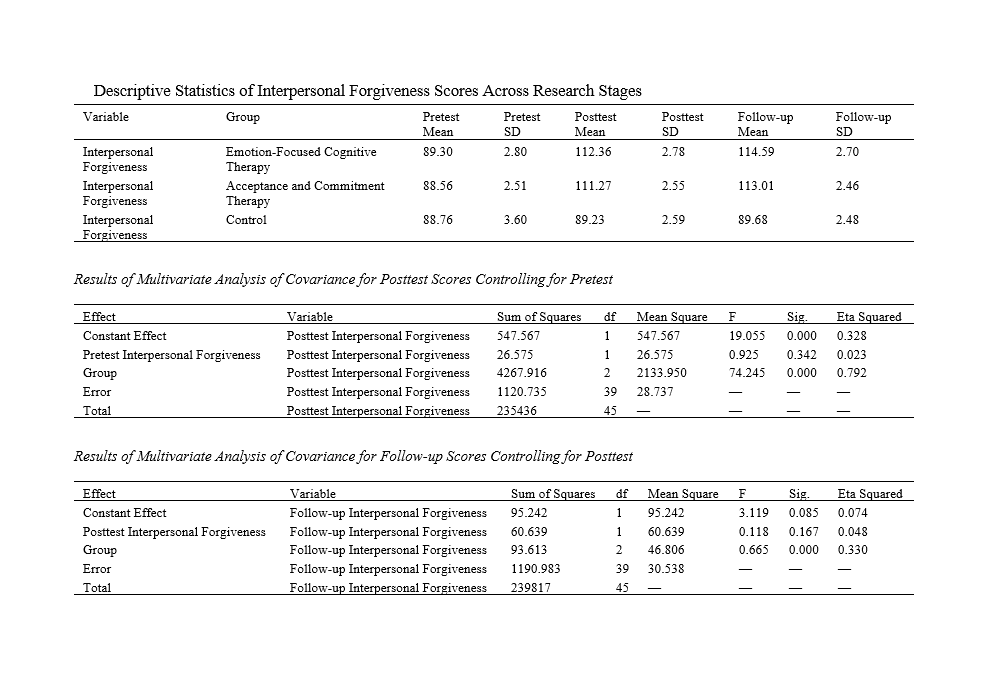
The present study aimed to compare the effectiveness of emotion-focused cognitive therapy and acceptance and commitment therapy on interpersonal forgiveness in women affected by marital infidelity. This applied semi-experimental study employed a pretest–posttest design with a three-month follow-up and a control group. The statistical population consisted of all women affected by marital infidelity who referred to specialized family counseling centers in Chalous, Iran, during 2025. Forty-five participants were selected through purposive sampling and randomly assigned into three groups: emotion-focused cognitive therapy (n=15), acceptance and commitment therapy (n=15), and control group (n=15). The first experimental group received ten 90-minute sessions of emotion-focused cognitive therapy based on Power’s protocol, while the second experimental group participated in ten 90-minute sessions of acceptance and commitment therapy based on the McKay and Lev protocol. The control group received no intervention. Data were collected using the Family Forgiveness Scale developed by Pollard et al. (1998). Inferential statistics included multivariate analysis of covariance and repeated-measures analysis of variance using SPSS-22 software. The findings demonstrated that both emotion-focused cognitive therapy and acceptance and commitment therapy significantly increased interpersonal forgiveness in comparison with the control group (p<0.01). The results of multivariate covariance analysis indicated a significant group effect on posttest interpersonal forgiveness scores with a large effect size. Bonferroni post hoc comparisons revealed that the mean scores of interpersonal forgiveness in both intervention groups were significantly higher than those of the control group at posttest and follow-up stages. Furthermore, emotion-focused cognitive therapy showed greater effectiveness than acceptance and commitment therapy in improving interpersonal forgiveness among women affected by marital infidelity. The stability of treatment effects during the follow-up stage confirmed the persistence of therapeutic outcomes over time. The results suggest that both emotion-focused cognitive therapy and acceptance and commitment therapy are effective interventions for improving interpersonal forgiveness in women affected by marital infidelity. However, emotion-focused cognitive therapy demonstrated superior effectiveness, likely due to its deeper emphasis on emotional processing, emotional awareness, and restructuring maladaptive emotional experiences. Therefore, therapists and family counselors may benefit from incorporating these approaches, particularly emotion-focused cognitive therapy, into psychological interventions designed for women experiencing emotional distress following marital infidelity.
Downloads
References
Arch, J. J., Fishbein, J. N., Finkelstein, L. B., & Luoma, J. B. (2023). Acceptance and Commitment Therapy Processes and Mediation: Challenges and How to Address Them. Behavior therapy, 54(6), 971-988.
Asgari, A., Azizi Ziabar, L. S., Asadi, J., & Hosseinai, A. (2023). Effectiveness of Acceptance and Commitment Therapy on Cognitive Emotion Regulation and Marital Forgiveness in Women Affected by Marital Infidelity. Rooyesh-e-Ravanshenasi Journal, 12(3).
Babapour, S., Shafiabadi, A., Shamir, A. S., & Andbil, A. F. (2023). The Effectiveness of Emotion-Oriented Therapy on the Treatment of Patients with Borderline Personality Disorder. Journal of Adolescent and Youth Psychological Studies, 4(9), 117-127.
Bozoyan, C., & Schmiedeberg, C. (2023). What Is Infidelity? A Vignette Study on Norms and Attitudes Toward Infidelity. The Journal of Sex Research, 60(8), 1090-1099.
Byrne, G., Ghrada, A. N., O'Mahony, T., & Brennan, E. (2021). A Systematic Review of the Use of Acceptance and Commitment Therapy in Supporting Parents. Psychology and Psychotherapy: Theory, Research and Practice, 94, 378-407.
Enez, O. (2021). An Overview of Emotion-Focused Therapy. Current Research and Reviews in Psychology and Psychiatry, 1(1), 77-95.
Ertazai, B., Nisi, A., Hamid, N., & Davoodi, I. (2022). Effectiveness of Emotion-Focused Therapy on Mental Pain, Experiential Avoidance, and Forgiveness in Depressed Women with the Experience of Romantic Failure. Shenakht Journal of Psychology and Psychiatry, 9(6), 64-77.
Fincham, F. D., & May, R. W. (2023). Divine Forgiveness and Interpersonal Forgiveness: Which Comes First? Psychology of Religion and Spirituality, 15(2), 167.
Gholizadeh, F., Fadaei, M., Soleimani, N., & Kharoushi, M. (2019). Effectiveness of Acceptance and Commitment Therapy on Interpersonal Forgiveness and Marital Intimacy in Women Affected by Marital Infidelity. Journal of Mashhad University of Medical Sciences, 62, 1825-1833.
Hidayat, F. N. N., & Nashori, F. (2025). The Role of Forgiveness in Moderating Self-Acceptance and Self-Control Among Adolescents of Divorced Parents. International Journal of Islamic Educational Psychology, 6(1), 51-75. https://doi.org/10.18196/ijiep.v6i1.25717
Hoseininik, S., & EslamZadeh, A. (2019). The Effectiveness of Cognitive Behavioral Group Training on Improving Post-Traumatic Symptoms, Quality of Life, Self-Esteem and Marital Satisfaction in Women Treated with Marital Infidelity. Journal of Women Research, 10(27), 53-71.
Imani Rad, A., Golmohammadian, M., Moradi, O., & Goodarzi, M. (2021). Effectiveness of Emotion-Focused Couple Therapy on Forgiveness and Relationship Beliefs in Couples Involved in Marital Infidelity. Journal of Psychological Sciences, 20(100), 653-665.
KazemianMoghadam, K., MehrabiZadeh, M., Kiyamanesh, A., & Hoseinian, S. (2018). The Causal Relationship of Differentiation, Meaning of Life, and Forgiveness with Marital Dissatisfaction Through Mediating Marital Conflict and Marital Satisfaction. Psychological Methods and Models Quarterly, 9(31), 131-146.
Khayatan, F., Hadian, S., & Golparvar, M. (2025). A Comparison of the Effectiveness of Emotion-Focused Schema Therapy, Compassion-Focused Forgiveness Therapy, and Cognitive-Behavioral Therapy on Emotional Capital and Its Dimensions in Women Victims of Domestic Violence. Yazd Health Dawn, 23(6), 92-108. https://tbj.ssu.ac.ir/browse.php?a_id=3704&sid=1&slc_lang=en&html=1
Kleiven, T. (2023). Power to Forgive: Interpersonal Forgiveness from an Analytical Perspective on Power. International Journal for Philosophy of Religion, 93(2), 147-162.
Klimczak, K. S., San Miguel, G. G., Mukasa, M. N., Twohig, M. P., & Levin, M. E. (2023). A Systematic Review and Meta-Analysis of Self-Guided Online Acceptance and Commitment Therapy as a Transdiagnostic Self-Help Intervention. Cognitive behaviour therapy, 52(3), 269-294.
Lai, L., Liu, Y., McCracken, L. M., Li, Y., & Ren, Z. (2023). The Efficacy of Acceptance and Commitment Therapy for Chronic Pain: A Three-Level Meta-Analysis and a Trial Sequential Analysis of Randomized Controlled Trials. Behaviour Research and Therapy, 165, 104308.
Marren, C., Mikoska, P., O'Brien, S., & Timulak, L. (2022). A Qualitative Meta-Analysis of the Clients' Experiences of Emotion-Focused Therapy. Clinical Psychology & Psychotherapy, 29(5), 1611-1625.
Motakeffar, M., Bakhshi Pour, A., & Ghasemi Motlagh, M. (2022). Comparison of the Effectiveness of Mindfulness-Based Cognitive Therapy and Emotion-Oriented Therapy on Psychological Cohesion in Patients with Type 2 Diabetes. Journal of Sabzevar University of Medical Sciences, 29(4), 563-575.
Mróz, J., & Bernacka, R. E. (2025). Self-Control and Forgiveness. The Mediating Role of Interpersonal Emotion Regulation. Psychiatria I Psychologia Kliniczna, 25(1), 12-17. https://doi.org/10.15557/pipk.2025.0002
Najibzadegan, A., Bahrainian, S. A., & Shahabizadeh, F. (2024). Efficacy of Acceptance and Commitment Therapy on Intimacy, Marital Forgiveness, and Marital Burnout in Women Affected by Extramarital Relationships. Aftj, 5(3), 102-112. https://doi.org/10.61838/kman.aftj.5.3.11
O'Connell Kent, J. A., Jackson, A., Robinson, M., Rashleigh, C., & Timulak, L. (2021). Emotion-Focused Therapy for Symptoms of Generalised Anxiety in a Student Population: An Exploratory Study. Counselling and Psychotherapy Research, 21(2), 260-268.
Olamijuwon, E., Odimegwu, C., & Chemhaka, G. (2021). Involuntary Childlessness and Marital Infidelity Among Women in Sub-Saharan African Countries: An Assessment of the Moderating Role of Women's Education. Archives of Sexual Behavior, 50(2), 601-614.
Potts, S., Krafft, J., & Levin, M. E. (2022). A Pilot Randomized Controlled Trial of Acceptance and Commitment Therapy Guided Self-Help for Overweight and Obese Adults High in Weight Self-Stigma. Behavior Modification, 46(1), 178-201.
Rokach, A., & Chan, S. H. (2023). Love and Infidelity: Causes and Consequences. International journal of environmental research and public health, 20(5), 3904.
Şahan, M., & Ceyhan, E. (2025). The Mediating Role of Forgiveness in the Relationship Between Emotion Regulation Difficulty and Relational Aggression in High School Students. Anadolu Üniversitesi Eğitim Fakültesi Dergisi, 9(2), 101-115. https://doi.org/10.34056/aujef.1487559
Shokri, M., Rahmani, M. A., & Abolghasemi, S. (2022). The Effect of Emotion-Oriented Couple Therapy on Forgiveness, Emotional Self-Regulation and Marital Boredom of Couples Seeking Divorce Referring to Family Social Emergencies. Islamic Life Journal, 6(1), 0-0.
Skalski‐Bednarz, S., Toussaint, L., & Konaszewski, K. (2025). Situational characteristics and emotional forgiveness: a two‐wave study with socially maladjusted youths in poland. Psychology in the Schools, 62(7), 2083-2095. https://doi.org/10.1002/pits.23452
Taghikhani, S., Nateghian, A., & Karsazi, H. (2024). Relations among memories of parental acceptance-rejection, psychological (mal)adjustment, forgiveness, and vengeance among Iranian adults. Journal of Genetic Psychology, 185(2), 125-141. https://doi.org/10.1080/00221325.2024.2303594
Timulak, L., Keogh, D., Chigwedere, C., Wilson, C., Ward, F., Hevey, D., & Mahon, S. (2022). A Comparison of Emotion-Focused Therapy and Cognitive-Behavioral Therapy in the Treatment of Generalized Anxiety Disorder: Results of a Feasibility Randomized Controlled Trial. Psychotherapy, 59(1), 84.
Yaghoobian, A., Mirza Hosseini, H., & Zargham Hajebi, M. (2021). Comparison of the Effectiveness of Emotion-Oriented Cognitive-Behavioral Skills Training and Test Techniques on Students' Educational Buoyancy in Students with Special Learning Disabilities. Journal of Learning Disabilities, 11(1), 91-108.
Zamiri, A., & Zamani, S. (2020). The Effectiveness of Emotion-Oriented Cognitive Therapy on Quality of Life and Social Adjustment in Mothers with Mentally Retarded Children. Health, 3, 11-20.
Zhang, Z., Leong Bin Abdullah, M. F. I., Shari, N. I., & Lu, P. (2022). Acceptance and Commitment Therapy Versus Mindfulness-Based Stress Reduction for Newly Diagnosed Head and Neck Cancer Patients: A Randomized Controlled Trial Assessing Efficacy for Positive Psychology, Depression, Anxiety, and Quality of Life. PLoS One, 17(5), e0267887.
Downloads
Additional Files
Publication Timeline
- Submitted
- Revised
- Accepted