Comparing the Effectiveness of Communication Skills Training and Emotion Regulation Training on Psychological Well-Being and Loneliness among Adolescents with Internet Addiction
Keywords:
Communication Skills Training, Emotion Regulation Training, Psychological Well-Being, Loneliness, Internet Addiction, AdolescentsAbstract
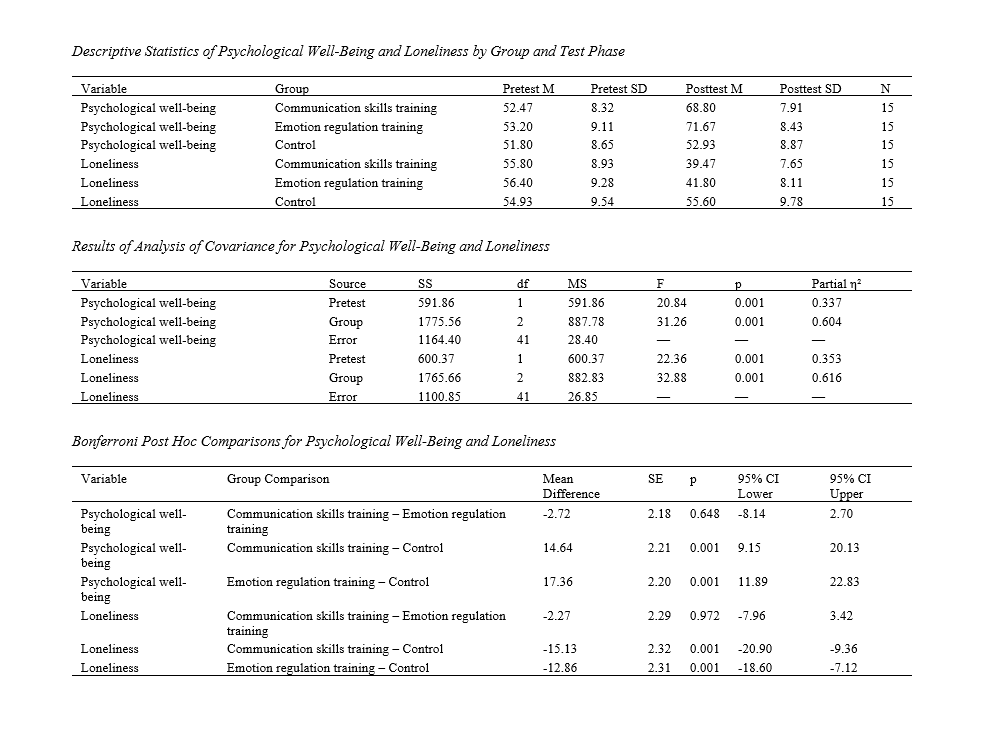
The present study aimed to compare the effectiveness of communication skills training and emotion regulation training on psychological well-being and loneliness among adolescents with internet addiction. This applied study was conducted using a quasi-experimental pretest–posttest design with two experimental groups and one control group. The statistical population consisted of female adolescents aged 15–18 years with internet addiction studying in upper secondary schools during the 2024–2025 academic year. After initial screening using Young’s Internet Addiction Test, 45 eligible students were selected and randomly assigned into three equal groups (n = 15): communication skills training, emotion regulation training, and control. The first experimental group participated in eight sessions of communication skills training, and the second experimental group received eight sessions of emotion regulation training, while the control group received no intervention. Data were collected using Ryff’s Psychological Well-Being Scale and the UCLA Loneliness Scale. Data analysis was performed using descriptive statistics, analysis of covariance (ANCOVA), and Bonferroni post hoc test in SPSS software. The results of analysis of covariance showed a significant difference among the three groups in psychological well-being after controlling for pretest scores (F = 31.26, p = 0.001, η² = 0.604). Both communication skills training and emotion regulation training significantly increased psychological well-being compared with the control group. Moreover, a significant group effect was found for loneliness (F = 32.88, p = 0.001, η² = 0.616), indicating that both interventions significantly reduced loneliness among adolescents with internet addiction. The Bonferroni post hoc test revealed no significant difference between communication skills training and emotion regulation training in improving psychological well-being or reducing loneliness (p > 0.05). The findings indicated that both communication skills training and emotion regulation training are effective psychological interventions for enhancing psychological well-being and reducing loneliness among adolescents with internet addiction.
Downloads
References
Alkal, A. (2025). The Role of Psychological Flexibility and Emotion Regulation in the Relationship Between Smartphone Addiction and Psychological Wellbeing in Adolescents: Three-Wave Longitudinal Serial Mediation Study. https://doi.org/10.21203/rs.3.rs-6530346/v1
Aslan, İ., & Polat, H. (2024). Investigating Social Media Addiction and Impact of Social Media Addiction, Loneliness, Depression, Life Satisfaction and Problem-Solving Skills on Academic Self-Efficacy and Academic Success Among University Students. Frontiers in Public Health, 12. https://doi.org/10.3389/fpubh.2024.1359691
Bakhtyari, M. B., & Mathur, K. (2023). Social Network Addiction and Perceived Loneliness in Relation With Gender and Country Among Adolescents in India and Afghanistan. Hong Kong Journal of Social Sciences(61). https://doi.org/10.55463/hkjss.issn.1021-3619.61.71
Bottaro, R., & Faraci, P. (2022). The Use of Social Networking Sites and Its Impact on Adolescents’ Emotional Well-Being: A Scoping Review. Current Addiction Reports, 9(4), 518-539. https://doi.org/10.1007/s40429-022-00445-4
Ciacchini, R., Orrù, G., Cucurnia, E., Sabbatini, S., Scafuto, F., Lazzarelli, A., Miccoli, M., Gemignani, A., & Conversano, C. (2023). Social Media in Adolescents: A Retrospective Correlational Study on Addiction. Children, 10(2), 278. https://doi.org/10.3390/children10020278
Coco, L., Balla, J., Noto, L., Perciavalle, V., Buscemi, A., Corrado, D. D., & Coco, M. (2025). The Brain in the Age of Smartphones and the Internet: The Possible Protective Role of Sport. Brain Sciences, 15(7), 733. https://doi.org/10.3390/brainsci15070733
Dong, R., Yuan, D., Xue, W., Cai, J., Ai, Z., & Zhou, S. (2025). Exploring the Relationship Between Social Media Dependence and Internet Addiction Among College Students From a Bibliometric Perspective. Frontiers in psychology, 16. https://doi.org/10.3389/fpsyg.2025.1463671
Falcón-Linares, C., González-Yubero, S., Mauri-Medrano, M., & Moreno, M. J. C. (2023). Impact of Social Media on Adolescence: Mapping Emerging Needs to Build Resilient Skills. Societies, 13(11), 238. https://doi.org/10.3390/soc13110238
G., M., & R., D. R. (2024). Exploring the Relationship Between Attachment Styles and Loneliness Levels in Young Adults. International Journal for Multidisciplinary Research, 6(3). https://doi.org/10.36948/ijfmr.2024.v06i03.19869
Hall, J. A. (2024). Ten Myths About the Effect of Social Media Use on Well-Being. Journal of medical Internet research, 26, e59585. https://doi.org/10.2196/59585
He, S., & Chen, I. H. (2024). Internet Addiction Among Teachers: A Systematic Review. Environment and Social Psychology, 9(6). https://doi.org/10.54517/esp.v9i6.2513
Hu, Y., Pei, M., Wang, D.-Y., Wu, X., & Wang, D. (2025). Activating Perceived Social Support Combined With Diluting Loneliness: Effects of the Personal Resources Energized Intervention Program (PREIP) on Problematic Smartphone Use Among Adolescents. Journal of Behavioral Addictions, 14(2), 914-928. https://doi.org/10.1556/2006.2025.00016
Invited Symposium. (2024). International journal of psychology, 59(S1), 18-36. https://doi.org/10.1002/ijop.13167
Jiang, L., & Yoo, Y. T. (2024). Adolescents’ Short-Form Video Addiction and Sleep Quality: The Mediating Role of Social Anxiety. BMC psychology, 12(1). https://doi.org/10.1186/s40359-024-01865-9
Lafton, T., Holmarsdottir, H. B., Kapella, O., Sisask, M., & Zinoveva, L. V. (2022). Children’s Vulnerability to Digital Technology Within the Family: A Scoping Review. Societies, 13(1), 11. https://doi.org/10.3390/soc13010011
Lesinskienė, S., Šambaras, R., Butvilaitė, A., Andruškevič, J., Kubilevičiūtė, M., Stanelytė, U., Skabeikaitė, S., Jūraitytė, I., Ridzvanavičiūtė, I., Pociūtė, K., & Istomina, N. (2024). Lifestyle Habits Related to Internet Use in Adolescents: Relationships Between Wellness, Happiness, and Mental Health. Children, 11(6), 726. https://doi.org/10.3390/children11060726
Lestari, T. (2024). Internet Addiction Leads to Loneliness or Loneliness Leads to Internet Addiction? Jurnal Psikiatri Surabaya, 13(S1), 87-94. https://doi.org/10.20473/jps.v13is1.62661
Liang, S., Che, X., Wang, H., 卡吾力, 阿. 娜. b., Ma, N., & Shui, Y. (2025). Relationship Between Soccer Physical Activity Enjoyment and Internet Addiction Among Adolescents: The Chain Mediating Effect of Emotional Self-Efficacy and Athlete Participation. Frontiers in psychology, 16. https://doi.org/10.3389/fpsyg.2025.1557282
Lu, Y., Chang, H., Meng, X., Li, Y., Liu, J., Yuan, W., Ni, J., Li, C., Li, L., Liu, L., Niu, Z., Zhong, H., Mei, S., Griffiths, M. D., Yang, T., He, Y., He, C., Yang, Y., Wu, L., . . . Rahardjo, W. (2024). Addictive Behaviors Among Youth and Adolescents in the Digital Age. https://doi.org/10.3389/978-2-8325-4853-0
Marciano, L., Ostroumova, M., Schulz, P. J., & Camerini, A.-L. (2022). Digital Media Use and Adolescents' Mental Health During the Covid-19 Pandemic: A Systematic Review and Meta-Analysis. Frontiers in Public Health, 9. https://doi.org/10.3389/fpubh.2021.793868
Mohammed, A. R. (2023). Lonileness, Internet Addiction, and Mental Health Among Adolescents: A Mediation Model. Psycho-Educational Research Reviews, 12(3). https://doi.org/10.52963/perr_biruni_v12.n3.01
Mu, H.-L., Jiang, Q., Xu, J., & Chen, S. (2022). Drivers and Consequences of Short-Form Video (SFV) Addiction Amongst Adolescents in China: Stress-Coping Theory Perspective. International journal of environmental research and public health, 19(21), 14173. https://doi.org/10.3390/ijerph192114173
Nahar, R. N., & Kakulte, A. (2022). Relationship Between Alexithymia, Difficulties in Emotion Regulation, Mental Health and Internet Addiction in Young Adults. Mind and Society, 11(02), 50-58. https://doi.org/10.56011/mind-mri-112-20225
Nibal, S. (2023). Loneliness as a Predictor of Internet Addiction Among Adolescentes From Arab Society in Israel. Edmetic, 12(2), 2. https://doi.org/10.21071/edmetic.v12i2.15872
Nurmaria, H., & Risnawati, E. (2022). The Relationship of Loneliness and Internet Addiction to Psychological Well-Being in Adolescents. Biopsikososial Jurnal Ilmiah Psikologi Fakultas Psikologi Universitas Mercubuana Jakarta, 5(2), 509. https://doi.org/10.22441/biopsikososial.v5i2.14644
Samanta, P., Mohapatra, I., Mitra, R., Mishra, J., Mahapatra, P., Mohakud, N. K., Pattnaik, J. I., Behera, M. R., & Nanda, P. (2024). Mindfulness as a Path to Freedom From Internet Addiction in Adolescents: A Narrative Review. Cureus. https://doi.org/10.7759/cureus.72544
Wang, J., & Shen, W. (2025). The Emotional Reinforcement Mechanism of and Phased Intervention Strategies for Social Media Addiction. Behavioral Sciences, 15(5), 665. https://doi.org/10.3390/bs15050665
Wei, P.-c. (2024). The Effect of Self-Compassion on Social Media Addiction Among College Students – The Mediating Role of Gratitude: An Observational Study. Medicine, 103(21), e37775. https://doi.org/10.1097/md.0000000000037775
Xiao, X. (2023). The Relationship Between Passive Social Network Site Usage and the Mental Health of Adolescents. Journal of Humanities Arts and Social Science, 7(1), 29-41. https://doi.org/10.26855/jhass.2023.01.004
Zewude, G. T., Natnael, T., Woreta, G. T., & Bezie, A. E. (2025). A Multi- Mediation Analysis on the Impact of Social Media and Internet Addiction on University and High School Students’ Mental Health Through Social Capital and Mindfulness. International journal of environmental research and public health, 22(1), 57. https://doi.org/10.3390/ijerph22010057
Zhang, H., & Yang, Y. (2025). Psychological Education in Higher Education: Opportunities and Challenges in the Internet+ Era. World journal of psychiatry, 15(5). https://doi.org/10.5498/wjp.v15.i5.103274
Zhang, Y., Li, Y., Xia, M., Han, M., Yan, L., & Lian, S.-L. (2023). The Relationship Between Loneliness and Mobile Phone Addiction Among Chinese College Students: The Mediating Role of Anthropomorphism and Moderating Role of Family Support. PLoS One, 18(4), e0285189. https://doi.org/10.1371/journal.pone.0285189
Zhang, Z., Chen, H., Ye, Y., Chen, H., Guo, H., & Zhou, J. (2025). Entropy-Based Risk Network Identification in Adolescent Self-Injurious Behavior Using Machine Learning and Network Analysis. Translational psychiatry, 15(1). https://doi.org/10.1038/s41398-025-03511-3
Downloads
Additional Files
Publication Timeline
- Submitted
- Revised
- Accepted