The Effectiveness of Cognitive Behavioral Therapy (CBT) in Reducing Addiction Severity and Craving and Improving Emotional Regulation in Individuals with Substance Use Disorder: A Quasi-Experimental Study
Keywords:
Cognitive Behavioral Therapy, Addiction Severity, Substance Craving, Emotional Regulation, Substance Use DisorderAbstract
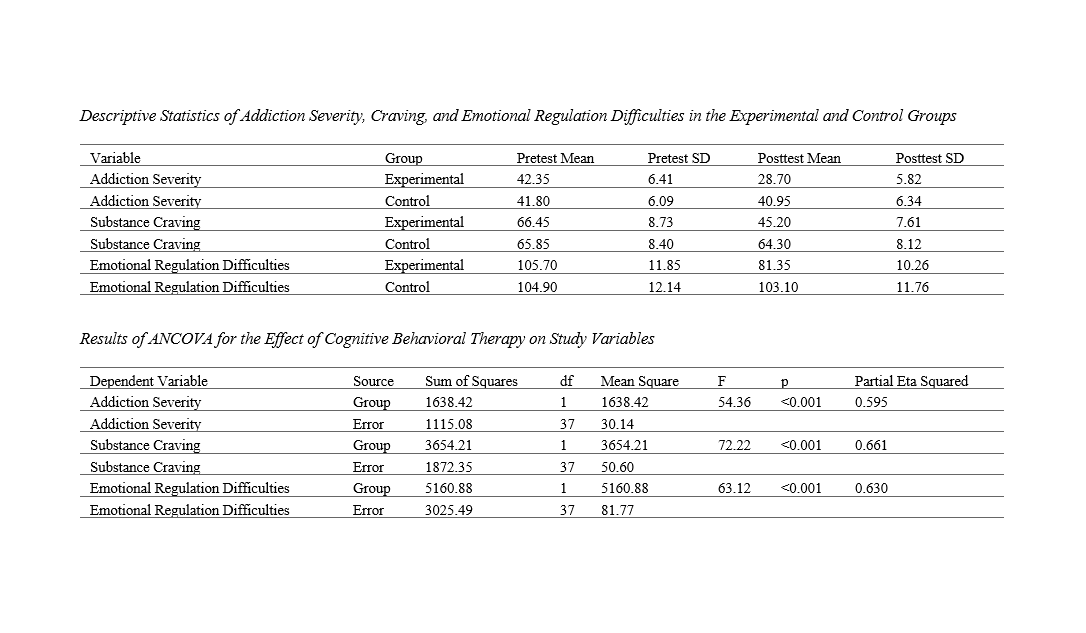
The present study aimed to examine the effectiveness of cognitive behavioral therapy in reducing addiction severity and substance craving and improving emotional regulation among individuals with substance use disorder. This study was conducted using a quasi-experimental design with a pretest–posttest structure and a control group. The statistical population included individuals with substance use disorder who referred to addiction treatment centers in Tehran in 2025. Using convenience sampling, 40 eligible participants were selected and randomly assigned to an experimental group and a control group, with 20 participants in each group. The experimental group received cognitive behavioral therapy in 10 sessions of 90 minutes, while the control group received no psychological intervention during the study period. Data were collected using the Addiction Severity Index, the Substance Craving Questionnaire, and the Difficulties in Emotion Regulation Scale. Data were analyzed using multivariate analysis of covariance. The results of ANCOVA showed that, after controlling for pretest scores, there was a statistically significant difference between the experimental and control groups in addiction severity, F(1, 37) = 54.36, p < 0.001, partial η² = 0.595, substance craving, F(1, 37) = 72.22, p < 0.001, partial η² = 0.661, and emotional regulation difficulties, F(1, 37) = 63.12, p < 0.001, partial η² = 0.630. These findings indicated that CBT significantly reduced addiction severity and substance craving and improved emotional regulation in the experimental group compared with the control group. The findings suggest that cognitive behavioral therapy can be considered an effective psychological intervention for individuals with substance use disorder. By targeting maladaptive thoughts, craving-related beliefs, emotional triggers, and ineffective coping patterns, CBT may help reduce addiction-related problems and strengthen emotional regulation capacity. Therefore, integrating CBT into addiction treatment programs may improve treatment outcomes and support relapse prevention.
Downloads
References
Aldao, A., Gee, D. G., De Los Reyes, A., & Seager, I. (2016). Emotion regulation as a transdiagnostic factor. Current opinion in psychology, 3, 1-6. https://doi.org/10.1016/j.copsyc.2015.09.004
Carroll, K. M., & Kiluk, B. D. (2017). Cognitive behavioral interventions for alcohol and drug use disorders. American Journal of Psychiatry, 174(10), 944-951. https://doi.org/10.1176/appi.ajp.2017.17020239
Chang, Y. C., Rubey, R. L., & Ladd, B. O. (2024). Brief emotion regulation strategies to reduce alcohol craving: Mediating role of state difficulties in emotion regulation. Behaviour Research and Therapy, 177, 104527. https://doi.org/10.1016/j.brat.2024.104527
Fazeli Rad, H., Noury Ghaesm Abadi, R., & Hasani, J. (2024). Craving, distress tolerance, emotion dysregulation, and experiential avoidance among patients in early recovery from opioid use disorder in residential programs. Journal of Substance Use, 29(3), 369-375. https://doi.org/10.1080/14659891.2023.2167743
Gross, J. J. (2015). Emotion regulation: Current status and future prospects. Psychological Inquiry, 26(1), 1-26. https://doi.org/10.1080/1047840X.2014.940781
Hofmann, S. G., Asnaani, A., Vonk, I. J. J., Sawyer, A. T., & Fang, A. (2012). The efficacy of cognitive behavioral therapy: A review of meta-analyses. Cognitive therapy and research, 36(5), 427-440. https://doi.org/10.1007/s10608-012-9476-1
Kiluk, B. D. (2019). Computerized cognitive behavioral therapy for substance use disorders: A summary of the evidence and potential mechanisms of behavior change. Perspectives on Behavior Science, 42(3), 465-478. https://doi.org/10.1007/s40614-019-00205-2
Magill, M., & Ray, L. A. (2009). Cognitive-behavioral treatment with adult alcohol and illicit drug users: A meta-analysis of randomized controlled trials. Journal of Studies on Alcohol and Drugs, 70(4), 516-527. https://doi.org/10.15288/jsad.2009.70.516
Manesh, S. E. (2026). Prediction of High-Risk Behaviors Based on Behavioral Brain Systems and Emotional Neglect with the Mediating Role of Cognitive Emotion Regulation Strategies among Young Adults in Tehran. International Journal of Education and Cognitive Sciences, 7(2), 1-14. https://doi.org/10.61838/kman.ijecs.329
McHugh, R. K., Hearon, B. A., & Otto, M. W. (2010). Cognitive behavioral therapy for substance use disorders. Psychiatric Clinics of North America, 33(3), 511-525. https://doi.org/10.1016/j.psc.2010.04.012
Nedaei, A., Ghamri, H., Sheykholeslami, A., & Sadri, E. (2025). The Effectiveness of "Cognitive-Behavioral Therapy" on the Difficulties of Emotional Regulation, Intolerance of Uncertainty and Thought Fusion in People Suffering From Comorbid Depression and Anxiety. Journal of Health Promotion Management, 13(5), 12-29. https://jhpm.ir/article-1-1588-fa.html
Paulet, T., & Weiner, L. (2025). Imagery-based cognitive therapy to reduce emotional dysregulation and mood instability in bipolar disorder: a case-series study. Behavioural and Cognitive Psychotherapy, 53(1), 1-16. https://doi.org/10.1017/S1352465824000420
Riya, Kumar, N., & Chandel, N. (2024). Enhancing emotion regulation and overcoming craving in alcohol dependence syndrome through mindfulness-based relapse prevention. Indian Journal of Psychological Medicine, 47(5). https://doi.org/10.1177/02537176241246332
Schulze, K., Mueller, I., Holt, D. V., Putz, S., Barnow, S., & Pruessner, L. (2026). Rethinking the Link between Cognitive Control and Emotion Regulation: A Meta-Analytic Review. Neuroscience & Biobehavioral Reviews, 106708. https://doi.org/10.1016/j.neubiorev.2026.106708
Sharei, A., Kasaeei Esfahani, A., & Salmani, A. (2025). The Effect of Mindfulness Therapy on Emotion Regulation, Cognitive Self-Awareness, and Tendency to High-Risk Behaviors in Orphaned and Poorly Monitored Adolescents: A Quasi-Experimental Study. Journal of Rafsanjan University of Medical Sciences, 23(9), 812-827. https://doi.org/10.61186/jrums.23.9.812
Skinner, M. D., & Aubin, H. J. (2010). Craving's place in addiction theory. Addiction, 105(4), 606-613. https://doi.org/10.1111/j.1360-0443.2009.02873.x
Smout, M. F., Longo, M., Harrison, S., Minniti, R., Wickes, W., & White, J. M. (2010). Psychosocial treatment for methamphetamine use disorders: A preliminary randomized controlled trial of cognitive behavior therapy and Acceptance and Commitment Therapy. Substance Abuse, 31(2), 98-107. https://doi.org/10.1080/08897071003641578
Stellern, J., Xiao, K. B., Grennell, E., Sanches, M., Gowin, J. L., & Sloan, M. E. (2023). Emotion regulation in substance use disorders: A systematic review and meta-analysis. Addiction, 118(1), 30-47. https://doi.org/10.1111/add.16001
Tull, M. T., Berghoff, C. R., Wheeless, L. E., Cohen, R. T., & Gratz, K. L. (2018). PTSD symptom severity and emotion regulation strategy use during trauma cue exposure among patients with substance use disorders: Associations with negative affect, craving, and cortisol reactivity. Behaviour Therapy, 49(1), 57-70. https://doi.org/10.1016/j.beth.2017.05.005
Webb, T. L., Miles, E., & Sheeran, P. (2012). Dealing with feeling: A meta-analysis of the effectiveness of strategies derived from the process model of emotion regulation. Psychological bulletin, 138(4), 775-808. https://doi.org/10.1037/a0027600
Wilks, C. R., Yin, Q., Ang, S. Y., Matsumiya, B., & Linehan, M. M. (2019). The therapeutic role of emotion regulation and coping strategies during a stand-alone DBT skills training program for alcohol use disorder and concurrent substance use disorders. Addictive behaviors, 98, 106035. https://doi.org/10.1016/j.addbeh.2019.106035
Zargar, F., Bagheri, N., Tarrahi, M. J., & Salehi, M. (2019). Effectiveness of emotion regulation group therapy on craving, emotion problems, and marital satisfaction in patients with substance use disorders: A randomized clinical trial. Iranian Journal of Psychiatry, 14(4), 283-290. https://doi.org/10.18502/ijps.v14i4.1978
Downloads
Additional Files
Publication Timeline
- Submitted
- Revised
- Accepted