The Effectiveness of Schema Therapy and Mindfulness on Psychological Distress in Patients with Rheumatoid Arthritis
Keywords:
Schema Therapy, Mindfulness, Psychological Distress, Rheumatoid ArthritisAbstract
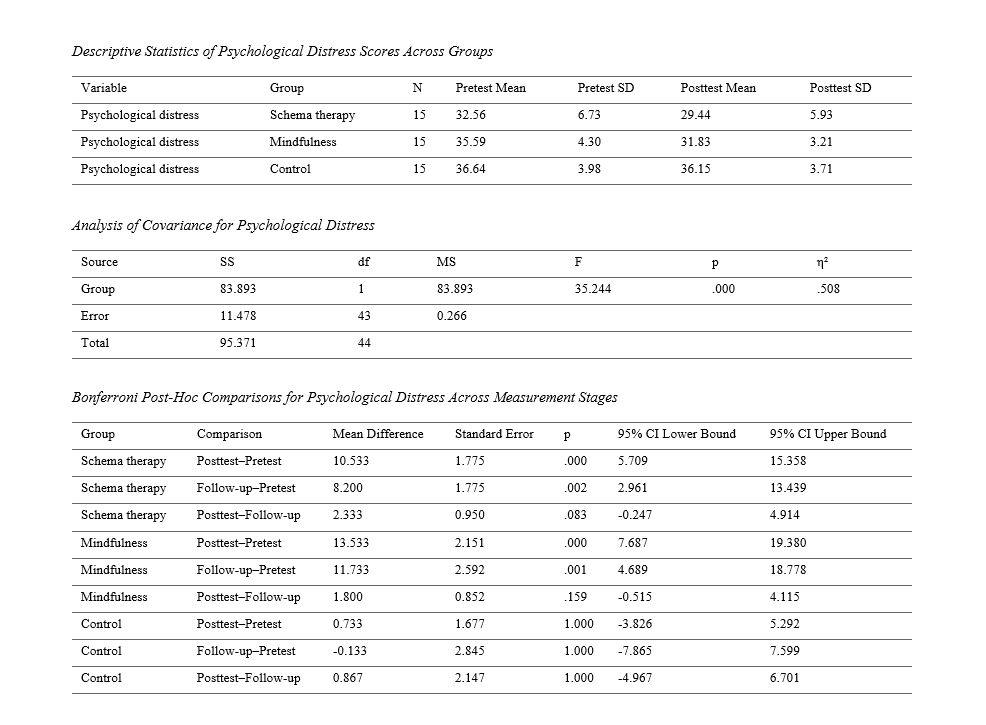
This study aimed to determine the effectiveness of schema therapy and mindfulness on psychological distress in patients with rheumatoid arthritis in Mashhad in 2025. The present study employed a quasi-experimental pretest–posttest design with a control group. A total of 45 patients with rheumatoid arthritis who met the inclusion criteria were selected through purposive sampling and were randomly assigned to the study groups. The Kessler Psychological Distress Scale (2003) was used for assessment. Schema therapy was implemented based on the model of Riso et al. (2008), and group mindfulness was conducted based on the therapeutic program developed by Teasdale, Williams, and Segal (2018). Data were analyzed using inferential statistical indices, including repeated-measures analysis of variance, multivariate analysis of covariance, and one-way analyses of covariance within the MANCOVA framework. The effectiveness of schema therapy and mindfulness on psychological distress in patients with rheumatoid arthritis was sustained (p < .05). However, no difference was observed between schema therapy and mindfulness in terms of their effectiveness. Group schema therapy and mindfulness can be used to reduce psychological distress in patients with rheumatoid arthritis and may partially alleviate the pain and suffering experienced by these patients.
Downloads
References
Akbari, R., & Khalatbari, A. (2025). The Mediating Role of Perceived Social Support and Mindfulness in the Relationship between Psychological Hardiness and Distress Tolerance Among Students. Journal of Adolescent and Youth Psychological Studies, 6(2), 79-89. https://doi.org/10.61838/kman.jayps.6.2.10
Bayat, M., Basharpoor, S., Aghajani, S., & Mikaeili, N. (2025). Comparison of the Effectiveness of Emotional Schema Therapy and Acceptance and Commitment Therapy on Distress Tolerance and Emotion Regulation Difficulties in Individuals with Major Depressive Disorder. Journal of Psychological Science, 24(150), 59-81.
Galvez-Sanchez, C. M., Montoro, C. I., Moreno-Padilla, M., Reyes Del Paso, G. A., & de la Coba, P. (2021). Effectiveness of acceptance and commitment therapy in central pain sensitization syndromes: A systematic review. Journal of clinical medicine, 10(12), 2706. https://doi.org/10.3390/jcm10122706
Hosseini, M., Ahadi, H., Jomehri, F., Kraskian Mojembari, A., & Ahadi, M. (2019). A study of the effectiveness of emotional schema group therapy on pain and depression in patients with rheumatoid arthritis. Scientific Quarterly of Psychological Methods and Models, 10(35), 119-135. https://dorl.net/dor/20.1001.1.22285516.1398.10.35.7.2
Kang, N., Jiang, Y., Ren, Y., Gong, T., Liu, X., Leung, F., & You, J. (2018). Distress intolerance mediates the relationship between child maltreatment and nonsuicidal self-injury among Chinese adolescents: A three-wave longitudinal study. Journal of youth and adolescence, 47(10), 2220-2230. https://doi.org/10.1007/s10964-018-0877-7
Kral, T. R., Davis, K., Korponay, C., Hirshberg, M. J., Hoel, R., Tello, L. Y., & Davidson, R. J. (2022). Absence of structural brain changes from mindfulness-based stress reduction: Two combined randomized controlled trials. Science advances, 8(20), 1-10. https://doi.org/10.1126/sciadv.abk3316
Li, Y., Li, P., Wang, H., & Ma, Y. (2017). How do resource structuring and strategic flexibility interact to shape radical innovation. Journal of Product Innovation Management, 34(4), 471-491. https://doi.org/10.1111/jpim.12389
Morf, H., da Rocha Castelar-Pinheiro, G., Vargas-Santos, A. B., Baerwald, C., & Seifert, O. (2021). Impact of clinical and psychological factors associated with depression in patients with rheumatoid arthritis: Comparative study between Germany and Brazil. Clinical Rheumatology, 40(5), 1779-1787. https://doi.org/10.1007/s10067-020-05470-0
Nazari, A., Saedi, S., & Abdi, M. (2021). Comparing the effectiveness of schema therapy and acceptance and commitment therapy on chronic fatigue syndrome and health anxiety in patients with multiple sclerosis. Journal of Mashhad University of Medical Sciences Faculty of Medicine, 64(6), 4290-4300. https://doi.org/10.22038/mjms.2022.64327.3781
Nouri Ghaleh Alikhani, F., Janadeleh, V., Emami, F., Gharibian, F., & Al-Kathir, F. (2025). Predicting Distress Tolerance in Mothers of Children with Physical-Motor Disabilities Based on Guilt, Self-Compassion, and Mindfulness. Rooyesh-e-Ravanshenasi, 14(8), 243-252.
Pasyar, S., Baghooli, H., Barzegar, M., & Sohrabi, N. (2023). The effectiveness of a mindfulness-based stress reduction program on psychological well-being, health anxiety, and body image in women with breast cancer. Nursing Education, 12(2), 101-111. http://jne.ir/article-1-1479-fa.html
Peeters, N., van Passel, B., & Krans, J. (2022). The effectiveness of schema therapy for patients with anxiety disorders, OCD, or PTSD: A systematic review and research agenda. The British Journal of Clinical Psychology, 61(3), 579-597. https://doi.org/10.1111/bjc.12324
Radu, A. F., & Bungau, S. G. (2021). Management of rheumatoid arthritis: An overview. Cells, 10(11), 2857. https://doi.org/10.3390/cells10112857
Rajaeizadeh, M. S., & Khayatan, F. (2025). Effectiveness of Schema Therapy on Distress Tolerance, Resilience, Emotion Regulation, and Parenting Styles in Mothers of Children with Attention-Deficit/Hyperactivity Disorder. Rooyesh-e-Ravanshenasi, 14(2), 123-134.
Ranney, R. M., Berenz, E., Rappaport, L. M., Amstadter, A., & Dick, D. (2022). Anxiety sensitivity and distress tolerance predict changes in internalizing symptoms in individuals exposed to interpersonal trauma. Cognitive therapy and research, 46(1), 217-231. https://doi.org/10.1007/s10608-021-10234
Talayeri, A., & Bavi, S. (2023). Comparing the effectiveness of mindfulness-based stress reduction therapy and emotional schema therapy on perceived stress and distress tolerance in women undergoing medication treatment for psoriasis in Ahvaz. Journal of psychiatric nursing, 11(5), 40-52. http://ijpn.ir/article-1-2197-fa.html
Taylor, C. D. J., Bee, P., & Haddock, G. (2017). Does schema therapy change schemas and symptoms? A systematic review across mental health disorders. Psychology and Psychotherapy, 90(3), 456-479. https://doi.org/10.1111/papt.12112
Timajchi, M., Aghahheris, M., Rafiepoor, A., & Nikoozadeh, E. K. (2025). The Effectiveness of Mindfulness-Based Stress Reduction Training on Psychological Distress Tolerance, Sexual Function, and Psychosocial Distress in Diabetic Patients. Ijbmc, 12(2), 104-112. https://doi.org/10.61838/ijbmc.v12i2.779
Vergne-Salle, P., Pouplin, S., Trouvin, A. P., Bera-Louville, A., Soubrier, M., Richez, C., Javier, R. M., Perrot, S., & Bertin, P. (2020). The burden of pain in rheumatoid arthritis: Impact of disease activity and psychological factors. European Journal of Pain, 24(10), 1979-1989. https://doi.org/10.1002/ejp.1651
Zhong, Z. M., Jiang, H., Wang, H., & Liu, Y. (2025). The Association Between Mindfulness and Athletes' Distress Tolerance: The Mediating Roles of Cognitive Reappraisal and Mental Toughness. Behavioral Sciences, 15(3), 298. https://doi.org/10.3390/bs15030298
Downloads
Additional Files
Publication Timeline
- Submitted
- Revised
- Accepted